


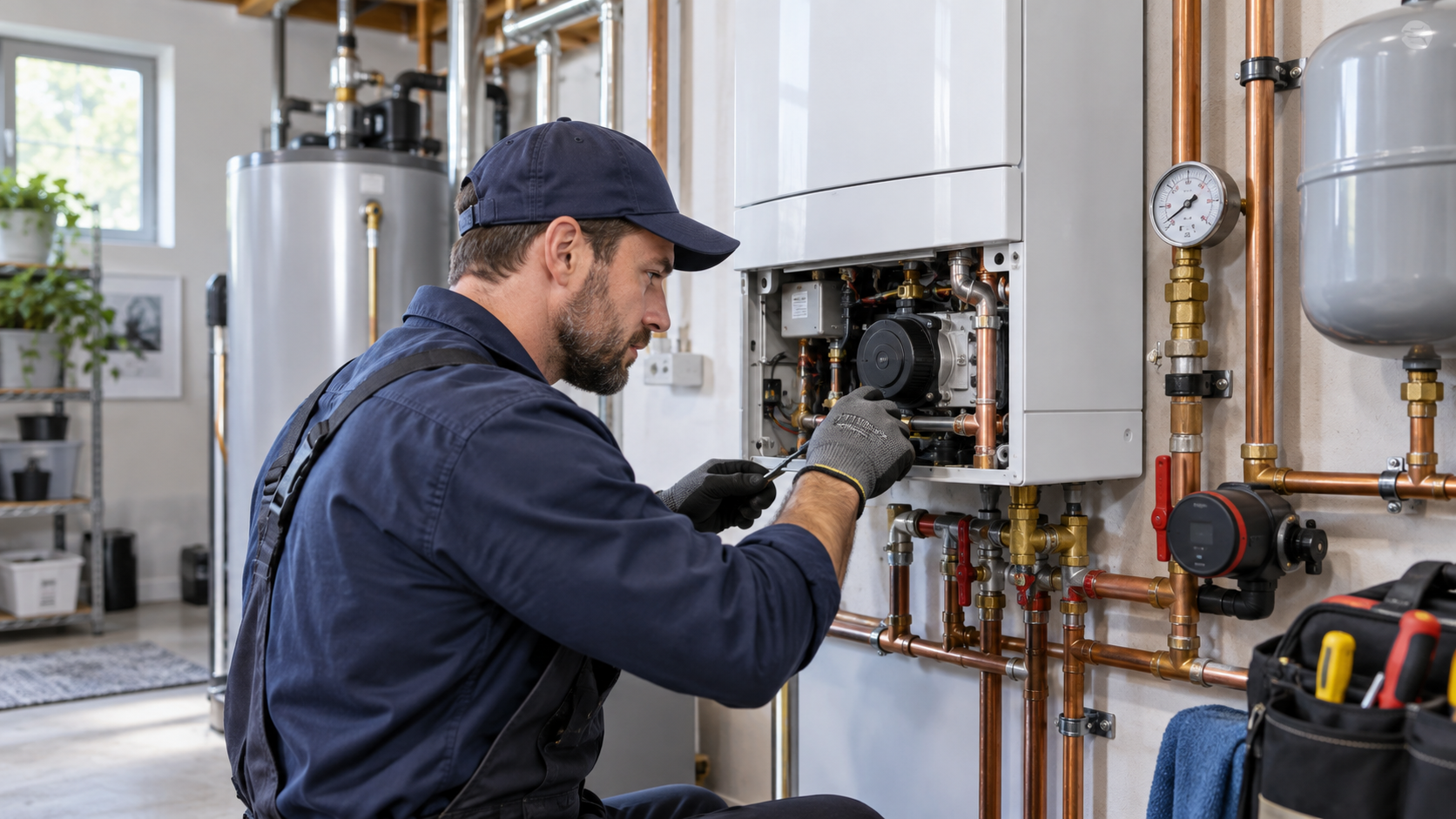
A boiler has an interesting place in the house. Most of the year, nobody talks about it. Then the first properly cold morning arrives, the thermostat goes up, and suddenly that metal box in the basement becomes the most important appliance you own.
That is usually when forgotten maintenance gets expensive.
Regular boiler service is less dramatic. A technician checks the system before a small issue turns into no heat, a leaking pipe, a failed circulator, or an emergency call on a freezing Sunday night.
For U.S. homeowners in 2026, routine annual boiler servicing commonly costs around $200 to $500, although a simpler inspection may cost less and a more involved visit can cost more. Boiler type, fuel, location, accessibility, system condition, and required cleaning all affect the final bill.
Repair is a separate story. Once a faulty part enters the picture, costs can move from a relatively inexpensive service call into several hundred dollars or more.
So, is yearly service actually necessary?
For fuel-burning boilers, annual professional inspection is a sensible safety routine. It also gives the technician a chance to catch pressure problems, venting issues, leaks, dirty burners, weak components, and other trouble before winter does the testing for you.
What Is Boiler Service?
Boiler service is a professional inspection and maintenance visit for a residential boiler and its related heating components.
It is not simply someone looking at the boiler for five minutes and saying, “Yep, still there.”
A proper visit can involve inspection, cleaning, performance testing, combustion checks on applicable fuel-burning systems, pressure checks, safety-device testing, vent inspection, and examination of visible piping and controls.
Exactly what happens depends on the boiler.
A gas boiler has different components from an electric boiler. An oil-fired system has its own maintenance needs. A modern condensing boiler is also quite different from an older cast-iron unit that has been heating the same house since everyone still had landlines.
How Much Does Boiler Service Cost in 2026?
There is no universal national service price because boilers vary a lot.
Current U.S. pricing data puts annual boiler servicing commonly around $200 to $500. Broader service-and-repair visits can run roughly $190 to $660 depending on the problem, while basic inspections may fall below the cost of a full tune-up.
| Boiler Service | Typical 2026 U.S. Cost | What It Usually Covers |
|---|---|---|
| Basic boiler inspection | About $70-$125+ | Visual and functional system checks |
| Annual boiler service | About $200-$500 | Inspection, maintenance, testing, and basic cleaning |
| Boiler cleaning | About $150-$350+ | Burner, heat exchanger, vent, or related cleaning |
| System flushing or descaling | About $150-$600 | Removal of sediment or mineral buildup where needed |
| Repair service call | About $75-$250 before major parts | Diagnosis and initial labor |
| Typical boiler repair | About $150-$750 | Varies widely by part and fault |
Those numbers are useful for budgeting, not as a guaranteed quote.
A technician working on an easily accessible gas boiler in a small home may charge much less than someone servicing an older oil system with heavy buildup, difficult access, and several failing components.
Location matters too. Labor prices in Boston, New York, Denver, Chicago, and smaller Midwest communities are not identical.
Why Boiler Service Prices Vary So Much
The word “boiler” covers a surprisingly wide range of equipment.
One homeowner may have a compact wall-mounted condensing boiler. Another has a large floor-standing cast-iron unit connected to old radiators. Someone else has an oil-fired system with a separate domestic hot-water tank.
Those are not identical service jobs.
The biggest pricing factors usually include:
- Gas, oil, propane, or electric boiler type
- Age and overall condition of the equipment
- Whether cleaning is included
- Whether combustion testing is required
- Ease of access around the boiler
- Number of heating zones
- Condition of pumps, valves, piping, and expansion components
- Whether replacement parts are needed
- Local labor rates
- Regular appointment versus emergency or after-hours service
That last point can make a big difference.
Routine maintenance scheduled in September is one thing. Calling someone at 11 p.m. during a January cold snap because the house is 54°F is another.
How Often Should a Boiler Be Serviced?
For most residential fuel-burning systems, once a year is a practical rule.
The U.S. Consumer Product Safety Commission recommends professional annual inspection and servicing of heating systems, with attention to chimneys and flues as well as the appliance itself.
Annual service is especially sensible for gas, propane, and oil boilers because proper combustion and venting matter for safety.
Electric boilers do not produce combustion gases, so the service process differs, but electrical connections, pumps, controls, pressure, and hydronic components still deserve periodic attention.
Always check the boiler manufacturer’s maintenance schedule too.
If a warranty requires annual professional maintenance, skipping it may create a second problem later when you need warranty coverage.
What Happens During an Annual Boiler Service?
A good technician works through the system rather than only looking at the burner.
The exact checklist varies, but a comprehensive boiler service may include inspection of the heat exchanger, burner, ignition system, controls, pressure, pumps, valves, expansion tank, flue, condensate system, and visible piping.
On applicable combustion systems, the technician may also perform combustion analysis.
This measures what is happening in the exhaust and helps confirm that the boiler is burning fuel correctly.
A modern high-efficiency boiler may also require inspection and cleaning of the condensate drain and trap.
That little drain line is easy to ignore until it clogs.
A Typical Boiler Service Checklist
- Inspect the boiler for leaks, corrosion, soot, or visible damage
- Check system pressure and temperature
- Inspect burner operation where applicable
- Check ignition and safety controls
- Inspect venting and flue connections
- Test combustion on applicable fuel-burning units
- Check carbon monoxide safety where appropriate
- Inspect circulating pumps and zone valves
- Check expansion-tank condition
- Inspect visible heating pipes and connections
- Clean components when required by the boiler design
- Inspect condensate drainage on condensing boilers
- Confirm thermostat and controls are communicating properly
The technician may find nothing wrong.
That is not wasted money.
“Everything is operating normally” is actually a pretty good result when the alternative is a cracked component or blocked vent.
Gas Boiler Service
Gas boilers are common in hydronic heating systems across colder parts of the U.S.
Service focuses heavily on combustion, ignition, venting, safety controls, pressure, and circulation.
A modern gas boiler should burn cleanly, vent correctly, and shut down safely if something goes wrong.
Carbon monoxide is one reason fuel-burning heating equipment deserves professional attention.
CO is colorless and odorless. You cannot reliably detect it by standing near the boiler and deciding the basement “smells fine.”
Working carbon monoxide alarms in the home are important, but they do not replace equipment inspection.
Oil Boiler Service
Oil boilers often require more cleaning than gas systems.
Soot buildup, burner components, fuel nozzles, filters, draft, and combustion settings may all need attention.
That extra work is one reason oil-boiler servicing can cost more.
A poorly adjusted oil burner can also become noticeably dirty.
If you see soot around the boiler or flue, do not treat that as a charming sign of an old New England house.
Have it inspected.
Electric Boiler Service
Electric boilers remove combustion from the equation.
No burner means no gas valve, fuel nozzle, or combustion exhaust to inspect.
But the boiler still has electrical elements, controls, connections, pumps, pressure components, and the rest of the hydronic system.
Electrical faults, failing pumps, leaks, pressure problems, and control failures can still stop the heat.
Service may be simpler in some cases, but “electric” does not mean “maintenance-free forever.”
Steam Boiler vs. Hot-Water Boiler Service
Not every boiler heats the home the same way.
Hot-water boilers circulate heated water through baseboards, radiators, fan coils, or radiant-floor tubing.
Steam boilers boil water and send steam through the piping.
Steam systems tend to have different controls, vents, water-level requirements, and maintenance concerns.
| System | Hot-Water Boiler | Steam Boiler |
|---|---|---|
| Heat delivery | Circulating hot water | Steam |
| Typical equipment | Pumps, expansion tank, zone valves | Steam vents, low-water controls, pressure controls |
| Common concern | Air, circulation, pressure, leaks | Water level, venting, pressure, sediment |
| Service approach | Hydronic circulation checks | Steam-specific safety and water checks |
| DIY assumptions | Do not assume steam procedures apply | Do not treat it like a hot-water system |
If you own an older steam system, hiring someone who actually understands steam is worth the effort.
Not every HVAC technician works with these systems regularly.
Best Time of Year to Schedule Boiler Service
Late summer and early fall are ideal.
The boiler has usually been resting, you have time to deal with repairs, and heating companies are not yet buried under emergency no-heat calls.
Think August, September, or early October in colder states.
Scheduling in spring can work too.
What is less appealing is waiting until the first freezing week of winter and joining thousands of other homeowners who suddenly remembered they own heating equipment.
If service uncovers a part that needs ordering, doing it before winter gives you breathing room.
Signs Your Boiler Needs Service Before the Annual Visit
Do not wait for the calendar if the boiler starts acting differently.
Heating equipment often gives small warnings before a full breakdown.
- Unusual banging, whistling, grinding, or gurgling sounds
- Visible water around the boiler
- Frequent pressure loss
- Some radiators staying cold
- Rooms taking much longer to heat
- Boiler repeatedly turning on and off
- Unexpectedly high heating bills
- Rust, corrosion, soot, or staining around the unit
- Error codes that keep returning
- Unusual exhaust or venting concerns
- Carbon monoxide alarm activation
If a carbon monoxide alarm sounds, treat it as a safety issue, not a maintenance reminder.
Follow the alarm manufacturer’s and local emergency guidance and get to fresh air rather than standing beside the boiler trying to troubleshoot it.
Why Is My Boiler Making Noise?
Some boiler noise is completely normal.
Pumps run. Valves move. Metal expands as it warms.
But a new sound deserves attention.
Gurgling can point to air in a hot-water system. Banging may involve water flow, pressure, trapped air, scale, or other system issues. Grinding can suggest a mechanical component such as a pump is struggling.
The sound alone rarely gives a perfect diagnosis.
That is why describing exactly when the noise occurs can help the technician.
“It bangs for five seconds every time zone two starts” is much more useful than “the boiler sounds weird.”
Does Boiler Service Improve Efficiency?
It can, particularly when a system is dirty, poorly adjusted, or operating with an obvious maintenance issue.
Cleaning a dirty burner or heat exchanger, correcting combustion settings, repairing controls, and restoring proper system operation can reduce wasted fuel.
But maintenance does not turn a 30-year-old boiler into a brand-new high-efficiency model.
There is a limit.
If the boiler is already clean, correctly adjusted, and operating normally, the energy savings from one maintenance visit may be modest.
The bigger value is often reliability, safety, and early problem detection.
Boiler Service vs. Boiler Repair
This distinction can prevent confusion when getting quotes.
Service is preventive.
Repair fixes an identified fault.
If you book annual service and the technician discovers a failed zone valve, leaking expansion tank, or damaged circulating pump, replacing that component is generally an additional repair.
Ask how the company handles that situation before the appointment.
Some technicians will quote the repair and wait for approval. Others may include small parts under a maintenance plan.
A clear estimate is better than finding surprise parts on the final invoice.
Common Boiler Repair Costs
Boiler parts vary widely in price.
A modest valve or igniter repair may stay in the low hundreds. A circulation pump, gas valve, heat exchanger-related component, or other major part can move much higher.
Current U.S. cost data places common boiler repairs roughly between $150 and $750, with some large component repairs reaching $1,000 or more.
At that point, the age of the boiler matters.
Putting $1,200 into a relatively young high-quality boiler may be perfectly reasonable.
Putting repeated four-figure repairs into a 25-year-old boiler becomes a different conversation.
How Long Does a Boiler Last?
Many residential boilers can remain in service for 15 to 20 years, and some well-maintained traditional systems last longer.
Age alone does not mean the boiler must be replaced.
A 17-year-old unit that runs reliably, has readily available parts, and does not require constant repair may still have useful life.
On the other hand, age plus frequent failures plus poor efficiency plus expensive parts can make replacement more sensible.
Do not make the decision from one number.
Repair or Replace?
Ask yourself a few practical questions.
How old is the boiler?
How often has it needed repairs during the last two or three years?
Are parts becoming difficult to source?
Does the system heat the house comfortably?
Is a major component failing?
Are you planning to stay in the home?
A trustworthy technician should be able to discuss both repair and replacement without turning every minor fault into a sales presentation for a new system.
Annual Service Plan or Pay Per Visit?
Many HVAC companies sell annual maintenance agreements.
These may include one scheduled service visit plus benefits such as reduced diagnostic fees, repair discounts, priority scheduling, or small replacement parts.
The value depends entirely on the contract.
A $350 plan that includes the service you would already buy, discounted repairs, and priority winter appointments may be useful.
A $500 plan filled with exclusions may not be.
Read what is actually included.
What Homeowners Can Check Between Services
You do not need to dismantle the boiler.
In fact, you should not perform combustion or internal fuel-system work unless you are properly qualified.
Simple observation is different.
Keep the area around the boiler clear. Watch for water on the floor. Notice new sounds. Look at the system pressure if your manufacturer instructs homeowners to monitor it. Make sure exterior vents are not obviously blocked. Test smoke and carbon monoxide alarms according to their instructions.
That is useful homeowner maintenance.
Taking apart a gas valve because you watched a twelve-minute video is not.
Do Radiators Need Maintenance Too?
The boiler is only one part of the heating system.
A perfectly healthy boiler cannot make a radiator heat properly if a valve is stuck or circulation is poor.
Hydronic systems can develop trapped air. Steam systems have vents and traps. Older radiator valves can fail. Pumps and zone valves can cause entire areas of the house to stay cold.
If some rooms heat normally and others do not, mention that during boiler service.
The problem may live elsewhere in the system.
Hard Water and Boiler Scale
Mineral-rich water can contribute to scale in parts of a heating or domestic-water system.
Scale acts like unwanted insulation on heat-transfer surfaces and can reduce performance.
Whether descaling is appropriate depends on the system design and actual buildup.
Do not automatically pay for a flush every year because someone added it to a menu.
Ask what condition they found and why the service is recommended.
High-Efficiency Condensing Boilers Need Attention Too
Modern condensing boilers can be highly efficient, but they are not maintenance-free.
These units intentionally create condensate while extracting additional heat from exhaust gases.
That means condensate drains and traps become part of routine maintenance.
Heat exchangers may also require manufacturer-specific cleaning.
Electronics and sensors monitor operation closely, which is useful until dirt, blockage, or another issue starts triggering error codes.
Follow the manufacturer’s service schedule rather than assuming newer automatically means less maintenance.
How to Hire a Boiler Service Technician
Boilers are more specialized than many homeowners realize.
A company that mainly installs central air conditioners may technically offer boiler service while doing very little boiler work in practice.
Ask directly.
How often do you work on my type of boiler?
Do you service this brand?
Do you work on steam if the system is steam?
Can you perform combustion analysis on my fuel-burning boiler?
For larger repairs, get a written estimate.
Verify licensing and insurance requirements in your state and locality.
Questions to Ask Before Booking
- What is included in the boiler service price?
- Does the visit include cleaning?
- Is combustion analysis included where applicable?
- Are travel or diagnostic fees added?
- How long does a normal service visit take?
- Do you service my boiler brand and fuel type regularly?
- Are small replacement parts included?
- What happens if you find a repair is needed?
- Will I receive a written service report?
- Do you offer an annual maintenance plan?
These questions make comparing companies much easier.
A $179 service that includes very little may not beat a $279 visit with proper testing and cleaning.
How Long Does Boiler Service Take?
A straightforward residential boiler service often takes around an hour, although the exact time depends on the system.
Older equipment, oil-fired units, neglected boilers, complicated zoning, cleaning needs, or discovered faults can extend the visit.
Do not judge quality entirely by speed.
A technician finishing in 18 minutes is not necessarily incredibly efficient.
They may simply have skipped half the inspection.
Can Boiler Maintenance Prevent Every Breakdown?
No.
A pump can still fail unexpectedly. Electronics can die. A valve that looked normal in October can stop working in February.
Maintenance reduces risk; it does not create immunity.
Think of it like maintaining a car.
Regular oil changes do not guarantee the starter will never fail, but skipping maintenance because failures can still happen would not make much sense.
The same logic applies here.
Boiler Safety and Carbon Monoxide
Fuel-burning boilers need proper combustion air and a safe path for exhaust gases to leave the house.
A blocked, damaged, corroded, or disconnected vent can create dangerous conditions.
The CPSC recommends professional annual heating-system inspection and specifically advises checking chimneys and flues for blockage, corrosion, and loose or disconnected sections.
Homes with fuel-burning appliances should also have properly installed carbon monoxide alarms.
Do not disable an alarm because it keeps sounding.
Find out why it is sounding.
FAQ
How much does boiler service cost in 2026?
Annual boiler service in the U.S. commonly costs about $200 to $500 in 2026. A simple inspection may cost less, while cleaning, descaling, difficult access, oil-fired equipment, replacement parts, and local labor rates can push the total higher.
How often should a boiler be serviced?
Annual professional service is a sensible schedule for most fuel-burning residential boilers. The CPSC recommends yearly inspection and servicing of heating systems. Always follow the boiler manufacturer’s maintenance schedule as well.
What is included in a boiler service?
A typical service may include inspection of the boiler, pressure, controls, pumps, valves, expansion components, burners, venting, and visible piping. Fuel-burning boilers may also receive combustion testing, while condensing units may need condensate-system inspection and cleaning.
How long does a boiler service take?
Many straightforward residential service visits take around an hour. Older, dirty, oil-fired, hard-to-access, or more complicated systems may require longer, particularly when cleaning or repairs are needed.
Is boiler service really necessary every year?
Annual service helps identify safety issues, leaks, combustion problems, pressure faults, worn parts, and developing failures before they become emergencies. It may also be required by the boiler manufacturer or warranty terms.
What is the difference between boiler service and boiler repair?
Boiler service is preventive maintenance and inspection. Boiler repair addresses a specific failure or damaged part. If annual service reveals a faulty pump, valve, sensor, or another component, repairing it normally costs extra unless your maintenance agreement says otherwise.
When should I replace a boiler instead of repairing it?
Replacement becomes worth considering when an older boiler needs frequent repairs, major parts are failing, efficiency is poor, parts are difficult to source, or repair costs are becoming disproportionate to the value and remaining life of the system. Age alone should not be the only factor.
Conclusion
Boiler service is one of those home-maintenance jobs that feels easy to postpone because a healthy boiler does not demand much attention.
It just sits there.
Quietly.
Until it does not.
For most U.S. homeowners with a gas, oil, or propane boiler, annual professional service is a sensible routine. It gives a technician a chance to inspect combustion, venting, pressure, controls, pumps, valves, leaks, and safety components before heating season puts the system under full load.
In 2026, expect a typical annual boiler service to cost roughly $200 to $500, although simpler inspections may cost less and more involved service can cost considerably more.
Oil systems may require extra cleaning. High-efficiency condensing boilers have condensate components that need attention. Steam systems need technicians who understand steam. Older systems may need more time simply because there are more years of wear to inspect.
The cheapest appointment is not always the cheapest service.
Ask what is included.
Does the technician clean the system where necessary? Do they perform combustion analysis on fuel-burning equipment? Do they inspect venting? Will you receive a service report? Are repairs quoted separately?
A clear answer matters more than a flashy discount.
Timing helps too.
Schedule service before winter, ideally in late summer or early fall. If a part needs to be ordered, you would rather learn that while the windows can still be open than during a January cold snap.
And pay attention between visits.
Water on the floor, repeated pressure loss, unusual banging, soot, returning error codes, cold radiators, or a boiler that suddenly cycles differently are all worth investigating.
Do not attempt internal gas, oil, combustion, or electrical repairs without the proper training.
There is a big difference between noticing a leak and rebuilding a burner.
Finally, remember that servicing the boiler also protects the rest of the heating system.
A boiler does not operate alone. Pumps, valves, radiators, pipes, thermostats, expansion components, vents, and controls all affect how comfortably and efficiently the house heats.
Good boiler service looks at the system rather than treating one metal box as if nothing else matters.
Most years, the visit will hopefully end with a boring sentence: everything is working correctly.
That is actually the goal.
Because boring heating equipment in January is wonderful.
Leave a Reply