


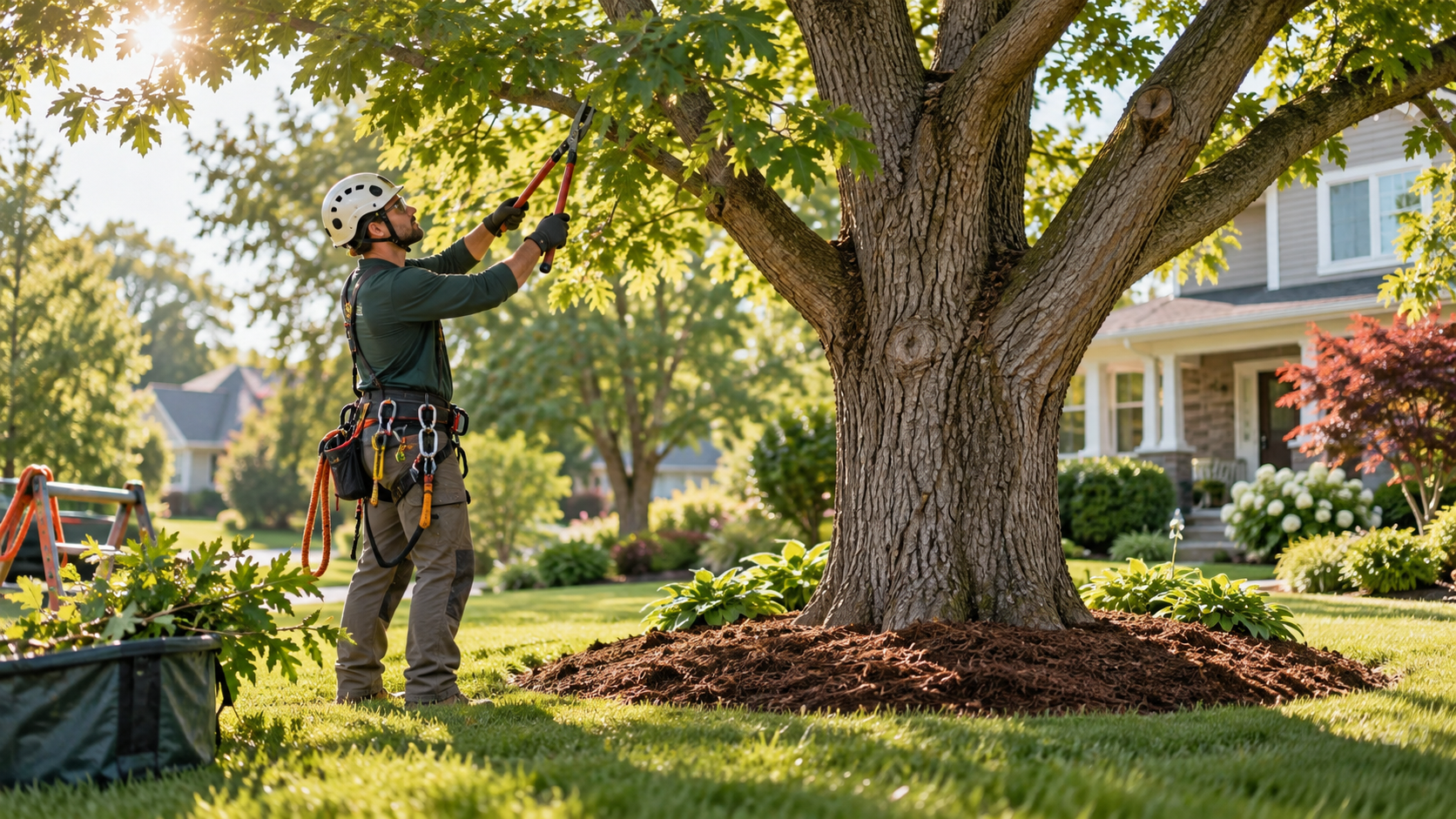
Trees are easy to ignore when everything looks fine.
The maple shades the patio. The oak drops acorns everywhere. The young dogwood blooms each spring. Life goes on.
Then a large branch lands in the driveway after a storm, leaves start turning brown in June, or mushrooms suddenly appear around the trunk. That is usually when tree care moves from “someday” to “we should probably deal with this now.”
Good tree care is mostly about preventing those moments.
Healthy trees can cool a yard, provide privacy, support wildlife, reduce soil erosion, and add real visual value to a property. Mature trees also take years to replace. Losing one because of poor pruning, root damage, or years of neglect can change the entire feel of a home.
The good news? Tree care does not need to be complicated.
Water correctly. Protect the roots. Prune with a reason. Watch for changes. Do not bury the trunk under mulch. And know when a job has moved beyond safe DIY territory.
That last one matters more than people think.
What Does Tree Care Actually Include?
Tree care is broader than cutting branches.
It covers everything that keeps a tree healthy, structurally sound, and compatible with the space around it.
For a typical U.S. homeowner, that may include:
- Watering during dry weather
- Mulching around the root zone
- Pruning dead or poorly positioned branches
- Watching for insects and disease
- Protecting roots during construction
- Checking trees after severe storms
- Managing branches near roofs, streets, and utilities
- Removing hazardous trees when necessary
Some of that is basic yard maintenance.
Some of it belongs to a trained arborist with climbing gear, ropes, saws, and insurance.
Knowing the difference is part of responsible tree ownership.
Why Healthy Trees Still Need Attention
A tree can look fine from the kitchen window and still have problems developing inside the canopy, trunk, or root system.
Dead branches may stay attached for months or years. Roots can be damaged by construction without obvious symptoms at first. Decay can develop inside a trunk while the outside still looks normal.
That does not mean every tree is secretly dangerous.
It means trees change slowly, and problems often become easier to manage when caught early.
A quick walk around your property a few times a year can tell you a lot.
Look up.
Look at the trunk.
Look where the trunk meets the soil.
Then look at what has changed since last season.
Watering Trees the Right Way
One of the most common tree care mistakes is watering too often and too shallowly.
A quick splash from a lawn sprinkler may wet the grass while leaving deeper tree roots relatively dry.
Trees generally benefit more from slower, deeper watering that reaches the root zone.
Young trees need the most attention because their roots have not spread far into the surrounding soil.
Newly planted trees may need regular watering during the first few growing seasons, especially during hot or dry periods.
Mature trees are often more resilient, but extended drought can still stress them.
Signs a Tree May Need Water
Dry soil several inches below the surface is a better clue than simply looking at the top layer.
Other signs can include wilted foliage, early leaf drop, scorched leaf edges, or a general loss of vigor.
But those symptoms are not specific to drought.
Root problems, disease, excess water, or heat can look similar.
That is why soil moisture matters.
Can You Overwater a Tree?
Yes.
Roots need oxygen as well as moisture.
Constantly saturated soil can reduce oxygen around roots and contribute to decline, especially in poorly drained yards.
If the soil stays wet for days after irrigation or rain, adding more water will not help.
This is particularly important for trees planted in low spots, heavy clay soil, or areas where downspouts drain toward the trunk.
Too much water and too little water can create surprisingly similar symptoms.
Mulch: Great for Trees, Easy to Get Wrong
Mulch is one of the simplest ways to support a tree.
A layer of organic mulch helps slow moisture loss, reduces grass competition, moderates soil temperature, and protects the trunk from lawn equipment.
The problem starts when mulch is piled against the trunk.
You have probably seen it.
A tree rises out of a perfect cone of mulch that looks like a chocolate volcano.
It may look tidy. It is not ideal for the tree.
Keeping mulch pulled slightly away from the trunk allows the root flare to remain visible and reduces constant moisture against the bark.
A Simple Mulching Setup
- Spread mulch broadly rather than piling it high
- Keep the trunk and root flare visible
- Avoid deep layers that stay wet for long periods
- Refresh the mulch when it breaks down rather than stacking new layers forever
- Extend the mulched area outward when space allows
The wider the mulched area, the less competition the tree has from turf.
You do not need to mulch the entire yard.
But a decent ring around a young tree can make mowing easier and reduce accidental bark damage.
What Is the Root Flare?
The root flare is where the trunk widens and transitions into the major roots at ground level.
On many healthy trees, you can see this broadening clearly.
If a tree goes into the ground like a telephone pole with no visible widening, it may have been planted too deeply or accumulated soil and mulch around the base.
That can cause problems over time.
Buried trunk tissue is not meant to stay constantly underground.
Deep planting can also affect root development and long-term stability.
Pruning: Less Is Often More
Pruning can improve tree structure, remove dead wood, increase clearance, and reduce certain hazards.
Bad pruning can do the opposite.
More cutting does not mean better maintenance.
A tree needs leaves to produce energy. Removing a large portion of the live canopy at once can stress the tree and encourage weak new growth.
Pruning should have a reason.
Maybe a dead limb hangs over the driveway. Maybe two branches rub together. Maybe a young tree needs structural training before poor branch attachments become bigger problems.
Those are practical reasons.
“It looks too big” is not always enough information.
When Is the Best Time to Prune Trees?
Timing depends on the species and the reason for pruning.
For many deciduous trees, dormant-season pruning is convenient because branch structure is easier to see and insect activity may be lower.
But there are exceptions.
Some flowering trees are pruned after blooming when preserving flowers matters. Certain diseases are also easier to manage when pruning happens during specific seasons.
Dead, broken, or hazardous branches may need attention whenever they become a safety concern.
If the tree has a known disease issue, species-specific timing matters more than a generic “prune in winter” rule.
What Is Tree Topping?
Tree topping is the severe cutting back of major branches or the top of the canopy to stubs.
It is generally considered a poor pruning practice for healthy landscape trees.
Topping removes a large amount of leaf area and often triggers rapid shoots below the cuts.
Those shoots can be weakly attached.
The large wounds also create opportunities for decay.
Ironically, topping is sometimes sold as a way to make a tree safer.
In the long run, it can create a worse structure.
Tree Care by Age
| Tree Stage | Main Priorities | Common Mistakes |
|---|---|---|
| Newly planted | Regular watering, correct mulch, stable planting depth | Overwatering, deep planting, mulch against trunk |
| Young tree | Structural pruning, root-zone protection, steady growth | Removing too much canopy, mower damage |
| Mature tree | Deadwood management, risk checks, root protection | Heavy pruning, construction damage, ignoring decay |
| Older tree | Safety, preservation, targeted pruning, monitoring | Aggressive reduction without clear reason |
Young trees are often where good tree care gives the biggest return.
A small branch that takes ten seconds to prune today may become a large structural problem fifteen years later.
That is why early structural pruning can be so useful.
Young Tree Care After Planting
The first few years matter.
Roots are still establishing, the canopy is developing, and the tree is adapting to a completely different environment from the nursery.
Keep grass and weeds from crowding the trunk.
Water according to weather and soil conditions.
Do not fertilize heavily just because you want faster growth.
And remove nursery stakes when they are no longer needed.
Staking can be useful when a new tree needs temporary support, but leaving tight ties in place for too long can damage the trunk.
Should Trees Be Fertilized?
Not automatically.
A healthy tree growing normally may not need extra fertilizer.
Fertilizer makes more sense when soil conditions or nutrient deficiencies support a clear reason for it.
Throwing a high-nitrogen lawn product around every tree because “plants like food” can create unnecessary growth without solving the actual issue.
If a tree looks weak, first consider water, root damage, soil compaction, pests, disease, and planting depth.
A soil test can sometimes tell you more than a bag of fertilizer.
How to Spot Tree Problems Early
Trees usually show stress somehow.
The hard part is noticing when the change is meaningful.
A few dead leaves are normal.
Half the canopy thinning over two seasons is different.
Watch for:
- Large dead branches
- Cracks or splits in major limbs
- Sudden canopy thinning
- Leaves that are unusually small or sparse
- Early fall color during summer
- Fungal growth around the trunk or roots
- Cavities or visible decay
- Peeling bark with extensive dead tissue underneath
- New leaning or soil movement around the roots
- Heavy insect activity combined with decline
One symptom by itself may not tell you much.
Several symptoms together deserve a closer look.
Fungus on a Tree: Should You Worry?
Sometimes.
Mushrooms growing on dead mulch are not the same thing as fungal fruiting bodies emerging directly from the trunk or major roots.
Some fungi are harmless decomposers.
Others are associated with wood decay.
If mushrooms or conks appear on the trunk, at the base, or around major roots of a large tree near a house, driveway, playground, or street, professional assessment makes sense.
You cannot judge internal strength from bark appearance alone.
Tree Cavities Are Not Automatically a Death Sentence
Older trees often develop cavities.
A hollow section does not automatically mean a tree must come down tomorrow.
Trees can remain standing for years with internal decay if enough sound wood remains and the overall structure is acceptable.
But cavity size, location, tree species, surrounding defects, wind exposure, and what the tree could hit all matter.
This is where a qualified arborist becomes useful.
A mature shade tree is worth evaluating properly before making a removal decision.
Storm Damage: What to Check First
After a major wind, thunderstorm, hurricane, ice event, or heavy snow, inspect large trees from a safe distance.
Do not stand under hanging branches while deciding how dangerous they look.
Look for broken limbs, split branch unions, hanging tops, exposed roots, new leaning, or branches resting on buildings and wires.
If a tree is touching electrical lines, stay away.
That is not a weekend chainsaw project.
Contact the utility or the appropriate qualified service provider.
Storm-Damaged Trees Can Sometimes Be Saved
A broken branch does not automatically mean the whole tree needs removal.
Healthy trees can often recover from limited canopy damage.
What matters is the amount of damage and where it occurred.
A few lost secondary limbs are very different from a split main trunk.
Young trees sometimes recover surprisingly well.
Large mature trees with major structural failure require much more caution.
Roots Matter More Than Most Homeowners Realize
The visible trunk and branches get all the attention.
The roots do a lot of the quiet work.
Construction is one of the biggest threats to established trees because root damage can happen long before canopy decline becomes visible.
Excavation can cut roots.
Heavy equipment can compact soil.
Adding several inches of soil can change oxygen availability.
Changing drainage can leave roots much wetter or drier than before.
If you are planning a driveway, addition, patio, pool, trench, or large landscape project near valuable trees, involve tree care professionals before the machines arrive.
After the roots are cut, options become limited.
How Far Do Tree Roots Spread?
Tree roots often extend well beyond the edge of the canopy.
Most are also shallower than many people imagine.
This is why digging a trench near the trunk can be far more damaging than it looks from above.
Roots do not stay neatly inside a circle drawn at the drip line.
The exact spread depends on species, soil, moisture, obstacles, and age.
Think broad and shallow rather than narrow and straight down.
Lawn Equipment Can Slowly Kill a Tree
A mower or string trimmer hitting the trunk may not look serious.
But repeated damage can injure bark and the living tissues beneath it.
A mulch ring solves much of this problem.
It keeps machines away from the trunk and reduces competition from turf at the same time.
Simple.
Cheap.
Surprisingly effective.
Tree Care Near Power Lines
Branches and electrical lines are a bad combination for DIY work.
Electricity can arc, branches can conduct current, and a limb can move unpredictably while being cut.
Do not assume you are safe because a branch is not physically touching a wire.
Utility-line tree work should be handled by trained professionals following proper clearance and electrical-safety procedures.
For street trees or trees near public lines, your utility or local municipality may also have its own responsibility and pruning schedule.
How Much Does Tree Care Cost in 2026?
Tree care pricing varies enormously because the work can range from pruning a small ornamental tree from the ground to dismantling a huge tree over a house with ropes and rigging.
Height matters.
Access matters.
Location matters.
Risk matters a lot.
| Tree Care Service | Typical Cost Pattern | Main Price Factors |
|---|---|---|
| Small-tree pruning | Usually lower-cost | Height, access, amount of pruning |
| Large-tree pruning | Moderate to high | Climbing, rigging, hazards, branch size |
| Tree health assessment | Usually lower than major physical work | Travel, inspection detail, testing |
| Tree removal | Wide range | Height, trunk size, location, equipment access |
| Emergency storm work | Often higher | Urgency, hazards, after-hours work |
A written estimate should make clear what is included.
Does the price include cleanup?
Will branches be hauled away?
Is stump grinding included?
Is the company removing all wood or leaving logs?
Those details can change the apparent price quickly.
What Is a Certified Arborist?
An arborist specializes in the care of trees and other woody plants.
Certification programs can demonstrate professional knowledge in tree biology, pruning, diagnosis, risk, and proper tree-care practices.
Certification is not the only thing that matters, but it is a useful signal when you need more than basic cutting.
If you are dealing with a valuable mature tree, suspected disease, structural defects, construction damage, or a possible removal decision, expertise matters.
The person giving you advice should understand trees, not only chainsaws.
Questions to Ask a Tree Care Company
- Do you carry liability insurance and workers’ compensation where required?
- Who will actually perform the work?
- Do you have arborist credentials or specialized tree-care training?
- What pruning method are you recommending and why?
- Will you use climbing spikes on a tree that is staying?
- Does the estimate include debris removal?
- Will the stump remain after removal?
- How will nearby landscaping and structures be protected?
- Do permits apply in my city or county?
- Can you explain why removal is necessary if you are recommending it?
You do not need the cheapest person with a chainsaw.
You need someone who can explain what they plan to do and why.
Be Careful With Climbing Spikes
Climbing spikes, sometimes called gaffs or spurs, puncture the bark and are useful during certain removals.
They are generally not appropriate for climbing a tree that is being preserved because the punctures damage living tissue.
If a company plans to spike its way up a healthy tree for routine pruning, ask questions.
Tree Removal Should Usually Have a Reason
Some trees genuinely need removal.
They may be dead, structurally unsound, severely diseased, badly positioned, or creating an unacceptable level of risk.
Other trees simply need pruning or monitoring.
Removal is permanent.
A sixty-year-old oak cannot be replaced by planting a six-foot sapling and waiting until next summer.
When the situation is not urgent, getting a second professional opinion can be worth it.
When a Tree Is Too Close to the House
Distance alone does not determine whether a tree is a problem.
Species, mature size, branch structure, roots, foundation type, soil, and actual defects matter.
A healthy tree near a house may simply need proper clearance pruning.
A poorly structured tree farther away may present a bigger hazard.
Do not remove a mature tree just because someone says roots “always destroy foundations.”
Actual site conditions matter.
Tree Roots and Foundations
Roots often get blamed whenever cracks appear in concrete.
The relationship is more complicated.
Roots tend to follow available moisture and soil conditions. They may interact with existing cracks, shallow structures, sidewalks, or certain soil conditions, but every foundation problem is not automatically a tree-root problem.
If you have structural concerns, involve the appropriate professionals rather than cutting major roots blindly.
Removing large roots can destabilize a tree.
Tree Care During Drought
Extended dry periods can stress even established trees.
During drought, prioritize slow watering around the root zone rather than spraying foliage.
Mulch helps hold moisture.
Avoid aggressive pruning simply because the tree looks stressed. Removing healthy leaves can reduce the tree’s ability to produce energy when it already has limited resources.
And be patient.
Drought effects can sometimes appear months after the hottest part of summer has passed.
Winter Tree Care
Winter is quieter but not irrelevant.
Heavy snow and ice can break weak branches.
Young thin-barked trees can develop sunscald in some climates.
Rodents and deer may damage bark.
Late winter can also be a useful time for inspecting deciduous branch structure because leaves are out of the way.
If you live in snow country, do not pile heavily salted snow repeatedly around valuable trees if you can avoid it.
Tree Care in Hot Southern Climates
Texas, Florida, Arizona, Georgia, and Southern California do not have the same tree-care calendar as Minnesota or Maine.
Heat stress, hurricanes, tropical pests, drought, irrigation, and local species all change priorities.
That is why local knowledge matters.
A pruning schedule that works for one species in Ohio may not be ideal for a different species growing in Florida.
General tree-care rules are useful.
Local tree biology finishes the job.
Should You Paint Pruning Cuts?
For most routine pruning, wound paint is generally unnecessary.
Trees do not heal wounds the way human skin does.
They compartmentalize damage and grow new tissue around the cut.
Proper cut location is usually more important than coating the surface.
There are limited situations involving certain pests or diseases where local guidance may recommend wound treatments.
That is another reason species and region matter.
Do Trees Need Annual Pruning?
No.
Some young trees benefit from periodic structural pruning.
Mature trees may go several years between significant pruning visits if they are healthy and well structured.
Pruning because the calendar says so can lead to unnecessary cutting.
Inspect annually.
Prune when there is a reason.
That is a better rule.
DIY Tree Care vs. Professional Work
Homeowners can handle plenty of basic care.
Watering, mulching, removing small dead twigs from the ground, checking for damage, and protecting the root zone are straightforward.
Work becomes a different category when ladders, chainsaws, large branches, electrical lines, rigging, or tree climbing enter the picture.
A branch that weighs hundreds of pounds does not care how many home-improvement videos you watched last weekend.
If you cannot predict exactly where the wood will move after the cut, call someone qualified.
FAQ
How often should trees be professionally inspected?
There is no single interval for every property, but valuable mature trees benefit from periodic professional assessment, especially after severe weather or when new defects appear. Homeowners should also visually inspect trees several times a year for changes.
How often should trees be pruned?
Trees do not automatically need annual pruning. Young trees may benefit from regular structural pruning, while mature trees may only need occasional deadwood removal, clearance work, or risk reduction. Pruning should have a clear purpose.
What is the best way to mulch around a tree?
Spread organic mulch broadly over the root area while keeping it away from direct contact with the trunk. Avoid deep mulch piles and “mulch volcanoes.” The root flare should remain visible.
How can I tell if a tree is unhealthy?
Watch for significant canopy thinning, large dead limbs, cracks, new leaning, fungal growth on the trunk or roots, early leaf drop, unusual leaf size, repeated dieback, or visible decay. Several symptoms together are more concerning than a single damaged leaf.
Should I remove mushrooms growing near a tree?
Removing the visible mushrooms does not address whatever is producing them underground. Mushrooms in mulch may be harmless, but fungal growth directly on the trunk or major roots can sometimes indicate decay. Large trees near structures should be assessed if suspicious fungal growth appears.
Can I prune a large tree myself?
Small branches reachable safely from the ground may be manageable for an experienced homeowner. Large limbs, climbing, chainsaw work at height, branches over structures, and any work near electrical lines should be left to trained professionals.
What is the most important part of tree care?
Protecting the root system and avoiding unnecessary damage are among the biggest long-term priorities. Correct watering, proper mulch, sensible pruning, and early attention to structural problems can prevent many expensive issues later.
Conclusion
Good tree care is rarely dramatic.
Most of it is small, boring, useful work done before something goes wrong.
Water a young tree during a dry summer.
Keep mulch away from the trunk.
Stop the string trimmer from hitting the bark every Saturday.
Remove a poorly positioned branch while it is still small.
Notice that one side of the canopy is thinning before half the tree is dead.
Those little decisions add up.
Mature trees are long-term assets. They shade homes, soften streets, support wildlife, reduce glare, create privacy, and make yards feel established in a way that new landscaping simply cannot copy overnight.
Protecting them makes sense.
At the same time, tree care is also about safety.
A dead limb over a driveway is not just an aesthetic issue. A split trunk near a bedroom deserves attention. A large tree leaning differently after a storm should not be ignored.
That does not mean every imperfect tree needs removal.
Old trees can have cavities, scars, unusual shapes, and dead branches while still remaining valuable parts of a landscape.
The goal is not perfection.
The goal is healthy growth and an acceptable level of risk.
For homeowners, the easiest routine is simple: look at your trees regularly, protect the roots, water when conditions call for it, mulch correctly, and avoid aggressive pruning.
Then bring in a qualified professional when the problem involves large branches, structural defects, disease questions, climbing, power lines, or possible removal.
And when someone recommends major work, ask why.
A good tree-care professional should be able to explain the reason in plain language.
They should be able to tell you what is wrong, what they propose doing, what happens if you do nothing, and whether there are less aggressive options.
That conversation matters.
Trees grow slowly.
Good decisions should not be rushed either.
Leave a Reply