


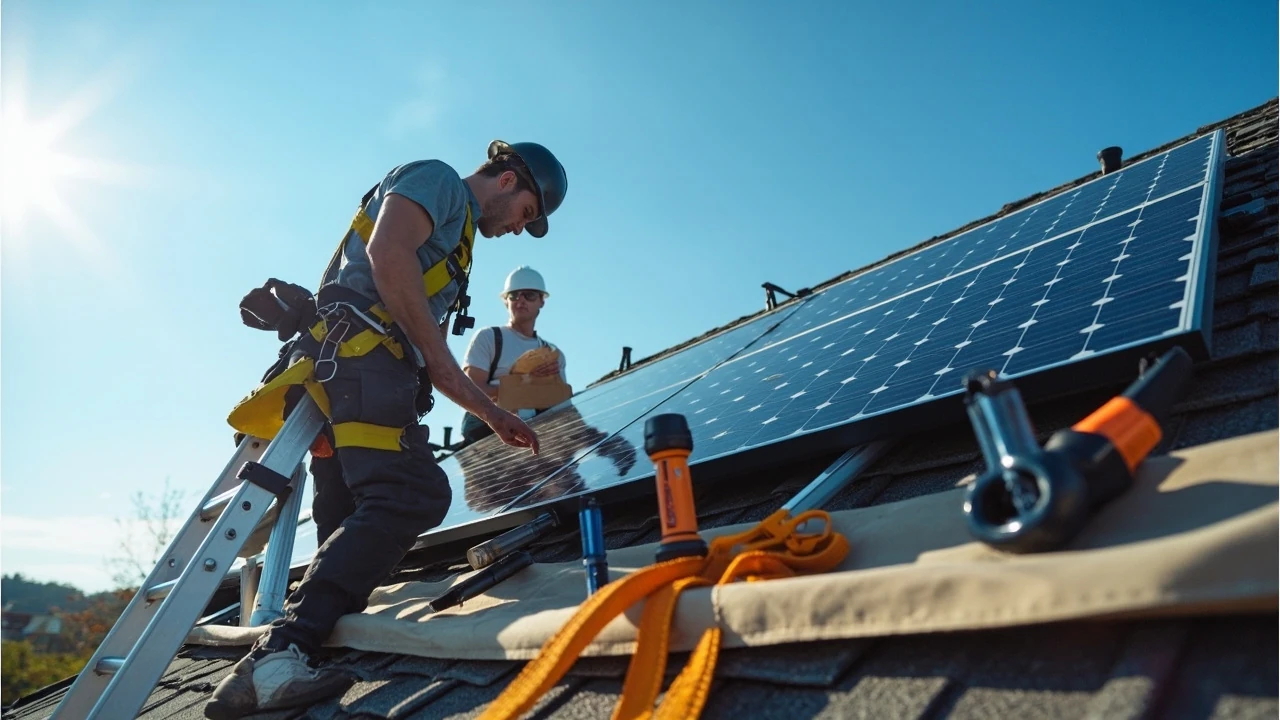
Solar panel repair companies
A service call from a solar panel repair company can be the difference between a system that quietly offsets the electric bill for another fifteen years and one that slowly leaks production until the inverter finally throws a fault. Most homeowners only search for solar panel repair companies after something has already gone wrong: a red light on the inverter, a streak of underperformance on the monitoring app, a roof leak traced back to a panel mounting point, or visible glass damage after a storm. By that point, the owner is shopping under pressure, often with a system that is still under a workmanship or manufacturer warranty, and not always sure which technician is the right one to call.
This guide is built for that moment. It walks through what solar panel repair companies actually do, the difference between an installer, a service contractor, and a manufacturer-authorized technician, how to verify credentials without taking a sales pitch at face value, what a realistic service visit looks like, and the questions that separate a careful contractor from a sloppy one. It is written for owners of residential and small commercial PV systems in the United States, where licensing, incentives, and warranty rules differ from country to country and even state to state.
What solar panel repair companies actually do
The phrase “solar panel repair companies” covers a wider range of work than most homeowners expect. A reputable firm handles the full stack of issues that can affect a photovoltaic system, not just broken glass.
Common service categories include:
- Diagnostic visits when the inverter reports a fault, production has dropped, or the monitoring app shows a string offline.
- Module-level repairs, including replacing cracked or delaminated panels, fixing hotspot-damaged cells, and addressing junction box failures.
- Inverter and power optimizer service, including firmware updates, replacement of failed units, and AC/DC disconnect troubleshooting.
- Wiring and combiner box work, such as replacing damaged MC4 connectors, burnt fuses, and degraded conductors.
- Mounting and racking repairs after roof leaks, wind uplift, or animal damage.
- Roof-to-array integration, including flashing replacement, seal rework, and raising arrays for a re-roof.
- Pigeon and pest exclusion, plus soiling and debris removal that goes beyond a simple rinse.
- System recommissioning after a long shutdown, a home sale, or an insurance event.
Not every company covers all of these in-house. Some solar panel repair companies are general electricians with solar training; others are former installers who have pivoted to a service-only model. A small number are manufacturer-authorized service providers, which means they have been vetted by a specific panel, inverter, or racking brand to perform warranty work on that equipment.
Repair vs. warranty vs. installer: who to call first
Before paying out of pocket, it helps to figure out who actually owns the problem. PV systems typically come with three overlapping coverage layers, and a good solar panel repair company will ask about all three before quoting a job.
| Coverage type | What it usually covers | Who performs the work | Typical term |
|---|---|---|---|
| Manufacturer product warranty | Defects in panels, inverters, optimizers, and racking components | Manufacturer-authorized technician or warranty swap | 10–25 years on panels, 5–12 on inverters |
| Workmanship / installation warranty | Errors in original install, roof penetrations, wiring mistakes | Original installer or a successor company | 1–10 years depending on state and contract |
| Homeowner’s insurance or home warranty | Storm, fire, hail, fallen tree, vandalism, and certain leak scenarios | Any licensed contractor acceptable to the carrier | Policy term, with deductible |
| Out of pocket service | Maintenance, soiling, animal damage, age-related wear, owner-caused issues | Any qualified solar panel repair company | No coverage; paid by owner |
The first call should almost always be the original installer if they are still in business, because workmanship claims are their responsibility and they already have the system on file. If the installer is gone or unresponsive, the next step is the manufacturer, whose customer service line can usually point to an authorized provider in your ZIP code. Independent solar panel repair companies come in when warranty channels are closed, when the issue is clearly outside coverage, or when you simply want a second opinion before authorizing any work.
Common problems that drive a service call
Most homeowner calls fall into a relatively small set of failure modes. Knowing which one you are dealing with helps both you and the technician triage the job before anyone climbs on the roof.
| Symptom | Likely cause | Likely fix | Typical warranty path |
|---|---|---|---|
| Inverter shows a red light, no production | Inverter failure, AC/DC disconnect, grid-side issue | Inverter replacement, wiring repair, utility coordination | Inverter manufacturer warranty |
| One or more panels underperforming on the monitoring app | Soiling, shading change, diode or junction box failure, bad optimizer | Cleaning, optimizer swap, panel replacement | Module or optimizer warranty |
| Cracked glass after hail or impact | Mechanical damage, thermal cycling | Module replacement, possibly racking rework | Often insurance, sometimes product warranty |
| Roof leak around array | Failed flashing, loose L-foot, degraded sealant | Flashing replacement, seal rework, possible re-roof coordination | Workmanship warranty or roofer |
| Animal damage under array | Pigeons, squirrels, raccoons nesting | Critter guard install, soffit repair, panel reset | Out of pocket |
| Production drop after a storm with no visible damage | Conductor damage, loose connector, hidden moisture ingress | Diagnostic, insulation testing, connector replacement | Varies by evidence |
| Battery or backup gateway offline | Firmware, communication wiring, battery cell imbalance | Update, wiring fix, battery service or replacement | Battery manufacturer warranty |
Two of these deserve extra attention. Cracked glass and animal damage are the two most common reasons that a perfectly functional array ends up needing a paid visit from solar panel repair companies, because the underlying panels and racking are usually fine, but the system can no longer operate safely or to code until the issue is corrected.
How to vet a solar panel repair company
Solar service is lightly regulated compared to the original install. There is no single national “solar repair license,” and many states allow any licensed electrician or even a general contractor to work on PV systems. That puts the burden of vetting on the homeowner. A careful screening call takes about twenty minutes and saves most of the bad outcomes people complain about online.
License, insurance, and certifications
- Ask for the state electrical license number and verify it on the state contractor board website. A suspended or expired license is an immediate red flag.
- Confirm general liability and workers’ compensation coverage, and ask for the certificate of insurance naming you as additional insured for the duration of the job.
- Look for North American Board of Certified Energy Practitioners (NABCEP) PV Installation Professional or PV Service Technician credentials. NABCEP is not a license, but it is the closest thing the industry has to a quality benchmark.
- Ask whether the company is a manufacturer-authorized service provider for your specific inverter or racking brand, which can be the difference between a paid and a warranty visit.
Experience with your specific equipment
- Have they worked on your inverter brand (Enphase, SolarEdge, SMA, Fronius, Tesla, Hoymiles, and so on) in the last six months?
- Do they stock common replacement parts for your panel model, or are they ordering them after the diagnostic?
- Have they handled your roof type: composition shingle, standing seam metal, tile, or flat membrane? Each behaves differently underfoot and under flashing.
- Do they perform their own roof work, or do they subcontract to a roofer? Either can work, but the handoff needs to be explicit.
Pricing transparency
- Ask for the diagnostic fee in writing, and clarify whether it is credited toward the repair if you proceed.
- Get a written estimate before any work begins, broken out by labor, materials, mobilization, and any roof or electrical permits.
- Ask about trip charges, minimum hours, and after-hours or emergency rates up front.
- Confirm payment terms. A reasonable deposit is normal for special-order parts; full payment up front is not.
References, reviews, and red flags
- Ask for two or three references from jobs similar to yours within the last year, and actually call them.
- Read reviews on Google, BBB, and Angi or Yelp, but pay more attention to how the company responded to negative reviews than to the star rating itself.
- Watch for high-pressure tactics, vague answers about parts, and any reluctance to share license or insurance details. A professional solar panel repair company expects these questions.
What a professional diagnostic visit looks like
A well-run service visit follows a recognizable pattern, even when the underlying problem turns out to be unusual. Knowing the steps helps you judge if you are getting a real diagnostic or a sales pitch disguised as one.
- Pre-visit paperwork. Before anyone climbs on the roof, the technician reviews the system design, equipment list, prior service history, and any warranty status. This is the step that separates a service company from a general handyman.
- Inverter and monitoring review. The technician pulls the last 30 to 90 days of production data, error codes, and string-level performance from the inverter or monitoring platform. Patterns here often point straight to a specific string or device.
- Visual roof inspection. With safety gear on, the tech inspects modules for cracks, discoloration, hotspots, debris, and animal intrusion, and inspects racking, flashings, conduit, and junction boxes for damage, corrosion, and loose hardware.
- Electrical testing. Using a clamp meter, insulation resistance tester, and possibly a thermal camera, the tech checks string voltage and current, ground continuity, and looks for hot spots on cells, bypass diodes, and connections.
- Customer debrief. The technician walks you through findings, shows the relevant photos or data, and lays out repair options with cost ranges before leaving the roof.
- Written quote and follow-up plan. Within a day or two, you should receive a written estimate, a clear scope of work, and a proposed schedule for the repair, including any utility coordination if the system needs to be powered down.
If any of these steps are skipped, especially the data review or the written quote, you are dealing with a less rigorous operation. That does not automatically mean the work will be bad, but it does mean you have less protection if it is.
What a repair actually costs
Costs vary widely by region, roof height, and equipment, but a few patterns hold across most of the United States. The numbers below are typical ranges, not quotes, and they exclude any panel or inverter replacement covered by warranty.
| Service type | What is included | Typical homeowner cost range |
|---|---|---|
| Diagnostic visit | Site visit, data review, written findings, basic repair credit | 150–400 |
| Single panel replacement (paid out of pocket) | New module, labor, mounting hardware, wiring | 700–1,800 |
| Inverter replacement (out of warranty) | New string or micro-inverter, electrical work, commissioning | 1,500–4,000 |
| Optimizer replacement | New optimizer, mapping, firmware update | 200–500 per unit |
| Critter guard and pest exclusion | Mesh barrier, sealing entry points, cleaning | 400–1,200 |
| Roof flashing rework around array | Flashing replacement, shingle work, sealants | 500–1,500 per penetration |
| System recommissioning | Full inspection, testing, re-permitting, utility paperwork | 600–1,800 |
Two of those line items tend to surprise owners. Single-panel replacement is expensive because most of the cost is labor and logistics, not the module itself, and the new panel rarely produces exactly the same voltage and current as its neighbors, which slightly caps the string. Inverter replacement is expensive because the unit itself, even a small residential string inverter, runs into four figures once you add the electrical work and commissioning. Both prices drop sharply when the equipment is still under warranty, which is one of the strongest arguments for working with manufacturer-authorized solar panel repair companies rather than paying retail.
Questions to ask before signing anything
Once you have narrowed the field to two or three solar panel repair companies, a short list of direct questions separates a serious bidder from a guesser. The list below is intentionally short so it can be asked on a single phone call.
- What do you think the most likely cause is, and what is the next step if you are wrong?
- Will you be on site personally, or sending a crew I have not met?
- How long will the system be powered down, and do I need to be home for that?
- Is any of this work likely to require a permit or utility coordination?
- If the repair uncovers a larger problem, how do you handle change orders?
- What warranty do you offer on your labor, and is it in writing?
Pay close attention to how the contractor handles the “what if you are wrong” question. Good solar panel repair companies will describe a tiered diagnostic: a low-cost first step that rules out the easy causes, a mid-range step that opens up the inverter or a junction box if needed, and a higher-cost repair that only happens once the cause is actually identified. Anyone who quotes a full repair before the diagnostic is complete is asking you to take the risk yourself.
How solar panel repair companies handle storm and insurance work
After a major weather event, a different kind of solar panel repair company shows up: the storm chaser. Some are legitimate regional firms that ramp up for a season; others are out-of-state operators with no intention of honoring a warranty. The patterns are easy to spot once you know them.
- They knock on doors or call from a list, often before you have even filed a claim.
- They offer to “cover your deductible” or waive it entirely, which is insurance fraud in most states.
- They pressure you to sign an assignment of benefits (AOB) that lets them negotiate directly with your insurer.
- They cannot produce a local address, a stable phone number, or verifiable references.
The safer path is to file the claim first, get the adjuster’s report, and then hire a local solar panel repair company you have vetted independently. Your carrier will usually give you the freedom to choose your own contractor, and a legitimate firm will be happy to work with the adjuster on scope and pricing rather than pushing you to sign paperwork on the spot.
How to extend the life of a system between service visits
Most service calls can be delayed or avoided entirely with a light, consistent maintenance habit. None of this is a substitute for professional service, but it does reduce the number of times you need to call solar panel repair companies in the first place.
- Watch the monitoring app monthly. A sudden drop or a string that goes offline is easier and cheaper to fix when caught early.
- Trim nearby vegetation so panels stay clear of new shade as trees grow.
- Rinse panels gently once or twice a year if you live in a dusty or pollen-heavy area; avoid pressure washers, which can damage seals and anti-reflective coatings.
- Keep critter guards in place if you have had any animal activity under the array.
- After any major storm, do a visual ground-level check for displaced panels, hanging conduit, or debris before calling a technician.
- Keep the system paperwork, including the original design, equipment list, and warranty documents, in one place so any service company can get up to speed quickly.
A well-maintained residential PV system will typically run 25 to 35 years, and the difference between a system that needs a major repair at year eight and one that does not is usually a small number of small, timely interventions.
How solar panel repair companies fit into a remodel or re-roof
If you are replacing the roof, adding a battery, or expanding the array, it is worth pulling a service company into the conversation early rather than treating them as a last resort. A good solar panel repair company can coordinate with your roofer, document the array before and after the work, and handle the re-commissioning that the utility and the inverter manufacturer may require after a significant change. The cost of that coordination is usually a few hundred dollars, and it prevents the more common outcome, in which the roofer and the solar contractor blame each other for a leak that shows up six months later.
The technology and construction of a modern solar panel also matters here, because newer cell architectures like PERC, TOPCon, and back-contact designs have different handling requirements, especially around the junction box and the rear contact layer, and an inexperienced crew can damage a perfectly good module simply by walking on it the wrong way.
On the homeowner side, one of the most useful documents to keep on file is a baseline of string-level performance from the day the system was commissioned. If a repair company can compare today’s readings to that baseline, they can spot a 4 percent degradation long before it shows up on your monthly bill. Homeowners who have worked with reputable residential solar programs through the U.S. Department of Energy often have access to independent performance data that an independent technician can use as a second reference point.
Red flags that suggest walking away
Not every solar panel repair company deserves your business, and the warning signs are consistent enough to recognize.
- No written estimate, or a verbal quote that changes once the crew is on the roof.
- Refusal to share license or insurance information.
- Pressure to sign a contract before a diagnostic is complete.
- Cash-only payment or a request to wire money to a personal account.
- A “lifetime workmanship warranty” with no company history to back it up.
- Vague answers about who will actually perform the work, and high turnover of the foreman between the estimate and the job.
If any of these come up early in the conversation, keep looking. The U.S. solar service market is large enough that there is almost always a second option, and the second option is almost always less expensive than fixing the first one.
Frequently asked questions
How much do solar panel repair companies charge for a diagnostic visit?
Most residential diagnostic visits in the United States fall between 150 and 400 dollars, depending on region, roof height, and whether the visit is credited toward a subsequent repair. Some companies waive the fee entirely if the issue is clearly covered by an active warranty and they end up doing the warranty work themselves.
Are solar panel repairs covered by homeowner’s insurance?
They can be, but only for specific causes. Standard homeowner’s policies typically cover sudden, accidental damage from storms, hail, fire, fallen trees, or vandalism. They generally do not cover gradual wear, age-related decline, or routine maintenance. A reputable solar panel repair company can document the cause clearly enough for an adjuster to make a coverage decision.
Can a regular electrician work on a solar panel system?
Sometimes. Many states allow a licensed electrician to perform solar work, especially on the AC side of the system and on certain repairs. However, DC-side work, module replacement, and racking modifications are a different skill set, and a general electrician without solar-specific training may not have the right test equipment or familiarity with rapid shutdown requirements.
How long does a typical solar panel repair take?
Simple jobs like a single optimizer swap, a critter guard install, or a connector replacement can be done in one to three hours. More involved work like a panel replacement, an inverter swap, or a flashing rework usually takes half a day to a full day, plus a follow-up visit for commissioning and utility coordination if the system needed to be powered down.
What is the difference between a manufacturer-authorized and an independent repair company?
A manufacturer-authorized company has been trained and approved by a specific brand to perform warranty work on that brand’s equipment. An independent company is free to work on any system but cannot bill the manufacturer for warranty repairs. The trade-off is that authorized providers may be slower to schedule, while independents are often faster and sometimes more flexible on pricing for out-of-warranty work.
Do solar panel repair companies need to be licensed in my state?
Almost always, at least at the electrical contractor level. Some states also require a separate solar or PV classification. The right way to check is your state contractor licensing board, which should be searchable online by company name or license number. A company that cannot or will not give you that number is not a safe bet.
Is it worth repairing a ten-year-old solar system?
Usually, yes, as long as the panels themselves are still in good condition and the rest of the system is sound. Replacing a single failed inverter, optimizer, or roof flashing on a ten-year-old array is almost always cheaper per kilowatt-hour than the equivalent new installation, because the racking, wiring, and permitting are already in place.
Can solar panel repair companies work on systems they did not install?
Yes, and most of their work is on systems installed by someone else. A service-focused company will usually ask for the original design documents, the equipment list, and the commissioning report so they can come up to speed quickly. If a contractor refuses to touch a system they did not install, that is a sign they may not be set up for service work at all.
How do I know if my solar panels are still under warranty?
Check the original installation contract for the workmanship term, then check each piece of equipment for its own product warranty. Panels are usually warranted for 10 to 25 years, inverters for 5 to 12, optimizers for around 25, and racking for 10 or more. Your installer should have left you with a packet that lists the exact start dates and terms for each component.
What should I do if my solar panel repair company finds a bigger problem than expected?
Ask for a written change order that explains the new finding, the additional cost, and the revised schedule, and do not authorize it until you have time to think it through. If the problem is large enough to threaten the rest of the system, it may be worth getting a second opinion from another solar panel repair company before committing, especially if the original quote is in the thousands of dollars.
Leave a Reply