


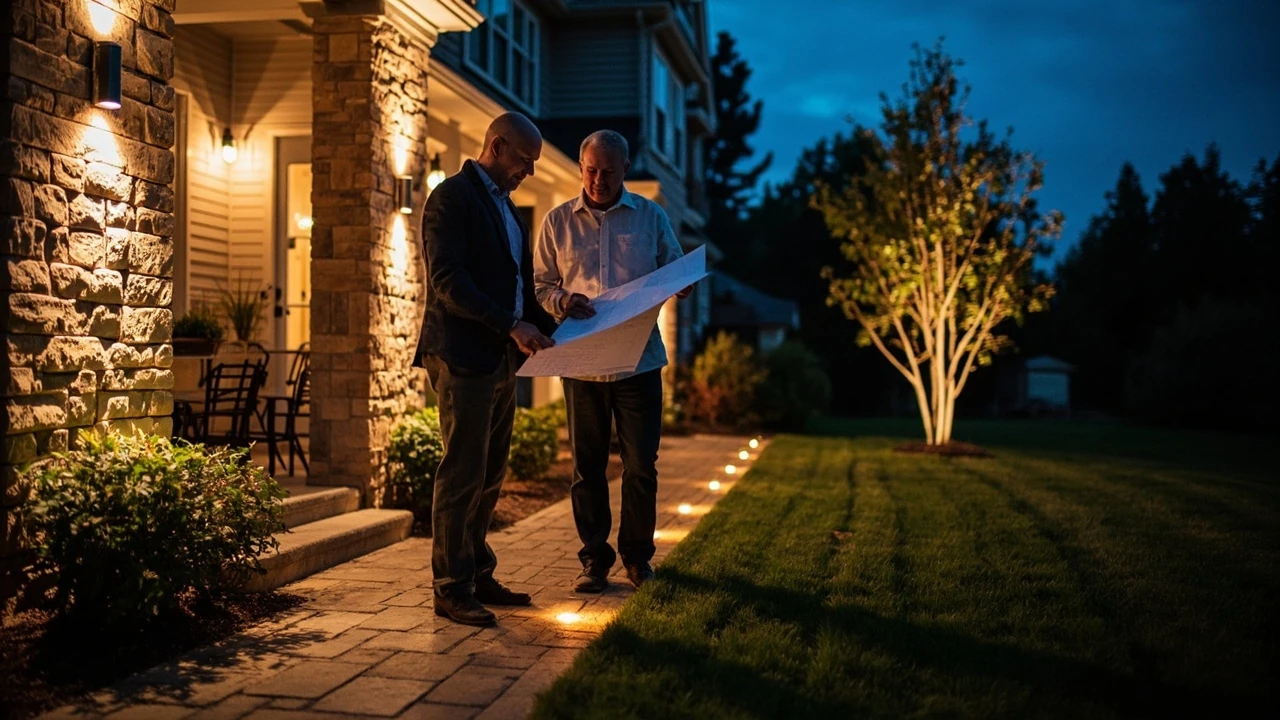
Outdoor lighting services for homes and small properties
You walk out to the driveway after dark and the path is a black ribbon of tripping hazards. The back patio disappears into shadow. The key you dropped next to the grill is somewhere in the grass. These are the daily frustrations that push homeowners to start looking into outdoor lighting services, often long before they have a clear idea of what those services actually include or what they should cost.
Outdoor lighting is unusual among home improvements because the result is felt every single evening, not just on the day the work is finished. A good plan makes a yard feel safer, easier to use, and more finished from the front. A bad plan, or work done with cheap components, can leave you with glare, dark corners, fixtures that fail after two winters, and a transformer that hums from the garage wall.
This guide walks through what a professional outdoor lighting service typically covers, how the work is scoped, what drives the price, and how to evaluate a contractor before you sign anything. It is written for a homeowner working on a single property, not a municipal streetscape or a commercial campus, and it focuses on practical decisions rather than marketing language.
What “outdoor lighting services” actually includes
The phrase gets used loosely. One company may treat it as a one-day fixture swap, another as a full design and installation package, and a third as an ongoing maintenance contract. Before comparing bids, it helps to understand the four building blocks that almost every legitimate outdoor lighting service is built on.
- Design and layout. A site visit, a conversation about how the yard is used, and a plan that shows fixture types, locations, beam spreads, and circuit groups. Some companies produce a written plan; others only mark locations with flags in the lawn.
- Fixture and component supply. The fixtures themselves, the low-voltage transformer, wiring, conduit where required, connectors, and controls such as timers, photocells, or smart modules.
- Installation. Trenching or boring for cable, mounting fixtures, aiming and adjusting beams at night, setting up the transformer, and programming controls.
- Service and maintenance. A first-year check, lamp or LED driver replacements, lens cleaning, re-aiming after plant growth, and winter or storm damage repair.
A bid that quietly drops one of these building blocks is often the reason one estimate looks much cheaper than the rest. A price that includes only fixtures and a transformer is not the same service as a price that includes design, installation, aiming, and a one-year tune-up, even if the fixture count looks identical on paper.
The most common types of outdoor lighting
Most residential outdoor lighting plans combine three or four of the following types. Each one solves a different problem, and the same fixture is rarely the right answer for more than one job.
Path and walkway lighting
Path lights are the short bollard-style fixtures that line a walk or driveway. Their job is not to light the path like a runway. It is to mark the edges so a foot lands on the paver instead of the lawn. Good path lighting produces overlapping pools of soft light every 6 to 8 feet, with the fixtures set back from the walk far enough that they do not become a shin hazard themselves.
Accent and uplighting
Accent fixtures aim up into a tree, a column, a stone wall, or a piece of sculpture. The light source is usually hidden in a ground-mounted well or behind a shrub. Uplighting is what gives a house that “finished” look at night, because it puts a soft wash on the architecture rather than a flat flood of brightness.
Downlighting and moonlighting
Downlights are mounted high in a tree or under an eave and aimed down. The effect mimics moonlight filtering through branches, which is why tree-mounted downlights are sometimes called moonlights. They are excellent for lighting a wide area of patio or lawn from a single, almost invisible source.
Wash and flood lighting
Wash fixtures spread a wide, even beam across a flat surface such as a stone wall, a fence, or a hedge. Flood lighting is the older, brighter version that throws a lot of light over a broad area. Wash lighting is usually what a designer reaches for first; flood lighting is reserved for specific tasks like a back tennis court or a service yard.
Step, deck, and hardscape lighting
These are small recessed or surface-mounted fixtures built into risers, posts, railings, and the edges of retaining walls. They are the most expensive per fixture because the work happens during construction, and the most expensive to add later, because the hardscape usually has to be opened up to run wire.
Security and entry lighting
This is the category homeowners ask about first and designers usually want to handle carefully. Bright entry and garage lights can be useful, but bare floodlights pointed at the house create glare, deep shadows, and complaints from neighbors. A layered security plan almost always combines motion-activated accent lighting with controlled entry fixtures, rather than a single 300-watt flood.
Low-voltage versus line-voltage systems
The single biggest technical decision in a residential outdoor lighting plan is whether the system runs at 12 or 24 volts or at the household 120 volts. Both can produce a beautiful result, but they are not interchangeable in cost, safety, or code requirements.
| Factor | Low-voltage (12V or 24V) | Line-voltage (120V) |
|---|---|---|
| Typical residential use | Most path, accent, and deck lighting | Some flood, security, and entry fixtures |
| Safety if a cable is cut | Very low risk of serious shock | Full household current, real shock risk |
| Installation depth | Shallow burial, often direct-burial cable | Deeper burial, conduit, and code-driven |
| Permit and inspection | Often not required for retrofits | Permit and inspection common |
| Fixture cost | Lower to mid-range | Mid to high, especially for LEDs |
| Best fit for | Landscape and architectural accent | Bright task and security lighting |
Most homeowners end up with a low-voltage system for the yard and a few line-voltage fixtures at the front entries and the garage. A good outdoor lighting service will explain where each is being used and why, rather than running everything on one voltage “because that’s what we always do.”
LED, halogen, and integrated fixtures
The light source inside the fixture matters almost as much as the fixture itself. Three options are common in residential work, and they behave very differently over a 10-year horizon.
- LED integrated fixtures. The LED module is built in and the whole fixture is replaced when the LED reaches the end of its life. This is the most common choice for new installations because the color, beam spread, and brightness can be tightly controlled, and the fixture is sealed against moisture.
- LED drop-in lamps. A standard fixture body that uses a screw-in or pin-base LED lamp. Easier to service in the field, but quality depends heavily on the lamp brand and the fixture’s heat management.
- Halogen. Warmer color and a familiar look, but much higher energy use, more heat, and shorter life. Most designers now steer new residential work away from halogen, though some homeowners still prefer the color.
Color temperature is part of the same decision. A warm 2700K LED reads as soft and residential, while a 3000K or 4000K fixture starts to look commercial. Mixing temperatures across one property is a common mistake, and a good design will keep the entire system within a narrow range, usually within about 200K of one target.
How a design is built before any wire is run
The sequence below is how a careful outdoor lighting service approaches a property. The order matters because changes made early in the design cost almost nothing, while changes made after trenching has started cost real money.
- Site walk and conversation. The designer walks the property at dusk and after dark, hears how the family uses the yard, and notes existing features such as trees, stone walls, water, and seating areas.
- Goal setting. Safety, wayfinding, curb appeal, entertaining, and security are listed and ranked. A yard that hosts weekly dinners will look very different from a yard whose only nighttime use is taking the trash out.
- Fixture plan and circuit layout. Each fixture gets a location, a type, a wattage, and a circuit. The transformer is sized with headroom for future fixtures, not run at 100 percent on day one.
- Night aiming. After the system is roughed in, the designer returns after dark to aim and adjust each fixture. This is the step that separates a magazine image from a yard full of glare.
- Client walkthrough and handoff. The homeowner walks the property with the designer, and any final adjustments are made on the spot. A short written summary of the system, the transformer location, and the warranty terms is left behind.
What a homeowner should expect to pay
The lighting industry has spent the last decade moving away from one-time product sales and toward ongoing service relationships, a shift that has been especially visible in commercial and municipal work. The Lighting as a service model turns fixtures into a subscription rather than a purchase, with the provider retaining ownership of the hardware and the responsibility for maintaining it. The same idea is starting to reach the high end of residential work, particularly for properties with large systems, multiple transformers, and a long-term plan for upgrades. For most single-family homes, the simpler version is still a one-time installation with a multi-year maintenance relationship, but the vocabulary and the expectations are clearly moving in the same direction.
It is hard to put a single price on a plan, because two properties with the same square footage can have very different needs. The numbers below are typical ranges for professional outdoor lighting services on a single-family home in many US markets, intended as a sanity check rather than a quote.
| Scope of work | Typical fixture count | Approximate price range | What is usually included |
|---|---|---|---|
| Front walk and entry only | 6 to 10 fixtures | Low to mid four figures | Path lights, two accent lights, transformer, timer |
| Full front yard plan | 12 to 20 fixtures | Mid to high four figures | Path, accents, tree lights, downlight, transformer |
| Front and back yard plan | 20 to 35 fixtures | High four to low five figures | All of the above plus patio, deck, and bed lighting |
| Large property or estate | 40 or more fixtures | Five figures and up | Multi-transformer system, smart controls, hardscape lights |
The price per fixture tends to fall as the fixture count rises, because the design, transformer, and truck roll are the same whether the crew installs 10 or 20 fixtures. The opposite is also true: a small job often costs more per fixture than a larger one, which is one reason a “couple of path lights” is sometimes surprisingly expensive.
Common ways a bid can mislead you
Outdoor lighting is a category where two proposals can both look professional and still describe very different work. A few patterns show up over and over, and they are worth asking about directly.
- Cheap fixtures, premium install. The labor and design are priced correctly, but the fixtures are a house brand with no real warranty. If a fixture fails in year three, the homeowner pays for both the new fixture and the service call.
- Real fixtures, no aiming. The crew installs everything and leaves before dark. Aiming is left to the homeowner, which almost never happens, and the result is glare and dark spots.
- Undersized transformer. The transformer is loaded near 100 percent to save a few dollars. Voltage drops at the end of the run, fixtures dim, and the system ages badly.
- No maintenance plan. The system is installed and the contractor disappears. Lamps burn out, tree growth blocks beams, and the original investment slowly looks worse every year.
None of these are hidden on purpose, but they are easy to miss when comparing two bids side by side. Asking how each issue is handled usually reveals a lot about the company behind the price.
Questions to ask before hiring a contractor
The right questions for a residential outdoor lighting service are not really about lighting. They are about the company, the warranty, and how the work will actually unfold. The list below is a useful starting point, and a contractor who is uncomfortable answering any of them is telling you something.
- Who designs the system, and will the same person be on site during aiming?
- Which fixture lines do you regularly install, and what is the warranty on the fixture body, the LED module, and the transformer?
- Is the transformer sized with extra capacity, and is the voltage at the farthest fixture checked during aiming?
- Will the crew aim the system at night, and is that visit included in the price?
- What happens if a fixture fails in the first year, and what does the service call cost after the warranty ends?
- Can you show two or three completed jobs nearby that can be driven or walked past after dark?
- Do you handle any needed electrical permits, and who is responsible if an inspector flags the work?
For many homeowners, the most useful question is the last one about completed jobs. A portfolio of beautiful projects on a website is a starting point, but a real address you can drive past at 9 pm is the only way to see how the work actually looks at night.
How lighting plans usually evolve after installation
Almost no one gets the plan right on the first try, and the best contractors expect that. The first winter is when most homeowners learn which paths they actually use, which trees they want to see from the kitchen, and which fixtures are brighter than they expected. A good outdoor lighting service treats the first year as a tuning period rather than a finished project.
Common adjustments during the first year include dimming a fixture that washes a bedroom window, adding a path light at a corner that turned out to be slippery, replacing a warm 2700K lamp with a 3000K lamp because the stone reads too yellow, and moving a downlight that has been blocked by new growth. None of these are failures of the original design. They are the natural result of a yard that is still being learned.
Maintenance and ownership over a 10-year horizon
A well-built low-voltage LED system should run for a decade or more with modest attention. The list below is the realistic maintenance shape of an outdoor lighting system over its first ten years, not a one-time punch list.
- Year 1. First-year check, free or low-cost under most warranties. Re-aim fixtures blocked by plant growth, tighten any connectors that worked loose, and confirm timer settings after daylight saving changes.
- Years 2 to 5. Annual or bi-annual visits, depending on the site. Clean lenses, replace any failed lamps, check transformer load, and adjust for new plantings.
- Years 6 to 10. Early LED driver failures in some fixtures, especially budget lines. A driver swap is usually cheaper than a full fixture replacement, but only if the fixture was designed to be serviced.
- Beyond 10 years. Most transformers and quality LED fixtures are still in service, but the system is usually expanded or partially refreshed. A new patio or a new tree often becomes the reason to revisit the original plan.
Homeowners who plan for that long arc, rather than treating the install as a one-time purchase, almost always end up happier with the result. The same is true for any other major home system, from a boiler service visit to a boiler service appointment that keeps the heating side of the house running on the same long schedule.
Smart controls, timers, and how to use them well
Controls are usually a small part of the total cost and a large part of the daily experience. The three options below cover almost every residential need, and a good designer will explain the trade-offs rather than pushing the most expensive system.
- Mechanical or digital timer. The simplest and most reliable option. Set the on and off times once a year and adjust twice a year for daylight saving. Best for homeowners who do not want an app on their phone.
- Photocell with timer. The lights come on at dusk, run until a set time, and shut off. Useful for front-of-house lighting that should be on every evening, regardless of the season.
- Smart controller and app. Schedules, dimming, and zoning from a phone, often with voice assistant integration. The most flexible option, and the one most likely to need a Wi-Fi reset every few years.
Dimming is worth its own mention. Running a system at 70 or 80 percent of full brightness at night lengthens LED life, reduces glare, and lowers energy use, all at the same time. It is one of the cheapest upgrades to specify during the original design and one of the hardest to add later.
Common code and safety issues worth knowing
Most residential low-voltage outdoor lighting work does not require a permit, but there are still a few rules that come up often enough to be worth a quick mention. The list below is general guidance, not a substitute for the rules in your own jurisdiction, and your contractor should be the one to confirm what applies on your property.
- Burial depth. Low-voltage cable rated for direct burial is usually allowed at a shallow depth, often 6 inches. Line-voltage cable typically has stricter depth and conduit requirements.
- GFCI protection. Outdoor receptacles and many outdoor circuits are required to be ground-fault protected. A tripped GFCI is sometimes the reason a system has gone dark after a storm.
- Transformer location. Mounted off the ground, in a ventilated space, and within reach of the GFCI-protected circuit that feeds it.
- Pool and water features. Fixtures near water face tighter rules on voltage, fixture rating, and placement. This is not a place to save money on components.
If a contractor shrugs off these points, that is a fair signal to slow the conversation down. A working familiarity with the local rules is part of what you are paying for, and it is one of the ways the work of an outdoor lighting service overlaps with the trade knowledge you would expect from any other residential contractor, from a kitchen remodeler to a residential moving company handling the more practical side of owning a home.
Where outdoor lighting is heading
Two practical shifts are worth watching. The first is the slow disappearance of color-temperature guessing, as more fixtures ship with switchable or factory-set color choices, and the second is the move toward replaceable LED modules, which is starting to make ten-year-old fixtures serviceable instead of disposable. Both of these trends are good for homeowners who are thinking about their property on a long horizon.
Putting it all together
Outdoor lighting services are not really about fixtures. They are about how a property feels at night, how safely a family can move around it, and how little the homeowner has to think about the system once it is in. A careful design, a clean installation, a transformer with headroom, fixtures that can be serviced, and a contractor who will still answer the phone in year three are the ingredients. The rest is patience, a willingness to walk the yard with the designer after dark, and a realistic budget for the parts of the property that matter most to you.
For most homeowners, the right next step is a single on-site consultation with two or three local outdoor lighting services, a careful look at each proposal using the questions in this guide, and a decision based on the quality of the plan and the people behind it, not the lowest line on the bid. Once the system is in, a small annual habit of walking the property at night and noting what has changed will keep the result looking intentional for many years to come.
Frequently asked questions
What do outdoor lighting services usually include?
Most residential outdoor lighting services include a site visit and design, supply of fixtures, transformer, and cable, the physical installation, nighttime aiming, and a first-year check. Larger plans also include multi-zone controls and a written maintenance schedule. The exact list varies by company, and it is worth asking for a written scope before signing.
How long does a typical installation take?
A small front-walk plan can be installed in a single day, while a full front and back yard plan usually takes two to four days of on-site work, spread across the rough-in, the aiming visit, and any final adjustments. Larger properties with hardscape lighting and multiple transformers can take longer, especially if trenching has to navigate existing irrigation or utilities.
Do I need a permit for outdoor lighting?
Most low-voltage residential outdoor lighting work does not require a permit, but line-voltage circuits, new outdoor receptacles, and work near pools or water features often do. Your contractor should know the local rules and tell you up front whether a permit is needed and who is responsible for pulling it.
How much does professional outdoor lighting cost?
A small front walk and entry plan often starts in the low four figures, a full front yard plan usually lands in the mid to high four figures, and a front and back yard plan commonly sits in the high four to low five figures. Per-fixture cost tends to fall as the fixture count rises, because the design and setup work is spread over more lights.
How long do LED outdoor fixtures last?
Quality LED fixtures are commonly rated for 50,000 hours or more, which is more than a decade of typical residential use. The LED module usually outlasts the warranty on the fixture body, and the failure point in real-world installations is often the driver or a connector, not the LED itself.
Can outdoor lighting be added to an existing yard without tearing it up?
Yes. Low-voltage systems are designed to be added with minimal disruption, using direct-burial cable laid in shallow slices cut into the lawn or tucked into bed edges. For established yards, most contractors can complete a full plan with only modest short-term damage to turf, which recovers within a few weeks.
What is the best color temperature for outdoor lighting?
Most designers recommend 2700K to 3000K for residential properties, with the entire system kept within about 200K of one target. Warmer tones read as softer and more residential, while cooler tones start to look commercial. Mixing temperatures across one property is one of the most common reasons a finished yard looks slightly off.
Is low-voltage outdoor lighting safe around children and pets?
Yes. A 12V or 24V system carries very little current, and a damaged cable does not pose the same shock risk as a household circuit. The main safety considerations are the same as for any outdoor equipment: secure cable connections, fixtures that are stable in the ground, and a transformer that is mounted off the ground and protected from weather.
How do I find a reliable outdoor lighting contractor?
Look for a company that designs, installs, and aims the system with its own crew, uses recognized fixture lines with a real warranty, and can show completed jobs that can be visited after dark. Ask how the transformer is sized, whether nighttime aiming is included, and what the service call cost looks like after the warranty ends. The answers usually tell you more than the price.
Can I expand the system later?
Almost always, as long as the original transformer was sized with headroom. A common mistake is to load the first transformer to its limit, which makes every future addition a small renovation rather than a quick add-on. Asking for extra capacity on day one is the cheapest insurance against a frustrating second visit.
Leave a Reply