


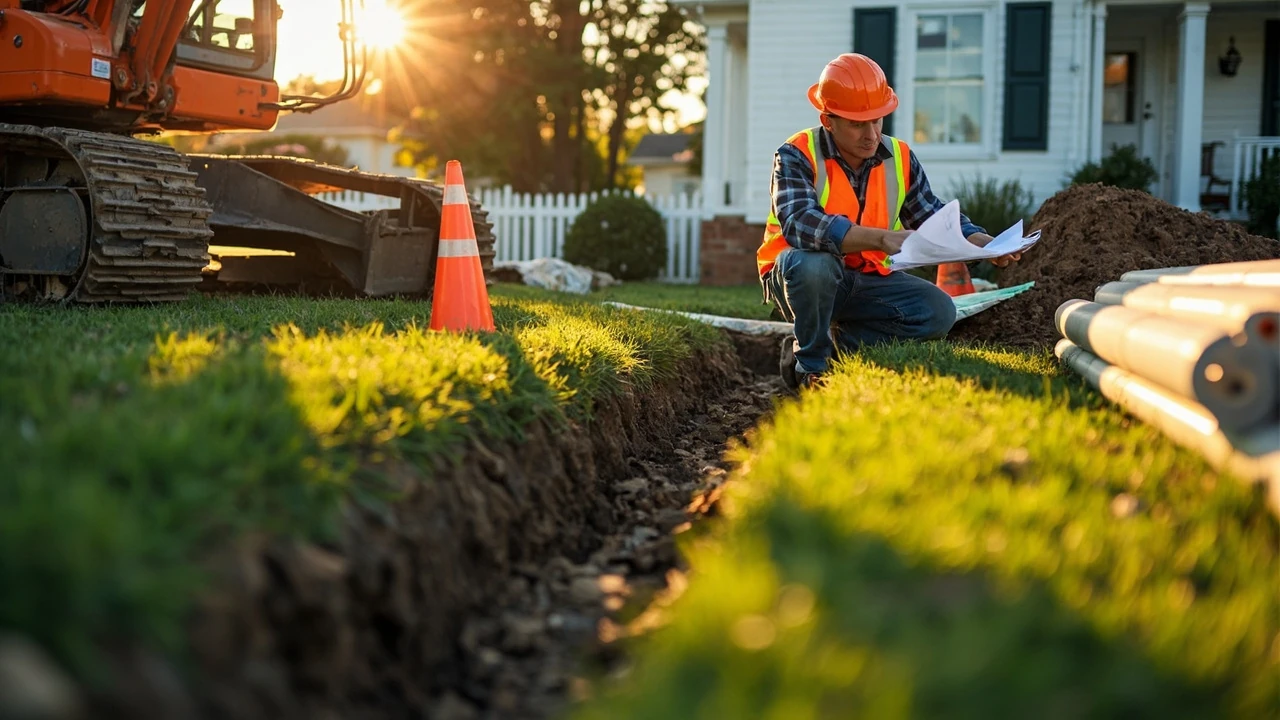
Sewer line replacement cost: what homeowners actually pay
A broken main line has a way of forcing a decision. One morning the lowest drain in the house gurgles, the next there is a soft patch in the yard that never dries, and the phone call to a plumber ends with a number that sounds like a car. Most homeowners arrive at that conversation with little sense of what a fair price looks like, which is why a careful look at sewer line replacement cost is worth doing before the excavator shows up.
The short version is that a full replacement in the United States typically runs roughly $3,000 to $7,500, with edge cases under $1,500 and large or deep jobs that climb past $20,000. Where any specific project lands inside that range depends on length, depth, pipe material, the method used, and what sits above the line, from a concrete driveway to a mature magnolia. The rest of this guide walks through each of those levers so the next estimate feels less like a guess and more like a set of choices with a price tag.
What drives the price of a sewer line replacement
Sewer work is unusual among home repairs because so much of the cost is in the ground rather than the pipe itself. A plumber is not just selling pipe, they are selling access to the pipe, the labor to remove the old one, and the restoration of whatever had to come out to reach it. Each of those factors is a separate line on an estimate, and each one can swing a project by thousands of dollars.
Several inputs are nearly always present, even when a quote looks simple on paper:
- Length of the run between the house and the city tap or septic tank.
- Depth of the pipe at the house and at the street, which changes how much dirt has to move.
- Surface cover, including slab, driveway, patio, deck, walkway, or mature landscaping.
- Pipe material being removed and the material being installed.
- Access for equipment, from a compact trencher to a full-size excavator.
- Local permits, inspection fees, and any required traffic control if the work crosses a sidewalk or street.
- Restoration costs after the pipe is in, including concrete, asphalt, sod, and hardscape repair.
Two homes on the same street can receive quotes that differ by 50 percent or more, and the difference usually lives in that list, not in the plumber’s hourly rate.
Typical price ranges for common situations
Numbers below are general ranges drawn from widely cited industry guidance and from the kind of line items that show up on real estimates. They are not a quote, and pricing in any specific market can be higher in dense urban areas or lower in regions with low labor costs. They are meant to help a homeowner recognize whether an estimate is in the right neighborhood.
| Scenario | Typical cost range | Main drivers |
|---|---|---|
| Short spot repair, shallow, easy access | $1,000 to $3,000 | Length under 10 feet, minimal surface cover |
| Standard full replacement, 40 to 60 feet, 4 to 6 feet deep | $3,500 to $7,500 | Average yard access, PVC pipe, open trench |
| Replacement under a concrete driveway or slab | $5,000 to $12,000 | Concrete cutting, removal, and replacement |
| Deep or long run to a city tap in the street | $8,000 to $20,000 | Permit fees, traffic control, deeper excavation |
| Trenchless replacement, 40 to 60 feet | $6,000 to $12,000 | Specialty equipment, less landscape restoration |
The middle row is where most single-family homes land when the line has failed outright and needs a full replacement. Anything that pulls the project out of that middle range, such as depth, paving, or a long run to the street, tends to push the total upward in fairly predictable steps.
How contractors put an estimate together
A good estimate is not a single number pulled from a chart. It is a sum of separate decisions, and understanding those pieces is the fastest way to compare two bids. The list below mirrors the way most licensed plumbers structure their quotes, even when the format on paper looks simple.
- Diagnostic work, often a camera inspection, to confirm the failure and locate the problem.
- Site prep, including locating utilities, marking the route, and setting up safety.
- Excavation, either a continuous trench or one or two access pits for a trenchless job.
- Removal and disposal of the old pipe, including any contaminated soil.
- Installation of the new pipe, fittings, and cleanouts, with proper slope and bedding.
- Inspection by the local authority having jurisdiction, if a permit is required.
- Backfill, compaction, and surface restoration to the condition found at the start.
If a quote collapses all of those into a single line, it is worth asking for the breakdown. The labor, materials, and restoration each have very different sensitivities, and a contractor who can explain them is usually a contractor who has done the work before.
Trench vs. trenchless: how the method changes the bill
The choice between an open trench and a trenchless method is often the single biggest decision a homeowner makes, because it changes both the line on the quote and the line for restoration. Each approach fits different conditions, and pushing the wrong one can end up costing more than it saves.
| Method | How it works | Best for | Cost impact |
|---|---|---|---|
| Open trench (dig and replace) | Excavate along the full length, remove old pipe, lay new pipe, backfill | Failed pipe, collapsed sections, shallow depth, limited budget | Lower upfront, higher restoration cost |
| Pipe lining (cured-in-place) | Insert a resin-saturated liner that hardens inside the old pipe | Intact pipe with cracks, root intrusion, or minor offsets | Moderate upfront, minimal digging |
| Pipe bursting | Pull a new pipe through the old one, fracturing the old pipe outward | Deteriorated pipe that still allows a cable pass | Higher upfront, replaces full diameter |
The catch with trenchless work is that the existing pipe has to be a candidate for it. If the line has collapsed, is full of standing water, or has major sags, the cable or liner simply will not make the run, and the project converts to an open trench by necessity. That is one reason plumbers almost always start with a camera inspection before quoting either method.
For a deeper look at how the two methods compare on price and disruption, Michael & Son’s overview of sewer line replacement pricing walks through the trade-offs in plain language, including why trenchless work can end up cheaper once landscape restoration is counted.
Pipe material and what it adds to the cost
Material is the part of the job that gets the most attention in marketing, but it is usually a smaller share of the total than excavation and restoration. Still, the choice of material matters for both cost and longevity, and the wrong choice on an older home can set up the next failure.
- PVC is the most common modern sewer pipe. It is light, resistant to corrosion, and usually the lowest-cost option. Schedule 40 PVC is standard for residential laterals in most jurisdictions.
- ABS is similar to PVC in performance, with a different look and a different joining method. It is accepted in some regions and not in others.
- Cast iron was common in mid-century homes. It is durable but heavy, and it corrodes over time, which is a leading reason older lines fail.
- Clay tile was the default before plastic. Sections can crack or shift at the joints, which is a frequent entry point for roots.
- Orangeburg is a bituminized fiber pipe used in some homes from the 1940s through the 1970s. It is known to deform and fail and is rarely a candidate for partial repair.
For a partial repair, plumbers usually match the existing material so the joints line up. For a full replacement, most will recommend PVC or, in heavier commercial settings, ductile iron. When an older home still has clay or Orangeburg, a single section repair is often a poor investment because the rest of the line tends to follow it into failure within a few years.
Where the money really hides in a sewer job
Once the pipe is in the ground, the project is far from over. For additional context, Several line items that do not appear on a plumber’s quote can change the final number a homeowner actually pays, and they are easy to miss during the stress of an active backup.
Camera inspection and locating
A camera inspection is usually the first paid step, and it costs somewhere between $150 and $500 on its own. It is the part of the job that tells the plumber where to dig, how deep the line is, and what kind of failure is present. Skipping it to save on the diagnostic almost always raises the cost of the repair, because the crew ends up digging in the wrong place or guessing at depth.
Surface restoration
Restoration is where a low bid can become a high bill. Concrete, asphalt, pavers, retaining walls, irrigation lines, and mature plantings all add cost when they have to come out and go back in. A plumber’s quote often assumes the homeowner will handle landscaping, while a general contractor’s quote may include it. The two are not directly comparable without asking the question.
Permits and inspections
Most municipalities require a permit for any work on the building sewer, and the inspection happens before backfill so the inspector can see the pipe, slope, and connections. Permit fees range from a low three-figure sum in small towns to several hundred dollars in larger cities, and a few jurisdictions charge a street-cut fee on top of that.
Emergency or after-hours work
A failed line that is actively backing up into the home often cannot wait for a Tuesday morning appointment. After-hours, weekend, and holiday calls carry a premium that can show up as a higher service fee, a higher minimum, or a surcharge on labor. If the situation allows any scheduling flexibility, using it can save several hundred dollars on the same scope of work.
Hidden conditions under the yard
Yards hold surprises. Big rocks, old foundations, high water tables, and unmarked utilities all slow excavation and can require additional equipment. A responsible contractor will call out that unknowns exist underground and will document anything unusual as it appears, but the contingency for that work is part of the price.
How to read two competing estimates
Two bids for the same job can be several thousand dollars apart and both be honest. The differences usually live in scope, assumptions, and method. A short checklist makes the comparison much faster.
- Confirm both quotes are for the same length, depth, and method.
- Check whether pipe material, fittings, and cleanouts are the same on both.
- Ask whether permits, inspection fees, and traffic control are included.
- Ask what each contractor assumes for surface restoration.
- Confirm the warranty on materials and labor, and what it covers.
- Ask about the payment schedule and what triggers any final payment.
If a low bid is missing restoration, the final number can climb past the higher bid once the yard, driveway, or sidewalk is put back. If a high bid includes work the other estimate treats as the homeowner’s responsibility, the comparison only works after the scope is matched up.
Signs the line needs replacement, not just a repair
Not every sewer problem calls for a full replacement, and a good diagnostic will often find a fix that costs a fraction of a new line. There are a few situations, though, where replacement is almost always the right call, even when a spot repair is technically possible.
- Repeated backups in the same fixtures within a short window, especially after a recent repair.
- Visible pipe materials known to fail, including Orangeburg, severely corroded cast iron, or shifted clay.
- Mature root systems that have invaded at multiple points along the line.
- Bellied or sagging sections where the pipe has lost its slope and holds water.
- Homes older than 50 years where the original line has never been replaced.
When more than one of those is true, a partial repair often becomes a Band-Aid on a line that is failing throughout. The cost of doing the work twice, including the second excavation, usually exceeds the cost of doing the full replacement once.
Ways to keep sewer line replacement cost under control
There is not much to negotiate about the price of pipe, but there are several decisions a homeowner can make that meaningfully change the final bill. Most of them happen before the excavator arrives.
- Get at least two written estimates from licensed and insured plumbers who pull permits in your jurisdiction.
- Ask each contractor whether trenchless is an option, and what would make it not an option for your line.
- Schedule the work during the contractor’s normal season if the situation allows, rather than as an emergency call.
- Move patio furniture, planters, and small structures out of the work path before the crew arrives.
- Ask the contractor to mark sprinkler lines and low-voltage lighting before excavation.
- Decide in advance who is responsible for sod, concrete, and any tree or shrub replacement.
- Ask about financing or phased payment, since some plumbers offer both for larger jobs.
None of these steps lower the plumber’s cost, but they reduce the hours on site, the surprises in the ground, and the restoration work that drives the final number up.
How long the work takes and what to expect on site
A standard residential replacement usually takes one to three working days, depending on depth and surface cover. Trenchless work can compress that to a single day for the pipe itself, with restoration scheduled afterward. The day-by-day shape of the project tends to follow a familiar pattern:
- Day 1: locates, permits posted, excavation, old pipe removed, new pipe laid, inspection.
- Day 2: backfill, compaction, and rough restoration, including concrete or asphalt patch if applicable.
- Day 3 or later: final restoration, including topsoil, sod, and any hardscape work that was deferred.
Water service to the home is usually off for part of one day, and the contractor will coordinate that window in advance. Driveways and yard access are typically restricted for 24 to 48 hours after backfill, and any concrete or asphalt patch needs time to cure before it is driven on again.
Warranty, insurance, and paperwork that protect the homeowner
A sewer line replacement is a significant investment, and the paperwork around it matters as much as the work itself. Three documents are worth keeping and reviewing before any work begins.
- The contract, which should spell out scope, materials, method, price, payment schedule, and warranty terms.
- The permit and final inspection sign-off, which confirms the work met code at the time it was done.
- The warranty, which usually splits into a workmanship warranty from the contractor and a manufacturer warranty on the pipe and fittings.
Workmanship warranties commonly run one to ten years, and manufacturer warranties on PVC and similar materials often run much longer. A contractor who is willing to put a clear warranty in writing is usually a contractor who plans to be around to honor it.
Frequently asked questions
What is the average sewer line replacement cost for a single-family home?
For most single-family homes, a full replacement falls between $3,500 and $7,500. Shorter spot repairs can come in under $1,500, while deep or long runs, especially under paving or across easements, can climb past $20,000. The exact number depends on length, depth, surface cover, pipe material, and method.
Is trenchless sewer replacement cheaper than digging?
Not always on the line item itself. Trenchless methods often cost more upfront because of the specialty equipment, but they usually save on landscape, driveway, and hardscape restoration. On a property with a concrete driveway, a finished patio, or mature landscaping, the total bill can actually be lower with trenchless.
Does homeowners insurance cover sewer line replacement?
Standard homeowners policies usually do not cover the sewer lateral from the house to the street, and they treat it as a maintenance item. Some insurers offer an optional sewer and water line endorsement for an additional premium, and some municipalities or utility districts offer separate lateral warranties. It is worth checking the policy and the local utility before assuming any of the cost is covered.
How long does a new sewer line last?
PVC pipe installed today is typically rated for 50 to 100 years under normal residential use. The more common reasons a new line fails early are poor installation, such as inadequate slope or improper bedding, or external causes, including root intrusion and ground movement. A reputable contractor with a clear workmanship warranty is the single biggest factor in how long the work actually holds up.
Can I live in the house during the replacement?
Yes, in most cases. Water service is usually off for part of one day, and there will be noise, dust, and equipment in the yard, but the home itself remains usable. If the work is happening because of an active backup, the home may not have been fully usable before the work started, and full fixture use returns once the new line is in service.
Do I need a permit for sewer line replacement?
Almost always, yes. Most jurisdictions require a permit for any work on the building sewer, along with an inspection before backfill. A licensed plumber who works in the area regularly will know which office to file with, what the fee schedule looks like, and how long the review typically takes. Skipping the permit can create problems at the time of sale and can affect insurance claims if something goes wrong later.
What is a cleanout, and do I need one?
A cleanout is a capped access point installed on the sewer line, usually near the house and sometimes near the property line. It gives plumbers a place to snake or camera the line without pulling a fixture inside the home. Most modern replacements include at least one cleanout, and adding one during a replacement is far cheaper than adding it later as a separate project.
How do I know whether I need a repair or a full replacement?
A camera inspection is the most reliable way to find out. A single crack, offset joint, or small root intrusion at an accessible location is often a candidate for a spot repair. Multiple defects, a collapsed section, severe corrosion, or pipe materials known to fail throughout, such as Orangeburg, usually point toward a full replacement. The plumber should be able to show the video and explain the call in plain terms before any digging starts.
Can I replace a sewer line myself?
In most jurisdictions, no. Work on the building sewer is almost always required to be done by a licensed plumbing contractor, pulled under a permit, and inspected. Beyond the legal requirement, the work involves excavation around utilities, proper slope, correct bedding, and code-specified materials. Mistakes tend to be expensive and invisible until the next backup.
How soon should I act if I suspect a sewer problem?
Sooner is better. A slow drain or occasional gurgle can be a sign of a partial blockage that is still manageable. A line that is already backing up into the home, or a yard patch that smells like a swamp, is a sign that the line has failed and is discharging where it should not. Waiting tends to turn a fixable problem into a more expensive one, and it raises the chance of water damage inside the home.
Leave a Reply