


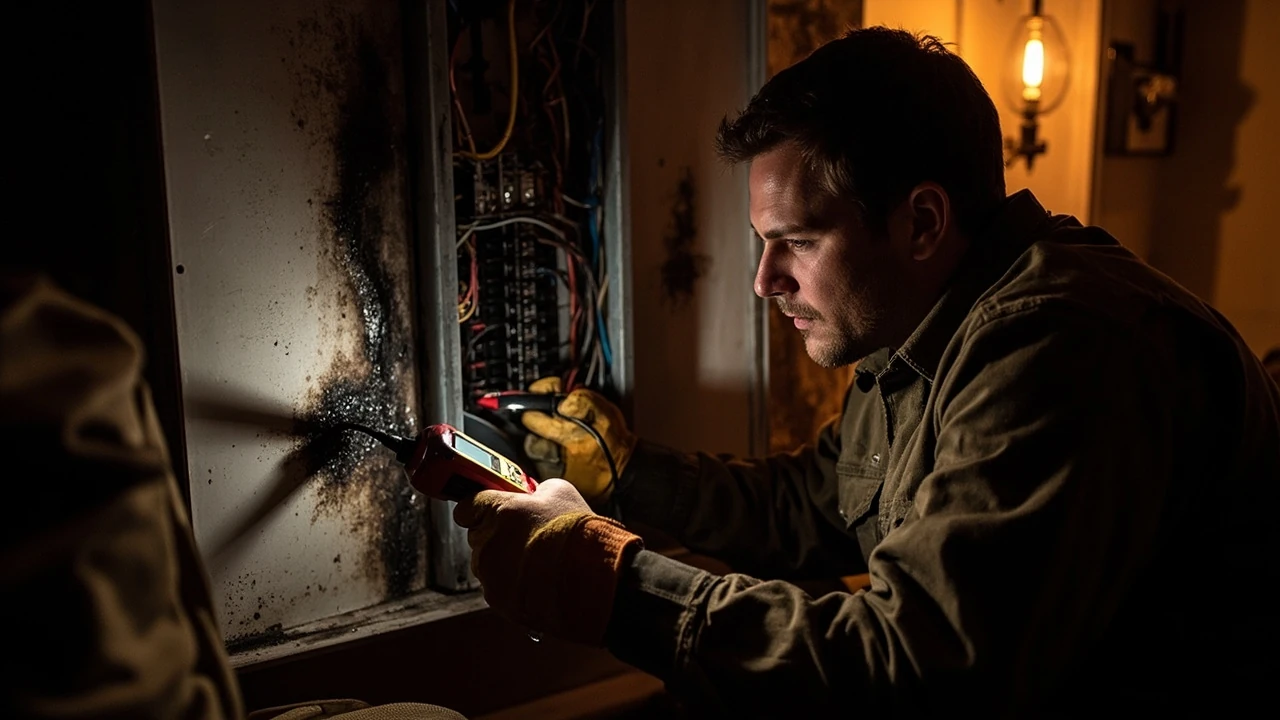
Emergency electrician: when to call and what to expect
A burning smell from the outlet near your kitchen counter, half the lights in the house suddenly going dark, a breaker that will not reset no matter how many times you flip it. These are the moments when a homeowner starts searching for an emergency electrician, and the difference between a calm response and a dangerous one usually comes down to what you do in the first few minutes.
An electrical emergency is not just an inconvenience. Faulty wiring and overloaded circuits are a leading cause of residential structure fires, and the same conditions that knock out your power can also threaten your family. This guide explains how to recognize the warning signs, what to do before the truck arrives, how 24-hour electrical service typically works, what it costs, and how to tell a real emergency from a problem that can safely wait until morning.
What counts as an electrical emergency at home
Not every electrical problem requires a midnight call. Electricians and fire investigators generally draw the line at conditions that pose an active risk of fire, shock, or loss of essential service. Understanding that line helps you avoid both panic and complacency.
According to guidance published on electrical wiring in residential buildings, most household emergencies fall into a few predictable patterns: overloaded circuits, damaged insulation, failing breakers, and appliances or fixtures that draw more current than the wiring was designed to carry. The visible warning signs vary, but the underlying causes are usually familiar to a trained technician.
You are probably dealing with a true emergency if any of the following apply:
- You smell burning plastic, rubber, or insulation from an outlet, switch, or panel.
- You see smoke, sparks, or scorch marks around outlets, switch plates, or the breaker box.
- A breaker trips repeatedly and will not stay reset, or a fuse blows more than once for the same circuit.
- You have partial power loss in a portion of the house with no utility-side outage explanation.
- An outlet or switch is hot to the touch, discolored, or making a buzzing or crackling sound.
- You experience a mild shock or tingle when touching an appliance, fixture, or metal surface connected to the system.
- Water has entered the panel, outlets, or any wiring, such as after a flood or major leak.
Single dead outlets, one burned-out bulb, or a tripped GFCI in a bathroom are usually not emergencies on their own, even though they are annoying. They become emergencies when they suggest a deeper problem, such as a repeated trip, a warm faceplate, or a pattern that mirrors a known fire sign.
What to do in the first ten minutes
Speed matters, but so does sequence. The right order of actions protects people first, then the building, then the equipment. Before you call anyone, walk through these steps calmly.
- Get people out of the immediate area if you see smoke, smell burning, or see scorch marks.
- Turn off the breaker for the affected circuit if you can do so safely. For a panel that is hot, smoking, or wet, do not touch it; go to the main and shut the whole house off.
- Unplug sensitive electronics on the affected circuit to prevent damage when power is restored.
- Check whether the problem is isolated to your home. Ask a neighbor, or look at your utility’s outage map, before assuming it is internal.
- Call 911 if there is active fire, smoke you cannot stop, or anyone has been shocked and is injured.
- Call an emergency electrician for conditions that are not on fire but still dangerous, such as a hot panel, repeated breaker trips, or a burning smell with no visible flame.
Do not pour water on an electrical fire. Do not open a panel that is hissing, sparking, or wet. Do not keep resetting a breaker that trips immediately; each reset sends current through a fault that may be heating the wire behind the wall.
How 24-hour emergency electrical service usually works
Emergency electricians operate outside normal business hours, which is why the cost structure and the response model differ from a scheduled service call. Knowing what to expect makes the conversation with the dispatcher faster and the bill less surprising.
Most established 24-hour electrical companies follow a similar workflow. After your call, a dispatcher asks a short set of triage questions, then decides whether to send a technician immediately or schedule the earliest available window. Many companies aim to be on-site within one to four hours for true emergencies, though rural response times can run longer.
A typical after-hours visit includes:
- A diagnostic fee or trip charge, which is often higher at night, on weekends, and on holidays.
- On-site testing using a multimeter, clamp meter, and insulation resistance tester to find the fault.
- Either a same-visit repair, if parts and time allow, or a temporary safety repair with a follow-up visit during business hours.
- A written summary of findings, code issues found, and any recommended non-emergency work.
For example, a company that markets 24-hour emergency electrical services in Fresno describes the same general flow: a triage call, an on-call technician, same-day dispatch for safety hazards such as burning smells or repeated breaker trips, and an inspection to identify what caused the failure so it does not repeat.
Common warning signs before a real failure
Most electrical emergencies do not come out of nowhere. The system usually complains for weeks before it fails outright, and a careful homeowner can often catch the warning signs during routine use.
Heat, smell, and sound
Outlets, switches, and breaker handles should never feel warm. A faint fishy or plastic smell around an outlet is one of the most reliable early indicators that wire insulation is overheating. Buzzing from a panel, dimmer, or large outlet can signal a loose connection that is arcing intermittently.
Visual cues
Brown or black streaks around an outlet, a melted or warped faceplate, or flickering lights on one circuit are physical evidence that something is wrong. If you see soot, treat it the same as smoke: shut the circuit off and call for service.
Behavioral cues
Breakers that trip under normal load, lights that dim when a large appliance starts, or appliances that behave erratically often point to an undersized circuit, a loose neutral, or a failing breaker. None of these are emergencies on their own, but they justify a non-urgent inspection before they become one.
Inside the diagnostic: what the technician actually checks
When an emergency electrician arrives, the work looks routine, but the sequence is deliberate. The goal in the first visit is to make the home safe, identify the immediate fault, and decide what can wait.
| Step | What the technician does | What it tells you |
|---|---|---|
| Visual inspection of panel and affected areas | Looks for scorch marks, melted insulation, water intrusion, double-tapped breakers | Whether the problem is localized or systemic |
| Breaker testing | Trip tests suspect breakers with a load meter | Whether the breaker itself has failed |
| Voltage and continuity checks | Measures voltage at outlets, checks hot-to-ground and hot-to-neutral | Whether the circuit has lost a conductor or has a high-resistance joint |
| Load assessment | Calculates expected draw versus breaker rating | Whether the circuit is overloaded or undersized for current use |
| Insulation resistance testing | Megohmmeter test on suspect runs | Whether wire insulation inside the wall has degraded |
| Ground and bonding verification | Confirms equipment grounding conductor and bonding jumpers | Whether a fault has a safe path to clear |
Many emergencies resolve into a small repair, such as replacing a failed breaker, a burnt outlet, or a loose neutral. Some reveal a larger problem, like aluminum branch wiring with deteriorating connections, a panel that is past its service life, or a subpanel installed without permits. The technician’s job in the first visit is to make the situation safe and to lay out the options.
Emergency vs. urgent vs. routine: how to triage your own call
Even when you are the one paying, you still need to decide how fast to act. The table below is a practical framework; treat it as a starting point, not a substitute for professional judgment.
| Category | Examples | Recommended response |
|---|---|---|
| Immediate emergency | Active smoke from outlet, fire, shock with injury, water in panel | Call 911 if applicable, then emergency electrician; shut main if safe |
| Same-day emergency | Burning smell, hot outlet, repeated breaker trips, partial power loss with no utility outage | Call emergency electrician for a same-day visit; avoid using the affected circuit |
| Urgent, not emergent | Single dead outlet, one GFCI that will not reset, mild flicker on one circuit | Schedule next-day service; avoid daisy-chained power strips on the circuit |
| Routine | Dimmer hum, mild LED flicker, planned panel upgrade, EV charger installation | Book a normal appointment; request a quote in advance |
If you are unsure, call and describe the symptom rather than guess. Dispatchers triage calls all day, and a one-minute conversation can clarify whether the situation can wait four hours or four days.
What an emergency electrician visit typically costs
Costs vary by region, time of day, and the scope of the fault, but the structure is fairly consistent. Three numbers usually appear on the invoice: a diagnostic or trip fee, an hourly labor rate, and parts.
| Component | What it covers | Why it changes at night |
|---|---|---|
| Diagnostic or trip fee | Travel and initial fault-finding | Higher after hours, weekends, and holidays to compensate on-call staff |
| Hourly labor | Time on-site for testing, isolation, and repair | After-hours rates are commonly 1.5x to 2x the daytime rate |
| Parts and materials | Breakers, outlets, wire, connectors, any code-required components | Pricing is similar to daytime, but stock may be limited late at night |
| Permit and inspection | Required for panel work and some circuit changes | Often deferred to business hours, even if the emergency repair is done at night |
| Follow-up or temporary repair | Safe, code-compliant interim fix with a planned permanent repair | Used when full repair needs parts, permits, or a power shutdown |
Be wary of anyone who quotes a flat fee by phone without asking a single question, refuses to give a written estimate, or pressures you to replace a whole panel on the spot. None of that is normal. A reputable company will explain the diagnostic fee, walk you through what they found, and give you options before doing additional work.
How to find a legitimate emergency electrician
After-hours electrical work is one of the more common areas for price gouging and outright scams, because homeowners are stressed and the timeline is short. A little preparation in advance pays off the first time you need help.
- Confirm the license number with your state or local licensing board. Most jurisdictions publish an online lookup.
- Verify insurance, including general liability and workers’ compensation, and ask for a certificate.
- Check reviews on multiple platforms rather than a single site, and read how the company responds to complaints.
- Ask whether the company employs its technicians or uses subcontractors, and who will actually show up.
- Get the diagnostic fee, the after-hours rate, and the payment terms in writing before work begins.
It is also worth establishing a relationship before an emergency. A short inspection during business hours, even if everything looks fine, gives you a baseline and a familiar number to call when something does go wrong.
Preventive steps that reduce the chance of a midnight call
You cannot eliminate every risk in a residential electrical system, but you can remove the most common causes of after-hours emergencies. Most of these are simple habits or one-time improvements.
- Replace any outlet that is warm, loose, discolored, or smells odd. The cost is low, and the failure mode is severe.
- Avoid daisy-chaining power strips or running extension cords as permanent wiring.
- Label your panel so any adult in the home can shut off a specific circuit or the main.
- Test GFCI and AFCI devices monthly using the built-in test button.
- Schedule a panel inspection if your home is more than 25 years old, has aluminum branch wiring, or has had major renovations without updated permits.
- Install whole-home surge protection at the panel to protect sensitive electronics and reduce stress on breakers.
- Keep the area around the panel clear for safe access during an emergency.
Two habits in particular pay off. First, never ignore a breaker that trips more than once for the same reason; the first trip is a warning, the second is a fault. Second, treat any burning smell as urgent even if the breaker has not tripped; some arcing faults do not draw enough current to trip a standard breaker but still generate enough heat to start a fire.
What to keep on hand before the technician arrives
Small preparations speed up the visit and reduce confusion. Have these ready when you call or while you wait:
- Access to the main panel and the affected area, with the panel cover clear of storage.
- A list of the symptoms, including when they started, what you were doing at the time, and which circuits are affected.
- The home’s approximate age and any prior electrical work you know about, including unpermitted DIY.
- A way to keep children and pets away from the work area.
- Payment method confirmed in advance, since some after-hours companies limit options.
When the emergency is over, plan the follow-up
An emergency electrician’s job is to make the home safe right now. The full repair, the permit, the inspection, and any code upgrades may still be pending. Build those items into your plan rather than assuming the fix is complete.
- Ask for a written summary of what was repaired, what was found, and what was deferred.
- Confirm whether the work requires a permit and inspection, and schedule it.
- Note any panels, breakers, or wiring the technician flagged for future replacement.
- Save the invoice for insurance purposes, especially if the event involved fire, water, or shock.
If the same circuit has failed before, treat the pattern as data. Repeated trips on the kitchen counter circuit, for example, often mean the circuit is overloaded by small appliances and needs to be split, not just reset.
Special cases: old wiring, panels, and post-event inspections
Some emergencies point to a deeper issue with the home’s electrical system. Three situations deserve their own attention.
Older homes with aluminum or knob-and-tube wiring
Homes built in the mid-20th century often have aluminum branch wiring, which expands and contracts more than copper and loosens at connections over time. Loose aluminum connections are a common cause of warm outlets and burning smells. A permanent solution usually involves copper pigtails with anti-oxidant compound, or a partial rewire. A repeated emergency on an aluminum-wired home is a strong signal to plan a rewire rather than patch.
Panels and breakers known to fail
Some panel and breaker brands from specific production years have documented safety issues. A technician may flag the brand and ask whether you want a planned replacement. If so, treat the emergency visit as the start of a longer conversation rather than the end of the problem.
After a flood, lightning strike, or major surge
Water and lightning can damage insulation, panel internals, and connected equipment in ways that are not visible right away. A post-event inspection, including insulation resistance testing, is a reasonable next step after any of these events, even if the system seems to work.
Frequently asked questions
How fast can an emergency electrician actually arrive?
Response time depends on the region, the time of day, and the company’s staffing. In most urban and suburban areas, a true emergency call aims for a one to four hour window. Rural areas and severe weather can push that out. When you call, ask the dispatcher for a realistic ETA based on current call volume.
Do emergency electricians work on weekends and holidays?
Most 24-hour companies do, but they usually charge higher diagnostic and labor rates for nights, weekends, and holidays. Ask the rate schedule when you call so you are not surprised by the invoice.
Should I shut off the main breaker before the electrician arrives?
If the affected circuit is identifiable and the panel is safe to touch, shut off that breaker. If the panel is hot, smoking, wet, or you are not sure, shut off the main. If the main itself is the problem, leave it on and wait for the technician unless the situation is actively dangerous.
Is a partial power loss always an emergency?
Not always. A utility outage can look like an internal problem. Check with neighbors and your utility’s outage map before calling. If only part of your house is dark and the rest of the neighborhood has power, that points to an internal fault and is more urgent.
What if my breaker keeps tripping but nothing is plugged in?
A breaker that trips with no load usually signals a wiring fault, a failing breaker, or a short inside the wall. Stop resetting it and call for service. Repeated resets can heat the wire behind the wall without clearing the fault.
Can a homeowner legally do their own emergency electrical repair?
Rules vary by jurisdiction, but most require licensed work for anything beyond very minor tasks, and many require permits for panel and circuit work. After-hours emergency repairs are typically expected to be done by a licensed electrician for safety and insurance reasons.
Will my homeowner’s insurance cover an emergency electrical visit?
Coverage depends on the cause and your policy. Damage from a covered event, such as a lightning strike, may be reimbursable; a one-time repair of an aging outlet usually is not. Keep documentation, and ask your adjuster before assuming the cost is out of pocket.
What if the burning smell goes away before the electrician gets here?
Treat it as if it is still there. The smell going away does not mean the fault has cleared; the connection may have cooled, the breaker may have weakened, or the arcing may be intermittent. Leave the circuit off and request a visit anyway.
How do I tell a real emergency from a tripped GFCI?
Press the reset button on the GFCI outlet, often found in bathrooms, kitchens, garages, and exterior outlets. If it resets and holds, you are probably dealing with a normal GFCI trip. If it will not reset, the circuit may be overloaded or have a ground fault, which is more urgent. If the outlet is warm or smells odd, leave the breaker off and call.
Should I replace my panel if an electrician recommends it during an emergency visit?
Not on the spot. A recommendation made during an emergency visit deserves a second opinion, a written quote, and time to compare options. If multiple licensed electricians agree that the panel is past its service life or has a known defect, planning a scheduled replacement is reasonable.
Leave a Reply