


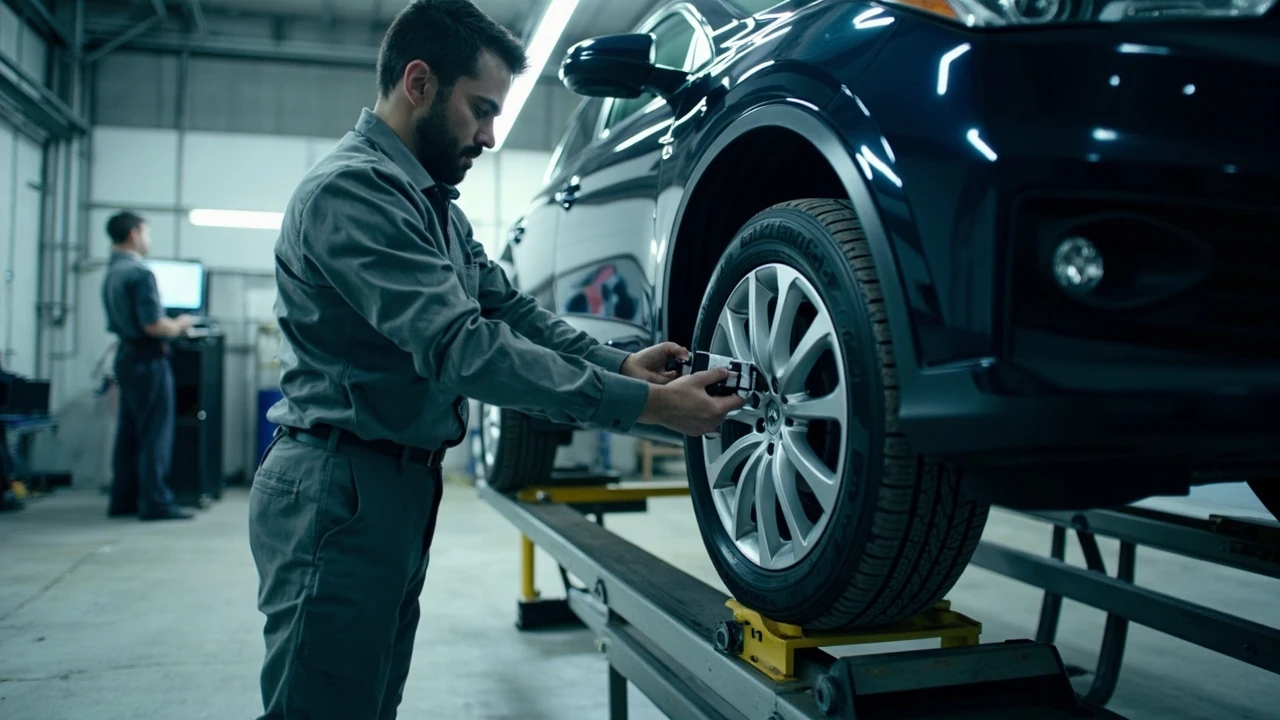
Firestone wheel alignment price: what drivers actually pay
A driver pulls out of a parking lot and feels the steering wheel tug slightly to the right. The car has been riding rough for a few weeks, the tires are wearing unevenly, and now the question is simple: what does a Firestone wheel alignment price look like, and is the service worth the trip to the shop?
For most passenger cars and light trucks, a single Firestone wheel alignment falls somewhere between $80 and $120 for a standard one-time service. A one-year warranty alignment usually lands in the same range with a limited re-adjustment window, and a lifetime alignment package, which covers the car for as long as the original owner keeps it, is commonly priced around $200. Those numbers are the starting point, not the final answer, because the actual firestone wheel alignment price on your invoice depends on the vehicle, the package you choose, and the labor rates at the specific shop you visit.
This guide walks through what is actually included in each Firestone alignment package, what can push the price up or down, and how to decide which option makes sense for the way you drive. It also covers when an alignment is genuinely necessary, what a proper alignment is supposed to fix, and the questions worth asking before you hand over the keys.
How Firestone structures its alignment pricing
Firestone breaks its alignment service into three main tiers. Each tier is built for a different kind of driver, and each one changes the firestone wheel alignment price you will see on the estimate.
The standard alignment is a one-time correction. A technician measures the angles of all four wheels against the manufacturer’s specifications, then adjusts what is adjustable. This is the right choice if your car recently hit a pothole, kissed a curb, or developed a pull after a suspension repair. You pay once, the angles are set, and the job is done.
The warranty alignment covers a full year of adjustments. If your car starts drifting or your steering wheel sits off-center within twelve months, you bring it back and the angles are corrected again at no extra charge. This option is built for drivers who want a safety net without committing to a long-term package.
The lifetime alignment is a single upfront payment that covers the car for as long as the original owner keeps it. There is no expiration on the coverage. For a driver who plans to keep a vehicle for several years and who drives in conditions that tend to knock alignment out of spec, the lifetime option frequently pays for itself by the second visit.
Thinking of it in plan terms helps. A one-time service is the pay-as-you-go option, the warranty package is a short subscription, and the lifetime package is a long subscription bundled into one payment. The math on which one is cheaper depends on how often you will actually need adjustments.
Typical Firestone wheel alignment price by package
The table below summarizes the package options, what they include, and the price range drivers commonly see at Firestone locations in the United States. Prices vary by region, vehicle, and shop, so treat these as planning numbers rather than a quote.
| Package | Typical price | Coverage period | Best suited for |
|---|---|---|---|
| Standard alignment | $80 to $120 | One-time service | Drivers with a recent alignment issue, a single pothole event, or a post-repair check |
| Warranty alignment | $100 to $150 | 12 months of adjustments | Drivers who want a year of protection without a long-term commitment |
| Lifetime alignment | $180 to $240 | As long as the original owner owns the car | Long-term owners, high-mileage drivers, and anyone on rough roads |
Most Firestone locations publish alignment pricing on their site, and many will give a firmer number over the phone if you share the year, make, and model of your vehicle. Alignment on four-wheel-drive trucks and SUVs sometimes costs more than on a small sedan because there are more adjustable angles and the shop has more work to do. Specialty vehicles, modified suspensions, and cars with electronic steering can also push the labor time up.
What actually changes the firestone wheel alignment price
Several variables move the final number on the estimate. Knowing them in advance helps you avoid surprises at the counter and gives you a clearer way to compare Firestone against an independent shop.
- Vehicle type and drivetrain. Front-wheel-drive cars typically need a two-wheel alignment, while all-wheel-drive and four-wheel-drive vehicles often require a four-wheel alignment. More wheels measured and adjusted means more labor.
- Adjustable suspension components. Some cars have non-adjustable rear alignment, which limits what a technician can correct. Others have multiple adjustable points at the front and rear, which takes longer but produces a more complete result.
- Modified or lowered suspensions. Cars with aftermarket coilovers, lift kits, or camber plates often need custom alignment settings, which adds time.
- Regional labor rates. A Firestone in a high-cost metro area will generally charge more than the same service in a smaller market.
- Add-on services. Tire rotation, balance, and road-force balancing are often bundled with an alignment. Each add-on raises the total, even if the alignment itself is priced low.
- Coupons and promotions. Firestone regularly runs alignment specials that bundle the service with tire purchases or seasonal maintenance, which can change the effective firestone wheel alignment price by a noticeable margin.
If you receive a quote that is far above or below the ranges above, ask the service advisor what is included and what adjustments the technician plans to make. A lower price can mean a two-wheel alignment on a vehicle that needs four-wheel work, and a higher price can simply reflect a more complete job or a more complex vehicle.
Two-wheel versus four-wheel alignment at Firestone
One of the most common points of confusion is whether a car needs a two-wheel or four-wheel alignment. The answer depends on the drivetrain and the manufacturer’s service procedure.
A two-wheel alignment, sometimes called a front-end alignment, measures and adjusts only the front wheels. This is the standard approach for many front-wheel-drive cars and for rear-wheel-drive vehicles whose rear suspension has no factory adjustment. A four-wheel alignment measures all four wheels and adjusts every angle the manufacturer calls for. It is required on most all-wheel-drive and four-wheel-drive vehicles, and on many modern cars with independent rear suspensions.
From a cost standpoint, a four-wheel alignment runs higher than a two-wheel alignment because of the extra measurement and adjustment time. If the shop quotes you a firestone wheel alignment price that looks unusually low, confirm whether the service is a two-wheel or four-wheel job and whether the rear angles are being measured at all.
What a proper alignment is supposed to fix
Alignment is not the same thing as balancing or rotating tires. It is a specific set of angular measurements that determine how each wheel sits relative to the road and to the other wheels. Three angles are adjusted in most alignments:
- Camber. The inward or outward tilt of the wheel when viewed from the front. Too much positive or negative camber causes uneven tire wear on the inside or outside edge.
- Toe. The direction the wheels point relative to the centerline of the car. Toe that is out of spec causes a pull, wandering steering, and rapid tire wear.
- Caster. The forward or backward tilt of the steering axis when viewed from the side. Caster affects steering stability and return to center, and it is usually not adjustable on most passenger cars.
A good alignment returns these angles to the vehicle manufacturer’s specifications. A poor alignment that ignores one of the angles, or that sets the angles to a generic “zero” instead of the factory values, can leave you with the same pull you came in to fix.
Signs that you actually need an alignment
Alignment work is often sold as routine maintenance, but there are specific conditions that genuinely call for it. If any of the following match what your car is doing, an alignment is worth booking.
- The steering wheel is off-center when you are driving straight on a flat road.
- The car pulls consistently to one side, even after checking tire pressure.
- Tires are wearing unevenly, especially on the inner or outer edges.
- You recently hit a pothole, curb, or speed bump hard and the steering has felt different since.
- You just had new tires installed, and the previous set wore out faster on one side.
- Suspension components such as control arms, tie rods, or struts were replaced.
None of these symptoms automatically prove that alignment is the problem. A tire with a separated belt, a worn ball joint, or a sticking brake caliper can mimic alignment issues, which is why a good shop inspects the suspension before turning a wrench. Expect a Firestone technician to check these items during the pre-alignment inspection.
How often Firestone recommends an alignment
Firestone generally suggests checking alignment once a year as part of routine tire maintenance, and immediately after any event that can knock the wheels out of spec. That annual check is what makes the lifetime package a reasonable value for many drivers, since the cost of a single annual alignment converges with the upfront lifetime fee over two or three visits.
If you drive on rough roads, carry heavy loads, frequently hit curbs, or have a vehicle with adjustable performance suspension, more frequent checks are reasonable. If you drive mostly smooth highways in a light commuter car, an annual check tied to your tire rotation is usually enough.
Firestone wheel alignment price compared with independent shops
National chain pricing for wheel alignment tends to cluster in a fairly narrow band, because the equipment cost and the labor time are similar across the industry. Independent shops and specialty alignment shops often match or undercut the firestone wheel alignment price, but the gap is usually small. Where independent shops tend to differ is in the depth of the alignment and the willingness to set custom alignment specs for modified cars.
| Provider type | Typical two-wheel alignment | Typical four-wheel alignment | Notes |
|---|---|---|---|
| Firestone | $80 to $120 | $120 to $180 | Standardized equipment, package options, lifetime plan available |
| Other national chains | $70 to $110 | $110 to $170 | Promotional pricing common, lifetime plans on offer at several competitors |
| Independent general repair shops | $60 to $100 | $100 to $160 | Pricing varies widely, often negotiable on bundled work |
| Specialty alignment shops | $90 to $140 | $130 to $200 | Often strongest option for modified suspensions and performance alignments |
For most stock commuter vehicles, the firestone wheel alignment price is competitive with what you will find at a well-reviewed independent shop. The deciding factors are usually convenience, warranty coverage, and how comfortable you are with the technician explaining the angles after the job is done.
What is included in a Firestone alignment service
Most Firestone alignment services include more than the adjustment itself. A typical visit covers the items below, and the bundled value is part of why the firestone wheel alignment price often looks higher than a bare-bones quote from a smaller shop.
- Pre-alignment inspection of steering and suspension components.
- Measurement of camber, caster, and toe on all adjustable wheels.
- Adjustment of alignment angles to manufacturer specifications.
- Verification of steering wheel centering.
- Test drive after the adjustment to confirm the vehicle tracks straight.
- Printed alignment report showing before-and-after measurements.
If the technician finds worn parts during the inspection, they will usually recommend replacement before aligning. A tie rod with a torn boot, a ball joint with excessive play, or a control arm bushing that has separated will not hold an alignment, and aligning the car without addressing those problems is a waste of the firestone wheel alignment price you are paying.
How to prepare for an alignment appointment
A small amount of preparation can save you money and time. Before you drop the car off, run through the following list.
- Confirm tire pressure on all four wheels. Mis-matched pressures will skew the alignment reading and can leave you with a steering pull that returns within days.
- Check that the wheels are free of curb rash, deep impact damage, or visible bending. A bent wheel cannot be aligned properly and may need replacement.
- Note the symptoms you have observed: when the pull started, whether it is worse on highway or city streets, and whether the steering wheel sits off-center.
- Bring records of any recent suspension work, new tires, or accident repairs so the technician understands what has already been touched.
- Decide which package you want ahead of time. The firestone wheel alignment price changes meaningfully between the standard, warranty, and lifetime options, and the service advisor will ask.
If you are unsure which package fits your situation, ask the advisor how long you plan to keep the car and how often you expect to need alignment adjustments. A two-minute conversation often points clearly to the right tier.
What to ask before you approve the work
Alignment pricing is one of the easier service categories to compare, but the small print still matters. The following questions help you understand the firestone wheel alignment price you are about to pay and the value you are getting for it.
- Is this a two-wheel or four-wheel alignment, and which angles will be measured and adjusted?
- Are the alignment specs being set to the vehicle manufacturer’s values, or to a generic zero?
- What does the warranty cover, and what conditions void it?
- Is tire rotation or balance included in the quoted price, or are those separate line items?
- If worn suspension parts are found, what is the cost to replace them before the alignment is completed?
- Will I receive a printed before-and-after alignment report?
These questions rarely offend a service writer, and the answers tell you quickly whether the shop is doing the kind of alignment you are paying for.
Common mistakes that waste an alignment
It is frustrating to pay for an alignment and have the symptoms come back within weeks. In most cases, the alignment itself was fine, but one of the following issues undermined it.
- Worn suspension components. Tie rods, ball joints, and bushings with play will not hold an angle setting. Alignments done on worn parts drift out of spec quickly.
- Unbalanced or out-of-round tires. A tire with a flat spot from a hard impact or a belt separation will create a vibration and steering feel that mimics alignment issues.
- Inconsistent tire pressure. Significant pressure differences between the left and right sides will cause a pull that no alignment can correct.
- Bent wheel. A wheel that is slightly bent from a pothole will run true only at one tire pressure, and the alignment will be set on top of an underlying geometry problem.
- Brake drag. A caliper that is sticking on one side will pull the car in that direction regardless of alignment.
A good shop checks for these issues during the pre-alignment inspection. If Firestone’s inspection flags any of them, addressing them first is almost always cheaper than re-aligning the car after the new parts have settled.
Does the firestone wheel alignment price change by vehicle brand
Yes, but the variation is driven more by vehicle design than by brand. European cars, especially those with multi-link rear suspensions, often take longer to align because there are more adjustable points. Trucks and SUVs with solid front axles are often quicker and cheaper to align than independent-front vehicles with the same wheel count. Performance cars with non-standard alignment specifications can require custom settings that add labor time.
Within a single brand, the firestone wheel alignment price usually sits within the ranges above. Between brands, the difference is more about how the shop structures its labor guide for a particular chassis than about a brand-specific surcharge.
Promotional pricing and seasonal specials
Firestone runs alignment promotions several times a year, often tied to tire changeover seasons in spring and fall. The promotional firestone wheel alignment price can be lower than the standard package, and it is sometimes bundled with tire purchase or balance services. If you are not in a rush, waiting a few weeks for a promotion is a reasonable way to save on the service, provided your tires and steering are not actively being damaged in the meantime.
Coupons and online pricing are usually honored at participating locations. Before booking, confirm the price with the specific shop you plan to visit, since independent franchise operators have some discretion in how they apply promotions.
What to do after the alignment is finished
Once the alignment is done, the vehicle should drive in a straight line with the steering wheel centered, the car should not pull at highway speed, and the steering wheel should return to center after gentle turns on a flat road. A short test drive before you leave the shop is worth the few minutes it takes.
Over the next few hundred miles, monitor how the steering feels and watch the tire wear pattern. If the car begins to pull again, return to the shop. Both the warranty and lifetime packages cover re-adjustments, and most reputable shops will re-check the alignment at no charge within a short window even outside the formal coverage period, especially if the angles have drifted significantly.
Frequently asked questions
How much does a Firestone wheel alignment cost for a standard car?
For most passenger cars, a standard one-time Firestone wheel alignment falls between $80 and $120. The exact firestone wheel alignment price depends on whether the vehicle needs a two-wheel or four-wheel alignment, the regional labor rate, and whether any add-on services are bundled in.
What is the difference between standard, warranty, and lifetime alignment?
The standard alignment is a single service. The warranty alignment covers re-adjustments for twelve months. The lifetime alignment covers re-adjustments for as long as the original owner keeps the car. The firestone wheel alignment price increases with each tier, and the lifetime option usually pays for itself after two or three visits.
Does Firestone do four-wheel alignments?
Yes. Firestone performs both two-wheel and four-wheel alignments. A four-wheel alignment is required for most all-wheel-drive vehicles and is recommended for many front-wheel-drive cars with independent rear suspensions. Four-wheel alignments cost more than two-wheel alignments because of the additional measurement and adjustment time.
How long does a Firestone wheel alignment take?
Most alignments take between 45 minutes and 90 minutes. Four-wheel alignments and alignments on vehicles with modified suspensions can take longer. Many Firestone locations offer same-day service, and some allow drop-off appointments so the work can be done while you are at work or running other errands.
Does Firestone align tires and balance them at the same time?
Yes. Tire balancing and rotation are often offered alongside an alignment, and many Firestone locations bundle them into a single package. The combined price is higher than an alignment alone, but bundling is usually cheaper than booking the services separately.
Is a Firestone alignment worth the price?
For most drivers, yes. A proper alignment extends tire life, improves fuel economy, and makes the car safer to drive, especially in wet conditions. The firestone wheel alignment price is competitive with what independent shops charge, and the warranty and lifetime packages add meaningful long-term value for owners who plan to keep their vehicles.
Can I align my own wheels to save money?
DIY alignment is possible with a portable alignment tool, but the results are not usually as accurate as a shop alignment, and the time required to learn the process and dial in the angles is significant. For most drivers, paying the firestone wheel alignment price is a better use of time and produces a more reliable result.
What voids a Firestone lifetime alignment?
Coverage usually applies only to the original owner and the original vehicle. Suspension modifications, collision damage that affects alignment, and certain aftermarket wheel or tire sizes can void the package. The exact conditions are spelled out in the service agreement, and it is worth reading before signing.
How do I know if I need an alignment or new tires?
A tire with uneven wear from bad alignment can sometimes be replaced, but a tire that is worn out from age or mileage will need replacement regardless of alignment. A technician can check tread depth and wear patterns during the pre-alignment inspection and tell you whether the tires are still serviceable.
Do Firestone alignment prices vary by location?
Yes. Labor rates, regional operating costs, and local competition all affect what a Firestone location charges. The firestone wheel alignment price at a shop in a high-cost metro area is usually higher than at a shop in a smaller market, which is why calling ahead with your vehicle details is the most reliable way to get an accurate quote.
Leave a Reply