


Lawn fertilizer service: what it actually covers and how to choose a provider
You walk out on the lawn in early spring and the turf looks tired, thin in spots, and pale compared to the neighbor’s yard. That is the moment most homeowners start searching for a lawn fertilizer service, often without knowing what a professional visit really includes, how often it is needed, or what a fair price looks like. A good service is more than someone dumping a bag of product from the truck. It is a planned sequence of applications tied to your grass type, soil condition, climate, and the way the yard is used.
This guide explains what a typical lawn fertilizer service includes, what it should cost, the tradeoffs between hiring a pro and doing it yourself, and the questions worth asking before signing a seasonal contract. It is written for homeowners who want a healthier lawn without overspending or falling for upsells that do not match their soil.
What a lawn fertilizer service typically includes
A professional lawn fertilizer service is a recurring program, not a single trip. Most providers structure their season around 4 to 7 visits, timed to match the growth cycle of cool-season or warm-season grasses. Each visit usually combines a fertilizer application with one or more related tasks.
- Soil and lawn assessment at the first visit, including grass type, thatch thickness, and visible stress.
- Granular or liquid fertilizer selected for the current season and the lawn’s condition.
- Pre-emergent or post-emergent weed control in early spring and fall, often bundled with feeding.
- Lime or sulfur applications to correct soil pH when a soil test indicates the need.
- Spot treatments for pests and disease such as grubs, brown patch, or dollar spot.
- Written service notes after each visit explaining what was applied and any follow-up watering or mowing instructions.
The exact mix depends on the region. A cool-season lawn in the northern United States usually gets heavy feeding in fall and lighter touch-ups in summer, while a warm-season lawn in the South pushes its growth from late spring through early fall. A provider who applies the same product on the same calendar date for every customer is following a script, not your lawn.
How a professional visit actually works
Most companies follow a predictable routine on each visit. Knowing the steps makes it easier to judge whether the work matches what you are paying for.
- Walkthrough. The technician checks for new bare spots, weed pressure, insect activity, and any irrigation or drainage issues before applying anything.
- Product selection. The bag or tank is matched to the lawn’s current needs, not last season’s leftover stock.
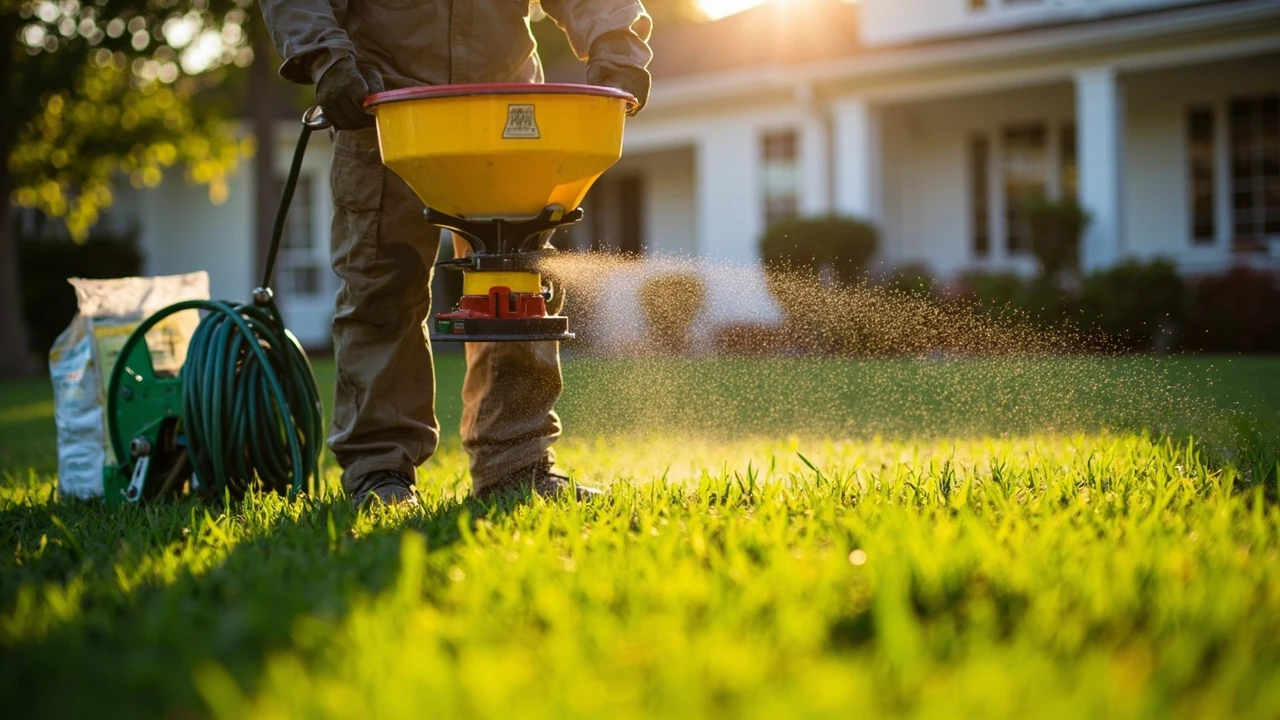
- Application. Granular fertilizer is spread with a calibrated broadcast or drop spreader, overlapping slightly to avoid stripes. Liquid treatments are sprayed with a hose-end or tank sprayer, often in fan patterns for even coverage.
- Edge and obstacle handling. Driveways, sidewalks, and beds are swept or blown clean to prevent product runoff into storm drains.
- Watering guidance. The technician leaves a brief note on when to water, when to mow, and how long to keep pets and children off the treated area.
- Documentation. A record of the products used, the rate applied, and the date is kept on file, which is useful if a pet or child ever has a reaction or if a warranty claim arises.
That last point matters more than it sounds. A reputable lawn fertilizer service keeps granular records by law in most states, because fertilizer and pesticide applications are regulated, and the applicator is usually licensed. Ask to see the technician’s license if it is not visible on the uniform or truck.
DIY vs. hiring a lawn fertilizer service
Doing it yourself is genuinely cheaper per application, but the savings come with tradeoffs. A professional brings calibrated equipment, products not always available to homeowners, and the timing knowledge that comes from treating hundreds of lawns a season. The table below compares the most common decision points.
| Factor | DIY fertilization | Professional lawn fertilizer service |
|---|---|---|
| Cost per application | Lower, often $40 to $90 in product for an average yard | Higher, typically $60 to $120 per visit or a seasonal package rate |
| Equipment needed | Spreader, sprayer, scale, sometimes a soil probe | Included in service |
| Product selection | Limited to consumer-grade bags at retail stores | Access to professional-grade fertilizers and adjuvants |
| Timing and rate accuracy | Depends on the homeowner’s research and equipment calibration | Calibrated by training and daily use |
| Liability and recordkeeping | Homeowner’s responsibility | Service provider is licensed, insured, and required to log applications |
| Time investment | Several hours per application, including shopping and cleanup | 15 to 30 minutes of the homeowner’s time per visit |
| Risk of lawn damage | Higher if rate or product is wrong, since there is no second set of eyes | Lower, but not zero; burn can still happen during heat waves |
For a small yard with a single grass type, light weed pressure, and an owner who enjoys lawn work, DIY is reasonable. For a larger yard, mixed turf, heavy clay or sandy soil, or a busy schedule, a service usually pays for itself in time and reduced mistakes.
What a lawn fertilizer service costs in 2026
National pricing varies widely by region, lawn size, and program depth, but the ranges below reflect what homeowners commonly report in 2026 for a full-season program with multiple visits.
| Service tier | Typical yard size | Visits per year | Approximate annual cost | What is usually included |
|---|---|---|---|---|
| Basic feeding only | Up to 5,000 sq ft | 3 to 4 | $250 to $450 | Fertilizer only, no weed control |
| Standard program | 5,000 to 10,000 sq ft | 5 to 6 | $450 to $800 | Fertilizer plus pre- and post-emergent weed control |
| Premium program | 10,000+ sq ft or problem lawns | 6 to 7 | $800 to $1,400 | Fertilizer, weed control, lime, grub prevention, and spot disease treatments |
| Add-on services | Any size | As needed | $40 to $150 each | Core aeration, overseeding, topdressing, or soil testing |
One-time applications are common too, usually priced between $60 and $120 per visit for a typical suburban lot. Seasonal contracts are often 10 to 20 percent cheaper per visit than one-off calls, and they lock in your place on the route. Always ask whether the quote is per application or per season, and whether aeration, seeding, or pest control is part of the same number or billed separately.
How often a lawn really needs to be fertilized
The number of fertilizer applications depends on grass type, soil quality, and how you use the lawn. A dense, well-irrigated turf in active growth can use more nutrients than a thin, shaded yard that struggles to begin with.
- Cool-season grasses (Kentucky bluegrass, tall fescue, perennial ryegrass): the heaviest feeding happens in fall, with a lighter spring application and sometimes a summer touch-up. Three to four feedings a year is typical.
- Warm-season grasses (Bermuda, zoysia, St. Augustine, centipede): the main growth window is late spring through early fall, so four to five applications timed to that period work well.
- Newly seeded or sodded lawns: starter fertilizer at installation, then a steady feeding schedule for the first full growing season to build root mass.
- Low-input or drought-tolerant lawns: one to two feedings a year is often enough, paired with a soil test to confirm what is actually missing.
More is not better. Over-fertilizing pushes leaf growth at the expense of roots, increases disease and thatch, and can wash into waterways. A trustworthy provider will recommend fewer applications if a soil test shows adequate phosphorus or potassium.
Reading a fertilizer label without getting lost
Every bag or bottle shows three numbers, the N-P-K ratio, which stands for nitrogen, phosphorus, and potassium. Those numbers tell you what the product actually delivers, and they matter more than the brand.
- Nitrogen (N) drives green color and leaf growth. It is the nutrient you apply most often.
- Phosphorus (P) supports root development and is most useful at establishment. Many states restrict phosphorus use on established lawns because runoff causes algae blooms in lakes and rivers.
- Potassium (K) improves drought tolerance, cold hardiness, and disease resistance. It is often the second number in fall blends.
A 32-0-10 fertilizer, for example, is high-nitrogen with some potassium and no phosphorus, a common summer blend. A 10-10-10 general-purpose product spreads more evenly across nutrients but is rarely the right choice for a lawn. Slow-release nitrogen, often labeled as WIN, polymer-coated, or sulfur-coated urea, feeds the lawn over weeks instead of days and reduces the risk of burn.
Why a soil test should come first
Fertilizing without testing is guesswork. A basic soil test, available through a state university extension office or a private lab for $15 to $40, returns pH, organic matter, and the actual levels of phosphorus, potassium, and several micronutrients. The result tells you what to add and, just as importantly, what to skip.
- pH between 6.0 and 7.0 is ideal for most turfgrasses. Outside that range, fertilizer is less effective because roots cannot absorb nutrients properly.
- Lime raises pH in acidic soils, and elemental sulfur or gypsum lowers it in alkaline soils. Both are slow to work, so they are applied separately from fertilizer.
- Phosphorus and potassium are reported in parts per million. If those numbers are already adequate, adding more is wasted money and a regulatory issue in many states.
Many lawn fertilizer service companies offer a soil test as part of an initial visit, or they will pull cores and send them to a partner lab. If a provider wants to start a multi-application program without ever testing, ask why. The honest answer is usually that they have a standard program, not a customized one.
How to pick a reliable lawn fertilizer service
Most metros have more providers than homeowners realize, which makes comparison shopping worthwhile. The list below is a practical screening order, from the most disqualifying issues to the niceties.
- Confirm licensing and insurance. Fertilizer and pesticide applicators are licensed at the state level. Ask for the license number and verify it with your state’s department of agriculture.
- Ask for a written program. A good service gives you a calendar of planned visits, the products used, and what to expect after each one.
- Check reviews carefully. Look for repeated complaints about missed visits, ignored callbacks, or burned lawns after hot weather. One bad review is noise; a pattern is signal.
- Compare soil-first approaches. Providers who start with a soil test and adjust the plan are more likely to skip unnecessary applications.
- Understand the contract terms. Annual programs usually auto-renew. Confirm the cancellation policy, the rescheduling window, and whether unused applications roll over.
- Ask about safety and pets. Granular fertilizer is generally safe once watered in, but liquid weed control often requires keeping pets off the lawn until it dries. Get that in writing.
For homeowners in regions with strict local rules, such as California, where sales of certain gas-powered yard equipment are being phased out, working with a provider also avoids investing in equipment you may not need in a few years. A directory such as Lawn Love’s Fairfield service page illustrates how modern lawn care providers bundle scheduling, insured crews, and online quotes into a single visit, which is a useful reference point when comparing local options.
Seasonal timing that actually matters
When fertilizer is applied is as important as what is applied. The same product in the wrong window can feed weeds instead of grass, or burn a lawn during a heat wave. The general calendar below is a starting point, not a rule.
| Season | Cool-season grass focus | Warm-season grass focus |
|---|---|---|
| Early spring | Light feeding with pre-emergent weed control | Pre-emergent weed control, light nitrogen to green up |
| Late spring | Skip if summer stress is expected, or apply slow-release | Heavier nitrogen to support active growth |
| Summer | Minimal feeding, focus on watering and mowing height | Continue nitrogen with iron for color without excessive growth |
| Early fall | Core aeration, overseeding, and the year’s most important feeding | Reduce nitrogen, apply potassium for winter hardiness |
| Late fall | Winterizer feeding, mostly nitrogen and potassium | Dormant feeding only in the warmest zones |
Within those windows, weather swings matter. A warm spell in February can justify an earlier spring visit, while a wet spring may push the first feeding back to avoid leaching nitrogen before roots can use it.
Common mistakes a good service helps you avoid
Even attentive homeowners make these errors. A professional lawn fertilizer service is partly valuable because it removes the temptation to fix one problem and accidentally create another.
- Applying nitrogen during summer heat. This causes burn and flushes growth that the lawn cannot sustain. Most programs pause or switch to iron-only products in July and August.
- Skipping a soil test for years. pH drifts over time, especially in acidic rainfall regions. Without testing, you keep adding fertilizer that the lawn cannot absorb.
- Mowing too short after an application. Cutting below the recommended height for the grass type removes the leaf surface the fertilizer is feeding.
- Watering at the wrong time of day. Granular fertilizer needs a soak within a day of application. Liquid treatments often need to dry before watering. Confusing the two wastes product.
- Bagging every clipping. Returning clippings recycles nitrogen and reduces total fertilizer need by up to a third over a season.
What to expect in the first three months of service
If you are hiring a lawn fertilizer service for the first time, the early season is when you find out whether you picked well. A realistic timeline helps you judge results without overreacting to slow starts.
- Week 1 to 2: existing grass greens up, weeds that were already present may still be visible because pre-emergent products stop new germination rather than killing mature weeds.
- Month 1: thin areas start to fill in if conditions are right, and weed pressure drops as pre-emergent activates.
- Month 2 to 3: turf density improves, color evens out, and the lawn should need less supplemental watering because deeper roots hold moisture longer.
Patience is part of the deal. Anyone promising a golf-course lawn in a single season is overselling. Real turf recovery from compaction, poor pH, or years of neglect usually takes two full growing seasons of consistent treatment.
Environmental and regulatory considerations
Lawn fertilizer, especially phosphorus and quick-release nitrogen, is a significant source of water pollution when it runs off hard surfaces into storm drains. Many states and municipalities have responded with rules that affect both homeowners and service providers.
- Phosphorus bans for established lawns are in place in most of the Northeast, the Great Lakes region, and large parts of the Mid-Atlantic.
- Setback rules prohibit fertilizer application within a certain distance of waterways, usually 10 to 25 feet, unless a deflector shield is used.
- Application blackouts before heavy rain are increasingly common, since storm runoff can carry nutrients directly to streams.
- Organic and slow-release requirements are appearing in some jurisdictions, particularly around the Chesapeake Bay watershed and parts of California.
A reputable provider knows the local rules, keeps application records, and adjusts visits around weather. Ask directly whether the company follows state-specific best management practices, which are usually published by the state’s department of agriculture or environmental agency.
How a lawn fertilizer service is regulated
Because fertilizer and pesticide applications affect more than the property being treated, most states regulate the people doing the work. The level of regulation depends on whether the visit includes pest or weed control products.
- Fertilizer-only applications often require a commercial applicator license but not a pesticide license.
- Combined fertilizer and weed control requires both, with separate categories for ornamental and turf treatment in many states.
- Recordkeeping is mandatory in most states and includes the date, location, product name, EPA registration number, and rate applied.
- Customer notification is required before pesticide applications in many states, with a posted sign or a door hanger listing the products used and re-entry intervals.
For a deeper background on how turfgrass management fits into agronomy and soil science, the English Wikipedia article on lawns covers the history, types, and environmental impact of managed turf at a useful overview level.
When a service is not the right answer
Sometimes the most useful advice is to wait or to skip a service entirely. A few situations call for restraint.
- Newly sodded or seeded lawn under three months old. Starter fertilizer should already be in place, and the lawn needs time to root before standard applications resume.
- Severe drought or water restrictions. Fertilizer without water burns the lawn. Pause the program until irrigation is reliable again.
- Recent soil test showing adequate nutrients. If phosphorus and potassium are already sufficient, additional applications waste money and may violate local rules.
- Lawn mostly shaded and thinning. No amount of fertilizer fixes a turf that lacks sunlight. The right move is to convert the area to shade-tolerant ground cover or mulch, not to feed a struggling lawn.
A simple checklist before you sign a contract
Use this short list to compare two or three providers side by side. It is meant to fit on a single page and to make pricing apples-to-apples.
- Number of visits per year and what each one includes
- Whether aeration, overseeding, and lime are part of the package or billed separately
- Total seasonal cost, including any setup or cancellation fees
- License number and proof of insurance on request
- Sample service report from a recent customer
- Policy for re-treatments if a visit is rained out or fails to control weeds
- Notification method for pet and child safety after each application
Two or three quotes that match on these points usually point to the right provider. Big price gaps without a clear reason, like a much smaller scope of work, often mean someone is cutting corners on product quality or visit frequency.
Frequently asked questions
How many times a year does a lawn fertilizer service need to come?
Most programs include 4 to 6 visits per year, with the exact number depending on grass type, soil condition, and the level of weed and pest pressure. Cool-season lawns often have a heavier fall schedule, while warm-season lawns concentrate applications in late spring and summer.
Is a professional lawn fertilizer service worth the cost?
For most homeowners with a yard larger than a few thousand square feet, yes. The savings on equipment, the accuracy of calibrated application, and the time saved typically outweigh the higher per-visit cost, especially when a soil test guides the program instead of a fixed package.
Can a lawn fertilizer service also handle weeds and grubs?
Most full-service providers do, because pre-emergent weed control, post-emergent spot treatments, and grub prevention are commonly bundled with fertilizer. Confirm that the technician carries both a fertilizer license and a pesticide license if you need weed or insect control included.
How soon can pets and kids use the lawn after a treatment?
Granular fertilizer is usually safe once it has been watered in and the lawn has dried, often within 24 hours. Liquid weed and pest control usually requires keeping pets and children off the grass until the spray dries, which can be a few hours, and sometimes longer if the label specifies a re-entry interval. Always follow the written instructions left by the technician.
Do I need to be home for each lawn fertilizer service visit?
Not usually. Most providers can access a gated yard with prior arrangement and leave a service report at the door. Some companies ask that pets be kept inside during the application window for safety.
What if it rains right after a fertilizer application?
Light rain within a day of a granular application is usually fine, since it helps move the product into the soil. Heavy rain soon after a liquid treatment can wash product off the leaf surface before it absorbs, and a re-application may be needed. Reputable providers reschedule when storms are forecast.
Can a lawn fertilizer service fix a lawn that is mostly weeds?
Partially. Fertilizer thickens the existing grass so it can outcompete weeds, and pre-emergent stops new weed seeds from germinating. A lawn that is more than half weeds usually needs renovation, including aeration, overseeding, and sometimes a full sod replacement, before a fertilizer program can do its job.
Is organic lawn fertilization a better choice?
Organic fertilizers feed the soil rather than the plant directly, which builds organic matter and supports microbial activity over time. They are slower, more expensive per unit of nitrogen, and rarely produce the quick green-up of synthetic blends. For homeowners prioritizing long-term soil health and lower runoff risk, organics are a reasonable option if expectations are adjusted.
How long does it take to see results from a lawn fertilizer service?
Visible color change usually appears within 7 to 14 days of the first application. Density and weed reduction take longer, often a full season, because the lawn needs time to grow into the space weeds previously occupied.
Can I cancel a seasonal lawn fertilizer service contract?
Most companies allow cancellation with 30 days’ written notice, though some require a minimum commitment through the end of the current season. Read the cancellation clause before signing, and ask whether unused applications are refunded or credited.
Leave a Reply