


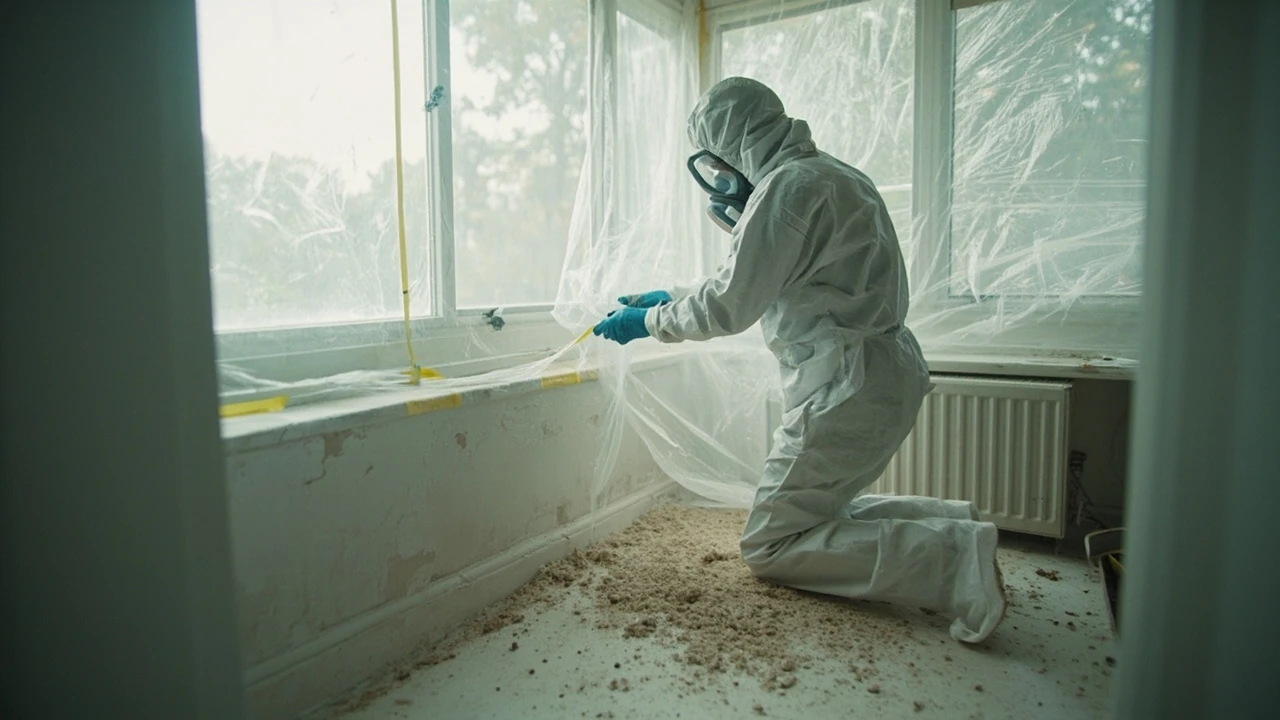
Asbestos removal: what homeowners actually need to know
A ceiling that flakes a little when you push a ladder against it. A patch of old vinyl flooring you want to replace. A pipe wrap in the basement that looks like it has not been touched since the house was built. Each of these is the kind of moment that sends a homeowner searching for information on asbestos removal, and each one deserves a measured answer rather than a panicked one.
Asbestos is not a single material. It is a family of six naturally occurring silicate minerals that were widely used in building products from the early 1920s through the late 1970s because they are heat resistant, strong in tension, and cheap. The same properties that made them useful also make them dangerous. When asbestos-containing materials are disturbed, they can release microscopic fibers that stay airborne long enough to be inhaled and lodged deep in lung tissue. The diseases linked to that exposure, including mesothelioma, asbestosis, and lung cancer, often take decades to appear.
That long delay is one reason the topic feels confusing. The hazard is invisible, the timeline is long, and the rules around asbestos removal are stricter than they are for almost any other residential job. This guide walks through what asbestos is, where it tends to hide in houses, how testing actually works, what a professional abatement looks like, and how to choose a contractor who will not cut corners.
Where asbestos hides in a typical home
Asbestos was used in hundreds of products. In residential construction, the most common locations are predictable because they line up with the materials that needed heat resistance, insulation, or reinforcement. The table below shows the materials most likely to contain asbestos in a house built before the 1980s, what they typically looked like, and how risky they are when left alone.
| Material | Typical location | Likely appearance | Risk when undisturbed |
|---|---|---|---|
| Spray-on insulation | Attics, between walls, around steel beams | Cementious, fluffy, or popcorn-like coating | Higher, fibers can shed if the surface is aged |
| Textured ceiling paint and “popcorn” ceilings | Ceilings, especially in homes from 1950 to 1980 | Bumpy white or off-white surface | Lower unless scraped or sanded |
| Floor tiles and sheet vinyl backing | Kitchens, bathrooms, basements, hallways | 9×9 inch tiles or 9-inch pattern sheets with dark adhesive | Lower, but sanding or breaking the tile raises risk |
| Boiler and pipe insulation | Basements, utility rooms, behind radiators | White or gray carded wrap around pipes and tanks | Higher if the wrap is crumbling |
| Vermiculite attic insulation | Attic floor, between joists | Light, pebble-like gray or brown granules | Variable, depending on contamination source |
| Roofing shingles and felt | Roof surface and underlayment | Asphalt-based shingles, often dark | Lower unless cut, drilled, or broken |
| Wall and ceiling plaster | Interior walls, especially in older homes | Hard, often gray or tan finish with fine texture | Lower unless sanded or removed |
| Cement siding (transite) | Exterior walls, garage walls, soffits | Flat or corrugated gray cement panels | Lower, but drilling or cutting releases fibers |
Undisturbed asbestos-containing material is generally a much smaller risk than the same material being cut, sanded, scraped, drilled, or broken. The job of asbestos removal is mostly about controlling that moment of disturbance so fibers do not end up in the air you breathe.
When a homeowner should worry, and when to leave it alone
Not every home built before 1980 needs abatement. The decision to test, contain, or remove depends on the condition of the material, the planned renovation, and who will be exposed. The table below is a simple way to think through the choice before you call a contractor.
| Situation | Recommended next step | Why |
|---|---|---|
| Material is in good condition, no planned work | Leave it in place, monitor over time | Encapsulation or management may be safer than removal |
| Material shows minor damage, no planned work | Have a pro assess and possibly encapsulate or repair | Localized fixes can seal the surface without full removal |
| Material is significantly damaged, friable, or shedding | Plan professional asbestos removal | Damaged material can release fibers during everyday activity |
| Planned renovation will disturb the material | Test first, then plan removal before work starts | Cutting, sanding, or demolition creates peak exposure |
| Material is outdoors in good condition (siding, shingles) | Leave in place unless a project requires disturbance | Outdoor release is usually less concentrated than indoor |
A useful rule of thumb is that any material that is crumbling, powdery, or easily broken by hand is “friable” and carries the highest risk. Solid materials such as intact floor tiles or cement siding are generally less risky when left alone, but become a real problem as soon as a saw or sander touches them.
How asbestos testing actually works
Testing is the gate between suspicion and action. A homeowner cannot reliably identify asbestos by looking at a material, because many asbestos products look identical to modern substitutes. The standard residential process looks like this:
- Decide which materials to sample. Focus on items that are damaged, friable, or about to be disturbed. Avoid sampling large intact areas and avoid any material that is already actively shedding.
- Hire an accredited inspector. In the United States, inspectors are usually state-licensed and follow protocols set by agencies such as the EPA and state health departments. They will not do the removal; they only collect samples and write a report.
- Keep the area calm during sampling. A small piece of material is wetted, cut, and sealed in a container. Good inspectors wet the area first, use minimal force, and seal the spot afterward.
- Use a qualified laboratory. The samples are analyzed by polarized light microscopy, and the lab reports the percentage and type of any asbestos present.
- Get a written report. The report should list each sampled material, the location, the analytical result, and a recommendation for management, encapsulation, or removal.
If you are planning a renovation, ask the inspector to sample every material that will be disturbed. It is common for one material to come back clean while a neighboring material in the same room contains asbestos, and the project plan has to account for both.
What a professional asbestos removal project looks like
Once testing confirms that a material contains asbestos and the decision is made to remove it, the work is normally done by a licensed abatement contractor. The job is more controlled than a typical remodel. A typical residential abatement follows a sequence like the one below, though the exact steps depend on state rules and the size of the job.
- Pre-job planning. The contractor pulls any required permits, posts notices, and coordinates with the local health or building department. A written work plan covers containment, negative pressure, and waste handling.
- Setup and isolation. The work area is sealed off with heavy plastic sheeting. Doors, vents, and returns are covered. A negative-pressure machine with a HEPA filter pulls air out of the containment and filters it before exhausting it.
- Worker protection. Crews wear disposable coveralls, sealed gloves, and properly fitted respirators. They decontaminate before leaving the containment and shower before re-entering the home.
- Wetting and removal. The material is wetted with a surfactant to keep fibers from becoming airborne, then carefully removed in sections. Wet cleanup and HEPA vacuuming happen continuously during the job.
- Bagging and waste handling. Wet debris is sealed in labeled 6-mil bags or wrapped in plastic, then moved out through a dedicated decontamination corridor. Waste is transported to a disposal facility licensed to handle asbestos.
- Final cleaning. The containment is wet-cleaned, HEPA-vacuumed, and sometimes wet-wiped a second time. A third-party clearance inspector then performs visual inspection and air sampling.
- Clearance and reconstruction. The clearance report has to come back below the action level set by regulation before the containment is taken down and the area is closed back up.
For a single small project, such as a piece of pipe wrap, the setup is shorter. For a full attic of vermiculite insulation, the crew may need several days plus clearance time before the space is usable again.
Cost ranges homeowners should plan for
Costs vary widely by region, by material, and by how much of the home has to be sealed off. A small, well-contained job in one room is dramatically cheaper than a whole-house project. The numbers below are realistic ranges across many U.S. markets, not a quote, and they exclude unrelated repair work such as drywall replacement.
| Job type | Typical scope | Indicative range | Notes |
|---|---|---|---|
| Single pipe or small boiler wrap | One accessible location, minor containment | Several hundred to about $1,500 | Often done as a half-day job |
| 9×9 floor tile and mastic in one room | Up to about 200 square feet, full containment | Often $1,500 to $4,000 | Adhesive removal adds time and cost |
| Popcorn or textured ceiling in one room | Up to about 300 square feet | Often $2,000 to $5,000 | Wetting the surface adds setup time |
| Whole attic vermiculite insulation | Whole-house insulation removal | Often $8,000 to $25,000+ | Size and access drive most of the cost |
| Whole-home or large multi-area project | Multiple materials and rooms | Often $20,000 and up | Reconstruction is usually quoted separately |
Three items often surprise homeowners. First, the price of testing is usually separate from the price of removal. For additional context, Second, reconstruction, including new drywall, paint, flooring, or insulation, is a separate contract with a different trade. Third, the final clearance inspection is usually a third-party cost, not a fee paid to the abatement contractor.
How to choose an asbestos removal contractor
The most important part of asbestos removal is the contractor doing the work. A good crew keeps the dust contained. A bad crew can spread fibers through the rest of the house and into neighboring units. The checklist below separates the questions worth asking from the answers that matter.
- State license and accreditation. Ask for the license number, verify it with your state department of health or environment, and confirm the license covers the material you need removed. Many states require a separate license for asbestos work.
- Specific training, not just experience. Crew leads should hold current training certificates for the type of work being done, including supervisor-level training. Ask to see the certificates, not just a company policy statement.
- Insurance that names asbestos work. General liability is not enough. Ask for a certificate of insurance that specifically includes asbestos abatement coverage and lists the policy limits.
- References for similar projects. A contractor who has done a lot of pipe wrap may not be the right fit for an attic insulation job. Ask for two or three references from the past year on similar materials and square footage.
- Written scope and a third-party clearance plan. A serious bid explains containment, negative pressure, decontamination, waste disposal, and who will perform the final clearance inspection. Vague scope is a red flag.
- Detailed price breakdown. Look for line items for setup, removal, decontamination, waste hauling, clearance, and any reconstruction. A single lump sum without a breakdown makes it hard to compare bids.
- Documentation of waste disposal. After the job, the contractor should provide a waste manifest or disposal receipt showing where the asbestos debris was taken. This is a legal document and should be kept with the project file.
Two or three written bids are a reasonable baseline for any project beyond a small pipe wrap. The cheapest bid is not always wrong, but a price that is dramatically lower than the others usually means something is being skipped.
What homeowners should never do during asbestos removal
Some of the worst exposure events happen when someone tries to save money by skipping the professional step. The list below is not theoretical; it reflects the patterns that show up in health department investigations.
- Do not sand, scrape, drill, or saw suspected material. A power sander on a popcorn ceiling can release large amounts of fiber in minutes.
- Do not use a regular household vacuum. Even a vacuum with a HEPA filter, unless it is rated for asbestos, can leak fibers through the exhaust and contaminate the surrounding rooms.
- Do not sweep or dry-broom the area. Dry sweeping re-suspends fibers that have already settled.
- Do not throw the material into regular trash. Asbestos debris has to be bagged, labeled, and disposed of at a facility licensed to receive it.
- Do not allow children, pets, or untrained family members in the containment area while the job is in progress or before clearance is complete.
- Do not reuse clothing, drop cloths, or tools that were inside containment. They should be treated as contaminated waste or decontaminated by the crew.
One other mistake to avoid: starting a demolition before the test results are back. It is common for a homeowner to tear out a bathroom in anticipation of a remodel and only then discover the drywall joint compound contained asbestos. By that point, the contamination has already spread.
Health risks in plain language
Asbestos-related disease is a dose-and-duration problem, but the dose needed to cause disease is lower than most people expect. The body cannot break down the fibers once they are lodged in lung tissue, and the immune response to those fibers is what drives disease over decades. Three conditions account for most of the serious outcomes:
- Mesothelioma. A cancer of the lining around the lungs and abdomen. It is strongly associated with asbestos exposure, has a long latency period, and remains difficult to treat.
- Asbestosis. A scarring of lung tissue that causes shortness of breath and reduced lung function. It is not cancer, but it is progressive and can be disabling.
- Lung cancer. Asbestos exposure multiplies the risk of lung cancer, especially in combination with smoking. The combination is worse than either risk alone.
This is why asbestos removal is treated as a regulated job rather than a home improvement. The risk is not dramatic in the moment, but it is severe over time, and it is unevenly distributed. The worker who sands without protection, the family member who sleeps above disturbed insulation, and the child who plays in a contaminated basement are all taking on a future health burden that is invisible at the time of exposure.
Regulatory context in the United States
Asbestos is regulated at both the federal and state level. The federal rules, mainly through the EPA and OSHA, set a floor, and most states add their own licensing, notification, and disposal rules on top of that. A few points are worth understanding before the project starts:
- Federal bans are narrow. The federal bans target specific product categories rather than all asbestos use. Many older materials still in place are legal to leave undisturbed but regulated when disturbed.
- State rules are usually stricter. Many states require licensed contractors, advance notice to the health department, on-site inspections, and specific disposal paperwork for any job above a small threshold.
- Renovations trigger rules. The EPA’s Renovation, Repair, and Painting rule covers work in pre-1978 housing and includes specific training and work-practice requirements for firms that may disturb asbestos.
- Disposal is trackable. Waste manifests create a paper trail from the job site to the landfill. Homeowners and contractors should both keep a copy for the project file.
If a contractor tells you that the rules are a hassle and that they will handle it informally, treat that as a serious warning sign. The paperwork exists for a reason, and a contractor who skips it is also likely skipping the containment.
Planning a renovation that involves asbestos
If a renovation will disturb suspected material, the cleanest path is to test first, remove second, and renovate third. The order matters because each step affects the next. The list below is a reasonable planning sequence for a homeowner.
- Get the plans in writing. Before any demo, finalize the scope of the renovation with your builder or contractor. Identify every surface that will be cut, drilled, or removed.
- Have an accredited inspector sample each surface on that list. The cost of sampling is small compared to the cost of the project, and it removes guesswork.
- Decide on a path for any positive results. For each positive material, choose between full removal, encapsulation, or a redesign of the project to avoid the material. The third option is often the cheapest.
- Schedule the abatement in advance. For larger projects, good contractors are booked weeks out, and a schedule conflict can push the renovation timeline.
- Plan for clearance and reconstruction time. The space will not be ready for the renovation crew until clearance is complete. Build a buffer into the schedule.
- Keep documentation for the next owner. The test report, abatement report, and disposal manifest are valuable records. Many buyers ask for them, and they make the home easier to sell later.
Insurance, liability, and disclosure
Homeowner’s insurance typically does not cover asbestos removal triggered by planned renovation, and it may not cover abatement driven by sudden damage either. The coverage depends on the policy language and the cause of the disturbance. A few practical points are worth checking before the project starts:
- Review the policy for pollution exclusions. Many policies exclude coverage for pollutants, and some courts have treated asbestos as a pollutant even inside a home.
- Ask the abatement contractor about their coverage. Their insurance protects you if their crew contaminates the rest of the house. If they are not insured for that, the risk falls back on you.
- Document the condition of the home before the job. Photos of adjacent rooms, HVAC returns, and the exterior near the work area are useful if a contamination claim arises later.
- When selling, disclose known information. Most states require sellers to disclose known material defects. A prior abatement with documentation is generally a positive, while a known but unaddressed issue is a liability.
Frequently asked questions
Do I need to remove asbestos if it is in good condition?
Not always. Undisturbed asbestos-containing material that is intact and in good condition is usually safer left in place than removed, because removal is the most common source of fiber release. The decision should be based on a professional assessment, the material’s condition, and any planned renovation that would disturb it.
How can I tell if a material contains asbestos without testing it?
You usually cannot. Many asbestos products look identical to modern substitutes, and visual inspection by a homeowner is not reliable. The standard approach is to hire an accredited inspector to collect samples and send them to a qualified lab for analysis.
Is asbestos removal a DIY project?
For most residential situations, no. State and federal rules restrict who can legally remove asbestos, and even small jobs create risk if containment, protective equipment, and disposal are not handled correctly. There are very narrow cases where homeowners can legally do their own work, but those are exceptions rather than the rule.
How long does a typical residential asbestos removal project take?
It depends on size and complexity. A small pipe wrap may take half a day for the removal plus a day or two for clearance. A whole attic of vermiculite insulation can take several days of work plus additional time for the clearance inspection before the space is usable again.
Can I stay in the house while the asbestos removal is happening?
Usually yes, but with restrictions. The work area has to be sealed off, and the HVAC system has to be shut down or isolated to keep the containment under negative pressure. Family members, especially children, pregnant people, and anyone with respiratory illness, should stay clear of the work area until clearance is complete.
What is the difference between encapsulation and asbestos removal?
Encapsulation seals the material in place with a coating or wraps it so fibers cannot be released, while removal physically takes the material out of the building. Encapsulation is often cheaper and faster, but it is only appropriate when the material is in good condition and is not going to be disturbed by future work.
How much does asbestos removal cost for a single room?
Costs vary by region and material, but a single-room job such as a bathroom floor or a popcorn ceiling often falls in the range of $1,500 to $5,000, excluding reconstruction. Whole-home projects, especially for vermiculite attic insulation, can run much higher.
What documents should I keep after the job is done?
Keep the original inspection report, the abatement contractor’s scope and contract, the clearance report from the third-party inspector, and the waste disposal manifest. These records are useful for future renovations, insurance questions, and any future sale of the home.
Do I need to test for asbestos before selling an older home?
Testing is not legally required in most states before a sale, but disclosure laws usually require sellers to share known information about asbestos. A prior inspection report, whether positive or negative, can be a useful disclosure document and can simplify negotiations.
What should I do if I already disturbed material that might have contained asbestos?
Stop the work, leave the area, and do not sweep or vacuum dry. Close interior doors and shut down the HVAC if possible. Then call a licensed asbestos professional for guidance. They will often recommend a cleanup and air test rather than full removal, but the right answer depends on what was disturbed and how much material was involved.
Leave a Reply