


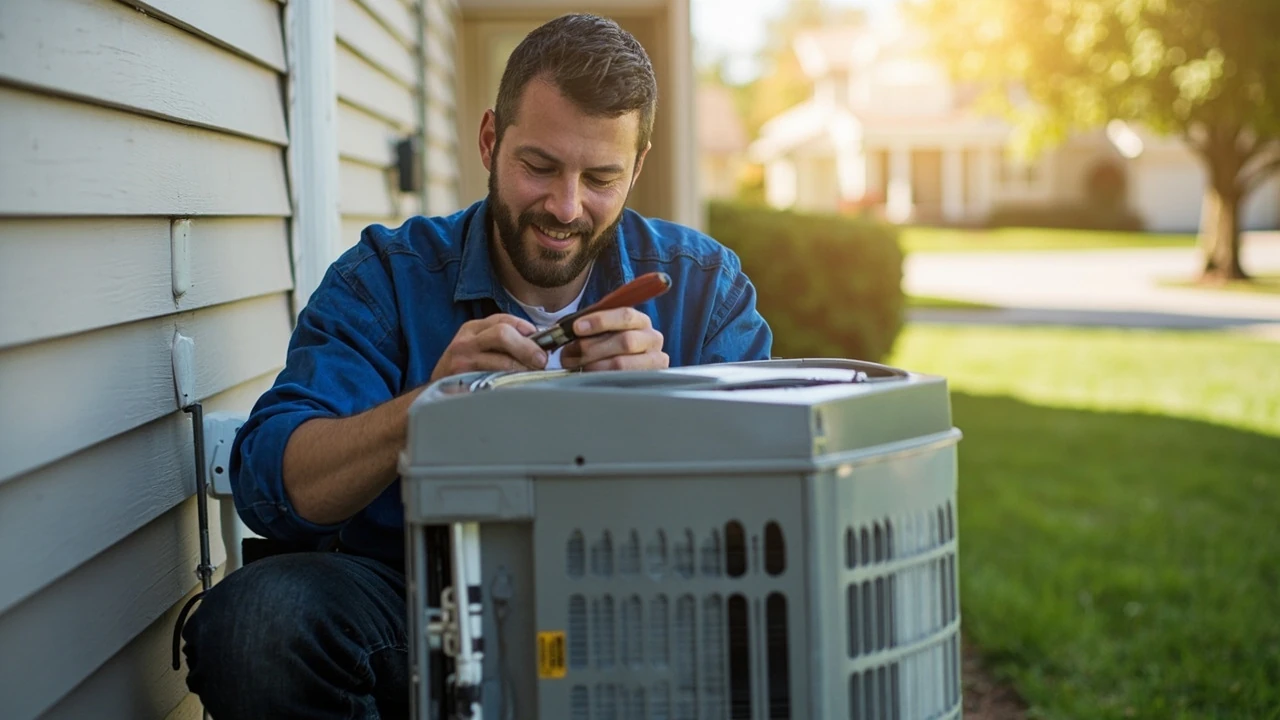
HVAC maintenance services: what a real visit should include
A homeowner calls for a tune-up in July because the upstairs bedroom will not cool below 80 degrees. The unit still runs, the filter was replaced last month, and the thermostat is set to 72. The technician arrives, opens the outdoor unit, and finds a condenser coil packed with cottonwood seeds, a blower wheel caked with dust, and a refrigerant pressure that is six pounds low. None of that would have shown up on a basic visual check, and none of it would have been fixed by replacing a filter. This is the gap that professional HVAC maintenance services are meant to close, and it is the gap most homeowners are trying to understand when they search for the term.
HVAC maintenance services are scheduled inspections, cleanings, adjustments, and tests performed on a heating, ventilation, and air conditioning system. They are not repairs in the emergency sense, and they are not a warranty. They are a recurring check that the equipment is running close to the way the manufacturer designed it to run. The benefit is fewer breakdowns, lower energy use, longer equipment life, and documentation that the system was cared for if a warranty claim ever comes up.
This guide walks through what a real maintenance visit should include, how often different systems need service, what the work typically costs, and how a homeowner can tell whether the technician actually did the job. It is written for owners of central air conditioners, gas furnaces, heat pumps, and ductless mini-splits in typical North American homes, not for commercial building engineers.
What counts as HVAC maintenance services
The phrase gets used loosely. Some companies use it to mean “we came out and looked at it.” Others use it to mean a structured, multi-step service with measurements, written results, and follow-up recommendations. The structured version is what a homeowner should be paying for, and it is also what most manufacturer warranties quietly assume is happening when they require “proof of maintenance” for coverage of a failed compressor or heat exchanger.
A genuine HVAC maintenance visit bundles four kinds of work:
- Inspection. Visual and instrument checks of components, wiring, safety controls, and the air distribution system.
- Cleaning. Removal of dust, debris, and biological growth from parts where buildup actually hurts performance, not just the parts that are easy to reach.
- Adjustment. Calibration of controls, tightening of electrical connections, lubrication of motors, and balancing of airflow where it is practical to do so.
- Testing. Measurement of refrigerant charge, temperature split, static pressure, combustion quality, and other values that show whether the system is doing its job.
Anything that crosses into replacing a failed part, repairing a leak, or rewiring a control is no longer maintenance. It is a repair, and it should be billed and documented as one. A trustworthy company will separate the two on the invoice, so a $129 tune-up does not quietly turn into a $900 repair with no conversation in between.
The realistic benefits and limits of routine service
Marketing for HVAC maintenance services often makes sweeping claims. Some of those claims are well supported, some are partial, and a few are simply wrong. A clear-eyed look at the evidence helps a homeowner set realistic expectations.
What maintenance actually improves
A clean condenser coil, a clean evaporator coil, a clean blower wheel, and the correct refrigerant charge have a measurable effect on cooling capacity and efficiency. The same is true on the heating side: a clean burner, a clean heat exchanger, and the correct gas pressure matter. When these things are off, the system has to run longer to do the same work, which raises the energy bill and shortens the life of the compressor, the blower motor, and the heat exchanger.
Well-maintained equipment also tends to fail in slow, predictable ways rather than fast, dramatic ones. A technician who checks the capacitor during a spring visit can see that it is swelling and replace it for $40 instead of letting it fail on the hottest day of the year, when the homeowner is paying emergency rates and the house is 90 degrees.
What maintenance does not do
Routine service does not make a 20-year-old furnace brand new. It does not turn a poorly sized system into a properly sized one. It does not compensate for leaky ductwork buried in a ceiling. It does not prevent every failure, especially electrical failures that happen between visits. A good technician will be honest about which of these problems fall inside the scope of a tune-up and which require a separate project.
| Claim about HVAC maintenance services | How well the evidence supports it | Honest framing for a homeowner |
|---|---|---|
| Lowers monthly energy bills | Supported when the system was dirty or out of adjustment before the visit | Expect a modest improvement, not a 50 percent cut in cost |
| Prevents most breakdowns | Partially supported, mostly through early detection | Reduces risk; does not eliminate the possibility of a failure |
| Extends equipment life | Supported for systems that would otherwise be neglected | A well-maintained 15-year furnace may reach 20; a neglected one often does not reach 15 |
| Keeps the warranty valid | Supported for most manufacturer warranties that require proof of service | Keep the invoices; a missing year can void a compressor claim |
| Improves indoor air quality | Partially supported, mostly through filter and coil cleaning | Maintenance helps, but it is not a substitute for source control or duct cleaning |
| Catches every safety issue | Partially supported, mostly for gas leaks and electrical hazards | Annual checks reduce risk; carbon monoxide detectors are still essential |
What a thorough HVAC maintenance visit should include
The exact list varies by equipment type, climate, and home, but a competent residential HVAC maintenance visit covers the same general ground. The detail below is what a homeowner should reasonably expect for a central split system with a gas furnace and an outdoor air conditioner. Heat pumps and mini-splits follow a similar structure with a few substitutions.
Indoor unit and air handler work
The technician should start inside, at the air handler or furnace. A real visit includes:
- Visual inspection of the heat exchanger for cracks, rust, or visible holes on gas systems. A mirror and flashlight are basic; a borescope is better.
- Inspection of the burner assembly, ignition system, and flame sensor. Cleaning the flame sensor is one of the highest-yield tasks in the whole visit.
- Measurement of the temperature rise across the heat exchanger on a gas furnace, compared against the nameplate range.
- Cleaning or replacing the air filter if the homeowner has not done it.
- Inspection and cleaning of the blower wheel and blower motor. A heavily dusted blower wheel is one of the most common reasons for low airflow.
- Tightening of electrical connections at the contactor, capacitor, and control board. Loose lugs cause voltage drop, which causes heat, which causes failures.
- Testing of the thermostat, including the heat anticipator setting on older systems or the calibration check on modern ones.
- Confirmation that the condensate drain is clear and that the float switch or safety shutoff works.
Outdoor unit work
Then the technician moves outside for the air conditioner or heat pump. The visit should include:
- Visual inspection of the cabinet, mounting pad, and refrigerant lines for damage or vibration.
- Cleaning of the condenser coil, either by brushing, rinsing with a garden hose at low pressure, or applying a foaming coil cleaner for heavily soiled coils. High-pressure washing is generally not recommended because it bends fins.
- Straightening of bent condenser fins with a fin comb where the damage is significant.
- Inspection of the contactor and capacitor. A bulging capacitor top is a sign the part is failing.
- Measurement of refrigerant pressure and, more importantly, superheat and subcooling on heat pump or cooling mode. Pressure alone does not tell the full story.
- Verification that the disconnect box is intact and that the whip is in good condition.
- Clearing of leaves, grass clippings, and other debris from around the unit, and a check that no plants or structures are blocking airflow within the manufacturer’s clearances.
Documentation at the end
The visit should end with a written or digital report. The technician should be able to explain, in plain language, what they found, what they adjusted, and what they recommend. If the report lists the same checklist for every home with no measured numbers attached, the work is probably being done on autopilot.
| Maintenance step | Why it matters | What a homeowner can do to help |
|---|---|---|
| Clean condenser coil | A dirty coil raises head pressure and reduces capacity | Keep shrubs, leaves, and lawn debris away from the unit |
| Clean evaporator coil or blower wheel | Reduces airflow restriction and indoor dust | Change the filter on the schedule that fits the home |
| Check refrigerant charge | Undercharge or overcharge harms efficiency and the compressor | Ask for the superheat and subcooling numbers, not just the pressure |
| Inspect heat exchanger | Cracks can leak carbon monoxide into the home | Keep combustible-air intakes clear and CO detectors working |
| Loose connections cause voltage drop and component failure | ||
| Clear condensate drain | A blocked drain can shut the system off or damage ceilings | Pour a small amount of diluted vinegar through the line quarterly |
| Test safety controls | Confirms the system will shut down when it should | Replace batteries in the thermostat and CO detectors yearly |
How often to schedule HVAC maintenance services
Most manufacturers and most HVAC companies recommend two visits per year, one in spring for cooling and one in fall for heating. The reasoning is simple: the system is being asked to do different work in each season, and the components that fail in one mode are not the same as the components that fail in the other. A spring visit catches a low refrigerant charge before the first heat wave. A fall visit catches a cracked heat exchanger before the first cold snap.
For homeowners in mild climates with a single combined system, a single annual visit is sometimes offered as a budget option. It is better than skipping service entirely, but it does miss the seasonal handoff, which is when a lot of problems become visible.
Some situations call for more frequent service, not less:
- Homes with multiple pets, smokers, or recent renovation work, where the filter and coils load up faster.
- Homes near construction, cottonwood trees, or agricultural fields, where the outdoor coil collects debris quickly.
- Heat pumps in regions with extreme winter weather, where defrost cycles put extra wear on the outdoor unit.
- Older equipment that has already had one major repair and is being kept running until a planned replacement.
Newer equipment under manufacturer warranty may have a specific maintenance schedule in the owner’s manual. Following that schedule matters more than following the company’s general recommendation, because a missed step can be a reason to deny a warranty claim later.
What HVAC maintenance services cost and what drives the price
Pricing varies widely by region, but the general shape is consistent. A single visit for one system typically falls in the $90 to $250 range. A maintenance plan that includes two visits, priority scheduling, and a discount on repairs usually costs $200 to $500 per year, sometimes billed monthly.
Several factors move the price up or down:
- System type and count. A heat pump with a gas furnace backup, plus a separate indoor air quality unit, is more work than a single split system.
- Region. Urban markets with high labor costs and high demand run higher than rural ones.
- Plan features. Plans that bundle repairs, parts warranties, and after-hours coverage are more expensive than bare-bones tune-ups.
- Technician time. A real two-hour visit with measurements and a written report costs more than a 30-minute walkthrough, and it is usually worth it.
Some companies offer free or deeply discounted “first visit” tune-ups. The work itself is fine for a basic check, but the upsell at the end can be aggressive. Reading the service agreement carefully, especially the auto-renewal and cancellation terms, prevents surprises.
| Pricing model | Typical range | What is usually included | Watch for |
|---|---|---|---|
| One-time single visit | $90 to $250 | Inspection, cleaning, basic adjustments | Limited time on site; “additional repairs” priced separately |
| Annual maintenance plan, single system | $150 to $300 | One visit per year, filter reminders, priority scheduling | Does not include repairs; read the cancellation policy |
| Annual maintenance plan, two visits | $200 to $500 | Spring and fall visits, discount on repairs, often a small parts warranty | Auto-renewal clauses, exclusions on older equipment |
| Premium membership | $500 and up | Multiple visits, no service fees, included diagnostics, repair credits | Higher monthly cost; some plans exclude major components |
How to judge whether a tune-up was done well
The technician has been in the house for 45 minutes and is heading for the door. How does a homeowner know the work was real? Three signals help separate a careful service call from a check-the-box visit.
The numbers were taken and shared
Refrigerant pressure, superheat or subcooling, temperature split across the coil, and temperature rise across the heat exchanger should all be measured. If the technician is willing to share those numbers and explain what they mean, the visit was probably thorough. If the report only has checkmarks and no measurements, the visit was probably light.
Specific recommendations were made
A real visit produces observations tied to the home: the return duct is undersized, the condensate line runs uphill, the filter rack has a gap that lets air bypass the filter. Generic recommendations like “consider upgrading your system” without a reason are a sign the technician is filling space, not reporting what they found.
The work was documented for the warranty
The invoice should list the equipment make, model, and serial number, the date of service, the technician’s name, and the tasks performed. That documentation is what the manufacturer asks for if a compressor fails in year seven of a ten-year warranty.
For an example of how a regional provider describes a complete residential visit, a family-run Woodbridge HVAC company outlines what their standard appointment covers, from visual checks and dust removal on key components to tests of safety controls and blower pressure. The structure of their visit is similar to what most reputable companies should be doing on a routine call.
Common mistakes homeowners make with HVAC maintenance
Some mistakes are harmless. A few quietly cost money, and one or two can shorten the life of the equipment.
- Skipping the filter between visits. A clogged filter is the most common reason for a high static pressure reading and a frozen coil. A technician cannot undo a month of restricted airflow in a single visit.
- Closing too many supply vents. Closing vents in unused rooms raises static pressure and can make the system noisy and inefficient.
- Setting the thermostat to extreme temperatures. A thermostat set to 60 in summer does not cool the house faster. It makes the system run longer and work harder.
- Postponing recommended repairs. A loose blower belt or a slow refrigerant leak that the technician flagged will usually get more expensive, not less, with time.
- Ignoring strange sounds or smells. A grinding blower, a sulfur smell from the furnace, or a sweet smell from the air handler are signals to call, not to wait for the next scheduled visit.
How HVAC maintenance services fit into a broader home care plan
The heating and cooling system is one of several building systems that need recurring attention. A few related topics come up often when a homeowner is thinking about whole-home maintenance.
Boiler service, for example, follows a similar logic of annual inspection and tune-up but with combustion and water-side checks that do not apply to forced-air systems. The practical boiler service guide for homeowners covers the overlap and the differences.
Battery health is another small but recurring item. The same idea of catching a weak component before it strands the homeowner shows up in this diagnostic guide to the signs of a bad battery, which is a useful reminder that preventive checks do not have to be expensive to be useful.
What to look for when choosing a provider
Choosing a company for HVAC maintenance services is partly about price and partly about trust. A few questions, asked up front, save a lot of guessing later.
- Will the same technician or a small team handle the home each year, so they learn the equipment?
- Is the company licensed and insured in the state or province where the home is located?
- Does the company service the make and model of the equipment, or do they subcontract unfamiliar brands?
- What is included in a maintenance visit, in writing?
- How are repair recommendations presented, and is the homeowner given the option to decline?
A company that answers these questions clearly and without defensiveness is more likely to do a careful job on the equipment.
A practical checklist for the next visit
Before the next scheduled HVAC maintenance services appointment, a homeowner can do a few small things to make the visit more productive.
- Note any rooms that are hotter or colder than the rest of the house, and any unusual sounds or smells from the system.
- Replace the filter if it is due, and write the date on the filter with a marker.
- Clear a two-foot space around the outdoor unit so the technician can work without delay.
- Make sure the thermostat is accessible and that any pets are secured.
- Have the model and serial numbers of the indoor and outdoor units ready, usually on a label on the side of each cabinet.
These small steps do not change the price of the visit, but they help the technician spend more time on the equipment and less time on logistics.
Frequently asked questions
How long does a typical HVAC maintenance appointment take?
Most residential visits run between one and two hours per system. A combined visit for a furnace and an air conditioner on the same trip usually takes 90 minutes to three hours, depending on how much cleaning is needed and how accessible the equipment is.
Do heat pumps need different maintenance than air conditioners?
Yes, in a few areas. Heat pumps run year-round, which means the outdoor unit accumulates debris faster and the reversing valve, defrost controls, and auxiliary heat strips need to be checked. The indoor coil and blower maintenance is similar.
Are maintenance plans worth the money?
For most homeowners, a plan that includes two visits, priority scheduling, and a repair discount pays for itself the first time the system fails on a weekend or holiday. For owners of newer equipment under a parts warranty, the value is the documented service history.
Can HVAC maintenance services lower my energy bill?
Often, yes, especially if the coils, blower, or refrigerant charge were off before the visit. The savings depend on how much the system was underperforming, and they tend to be modest, not dramatic.
What should I do between maintenance visits?
Change or check the filter monthly during heavy use seasons, keep the area around the outdoor unit clear, watch for new sounds or smells, and keep at least one working carbon monoxide detector on each floor of the home.
Will maintenance void my warranty if I skip a year?
It can. Many manufacturer warranties require proof of annual professional service, and a missing year is sometimes used as a reason to deny a claim. Keeping the invoices and service reports protects the warranty.
Is it normal for a technician to recommend repairs during a maintenance visit?
Yes, and it is a sign the visit was thorough. A maintenance appointment is not a guarantee that nothing else is needed. The technician should explain the finding, the urgency, and the cost, and let the homeowner decide.
Can I do any of the maintenance myself?
Homeowners can safely change filters, clear debris from around the outdoor unit, and pour a small amount of diluted vinegar into the condensate drain. Anything involving refrigerant, the heat exchanger, gas pressure, or electrical components should stay with a licensed technician.
How do I know if my system is too old to be worth maintaining?
A general rule of thumb is that maintenance makes sense when the system is under about 10 to 15 years old, depending on the type, and the repair cost is small relative to the replacement cost. Once a major component like a compressor or heat exchanger fails twice, replacement usually starts to make more sense.
Should I get a second opinion if a technician recommends a big repair?
Yes, especially if the recommendation comes during a maintenance visit rather than an emergency. A second licensed opinion, ideally from a company that does not sell the same brand, is a reasonable check on a four-figure repair estimate.
Leave a Reply