


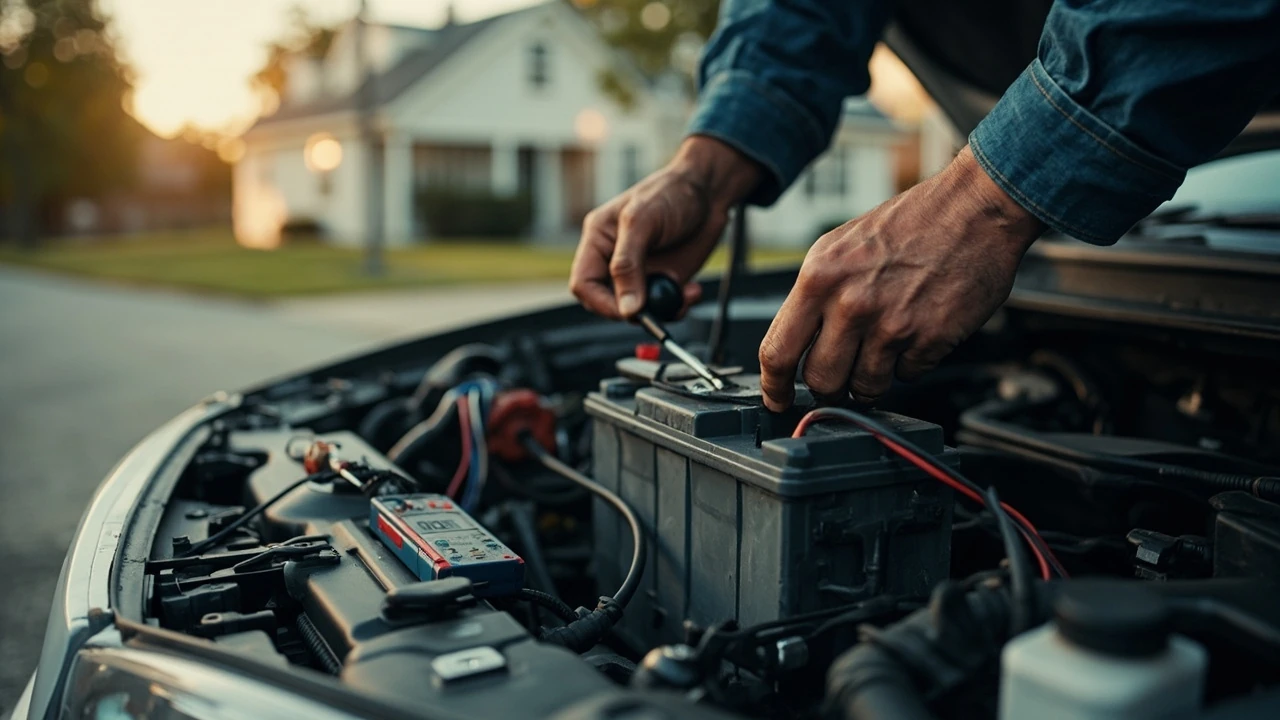
Signs of a bad battery you can actually spot at home
The first cold morning of the season is when most homeowners finally notice the signs of a bad battery: a hesitant crank, a clicking starter, dim interior lights, and a dashboard that flickers like a candle in the wind. A lead-acid battery does not usually die in a dramatic way. It fades. Voltage drops a tenth of a volt at a time, capacity shrinks with each deep discharge, and one morning the engine simply does not turn over.
Because the battery quietly supports almost every electrical system in a modern home, from the car in the driveway to the backup unit that keeps the sump pump and internet router alive during a storm, recognizing those early symptoms saves a tow, a flooded basement, or a service call on a Sunday. The guidance below focuses on practical diagnosis for two common household settings: the family vehicle and a small stationary backup battery. The same chemistry behaves the same way in both.
Why batteries fail in the first place
Most 12-volt starter batteries and small sealed lead-acid backup units follow a similar aging curve. Sulfation builds up on the plates when a battery sits undercharged for long periods. Heat accelerates grid corrosion and water loss. Vibration cracks plates and internal straps. Each parasitic drain from a vehicle’s computer, alarm, or infotainment clock subtracts a little more depth the next time the engine is off for a week. After three to five years of normal use, the battery simply has less active material left to deliver current.
Understanding the failure mode matters because it shapes the symptoms. A battery that has slowly lost capacity tends to crank slowly on cold mornings. A battery with a cracked plate may work fine one trip and refuse the next. A backup battery that has been sitting at a low state of charge for months often refuses to take a full charge at all.
How a healthy 12-volt battery is supposed to behave
Before judging a battery as bad, it helps to know what “good” looks like. A fully charged, rested 12-volt lead-acid battery should read about 12.6 to 12.8 volts at the terminals with the engine off and no loads for several hours. While the engine is running, the charging system should bring system voltage to roughly 13.7 to 14.7 volts. A healthy battery can hold that surface charge for weeks if there is no parasitic draw.
Under load, a good battery holds voltage above about 9.6 volts during a cranking event at room temperature. If voltage collapses well below that number during cranking, the battery is either deeply discharged, severely sulfated, or near the end of its life. The same idea applies to stationary backup batteries: a healthy unit holds its rated voltage, accepts charge current, and runs a load test for the expected runtime.
The most common signs of a bad battery in a vehicle
Car batteries give a fairly consistent set of warning signs. The trick is learning to read them in the right order, because the cheapest, most obvious clues usually show up first.
Slow or hesitant engine cranking
The single most reported symptom of a failing starter battery is a slow crank. The engine turns over at a lower speed than usual, the starter sounds labored, and the dashboard lights may dim with each compression stroke. On a healthy battery, the starter motor draws several hundred amps and the engine spins quickly. On a weak one, the same load drops terminal voltage so far that the starter cannot maintain speed.
Clicking sound but no engine turnover
A rapid clicking from the engine bay, especially when the key is held in the start position, usually means the battery has just enough charge to energize the solenoid but not enough to turn the starter motor. The pattern is unmistakable: a sharp click, a brief pause, another click, and so on. If jump-starting the vehicle gets it running and the battery does not recover after a long drive, the battery itself is the most likely culprit.
Dim headlights and weak interior electronics
With the engine off, headlights that look yellowish, dashboard lights that pulse, or an infotainment screen that resets while cranking are all classic signs of a weak battery. A simple at-home test is to watch the headlights while a helper turns the key: if the lights drop sharply the moment the starter engages, the battery is not holding surface charge well.
Swollen or misshapen case
A battery case that looks bloated, especially along the sides, has overheated. Heat damage can come from a stuck voltage regulator pushing more than 15 volts into the battery, from chronic undercharging that allows stratification, or simply from a hot engine bay. A swollen case is both a sign of failure and a safety hazard, because the sealed cells can vent acid or, in extreme cases, crack.
Corroded or powdery terminals
Bluish-white or greenish powder around the battery terminals is a symptom, not always a cause. Heavy corrosion raises resistance at the cable connection, which makes the battery look weaker than it really is. It also points to slow venting of hydrogen gas, which is more common on older batteries and on units that sit at a high state of charge in warm weather. Cleaning the terminals and re-checking voltage tells you whether corrosion was masking a good battery or whether the battery itself is on its way out.
Rotten egg smell under the hood
A sulfur or rotten egg smell near the battery usually means the cells are venting hydrogen sulfide. This can happen during overcharge, deep discharge followed by a heavy charge, or simple end-of-life venting. The smell often comes with a swollen case and reduced performance. It is also a sign to ventilate the area and avoid sparks near the battery.
Battery warning light that stays on
The battery-shaped warning lamp on the dashboard is designed to flag charging system problems, not battery health directly. Still, if the light comes on while driving and the engine keeps running, the alternator is probably doing its job for now. If the same light appears, the headlights dim, and the engine soon stalls, the battery is no longer being topped up and the system voltage is dropping. In that situation, the battery and the alternator are both suspects until you test them separately.
Age and history
Even a battery that tests fine today will not last forever. Most flooded lead-acid starter batteries are rated for three to five years of normal use. Absorbed glass mat (AGM) batteries often last a year or two longer when kept on a maintenance charger. If the battery is past its fourth winter, every other symptom deserves more weight, because the underlying capacity is already marginal.
Signs of a bad battery in a home backup system
Stationary batteries behave the same way chemically, but the symptoms show up differently. A backup battery that used to run a sump pump for six hours may now run for two, or it may trip the inverter at the first surge. Because these batteries are often hidden in a closet, basement corner, or garage shelf, the early warnings are easy to miss.
Shortened runtime during a real outage
The first sign most homeowners notice is not a number on a meter but a feeling: the lights dim earlier than they used to, the fridge cycles off, the router drops. A backup battery that once covered a six-hour outage but now gives up after ninety minutes is losing usable capacity. The cells are still holding voltage at rest, but they cannot sustain load for as long as they did when new.
Inverter alarms and error codes
Modern inverters and uninterruptible power supplies log fault codes for low battery, overcurrent, and cell imbalance. A repeated low-battery warning during routine use, or an inverter that shuts down even when grid power is available, often traces back to a battery that can no longer hold its rated capacity. Checking the event log is faster and cheaper than guessing.
Visible bulging, leaks, or crusty residue
Sealed lead-acid batteries that bulge, crack, or leave a white crystalline crust around the terminals are failing. The crust is dried electrolyte that has vented and recondensed. Any visible leak is a reason to retire the battery carefully, wearing gloves, and to neutralize the residue with baking soda and water before installing a replacement.
The unit will not hold a charge
A backup battery that sits on the charger for a full day, then drops to less than 12 volts within hours of being disconnected, has lost most of its active material. Some chargers will refuse to recondition a deeply sulfated battery at all. This is the stationary equivalent of a car that will not start the morning after a long drive.
How to confirm a bad battery at home
Symptoms are useful, but a quick test removes the guesswork. Three at-home checks cover the vast majority of cases.
Resting voltage test
Set a digital multimeter to DC volts, connect the red lead to the positive terminal and the black lead to the negative terminal, and read the voltage with the vehicle or device off and the battery rested for at least a few hours. Compare the reading to the table below.
| Resting voltage (V) | Approximate state of charge | What it usually means |
|---|---|---|
| 12.6 – 12.8 | 100 percent | Healthy and fully charged |
| 12.4 | About 75 percent | Slightly low, often from short trips |
| 12.2 | About 50 percent | Undercharged, may show symptoms |
| 12.0 | About 25 percent | Significantly discharged, often sulfated |
| 11.8 or lower | Effectively dead | Severely discharged or damaged |
A reading under 12.4 volts after a long drive and a full overnight rest is one of the earliest signs of a bad battery, because it means the battery is not holding the charge the alternator put into it.
Cranking voltage test
With the multimeter still connected, have a helper turn the key to start while you watch the voltage. A healthy battery at room temperature will dip to about 9.6 to 10.5 volts during the first second of cranking and then recover. A battery that drops below 9 volts, or that stays below 10 volts for several seconds, does not have the cranking capacity it needs. This is the test that catches a battery that reads fine at rest but fails under load.
Parasitic draw check
If the battery keeps dying overnight, suspect a parasitic draw. With the vehicle fully asleep (doors closed, key out, systems timed out), disconnect the negative terminal and connect a multimeter set to milliamps between the cable and the post. A normal modern vehicle usually shows a draw between 20 and 50 milliamps. A reading of several hundred milliamps points to a light staying on, a stuck relay, or an aftermarket accessory wired directly to the battery. Leaving a draw that high on a weak battery will repeat the failure every morning.
Bad battery versus bad alternator: how to tell them apart
Many of the symptoms above are shared between a weak battery and a weak alternator, because the two work as a pair. A simple separation test takes only a few minutes.
| Symptom | More likely the battery | More likely the alternator |
|---|---|---|
| Engine cranks slowly first thing in the morning | Yes | No |
| Engine dies shortly after jump-start | No | Yes |
| Battery warning light while driving | Sometimes | Yes |
| Headlights dim more at idle than at speed | No | Yes |
| New battery goes flat within a week | Sometimes | Yes if charging voltage is wrong |
| Rotten egg smell from the battery | Yes | No |
The clearest separation is to start the vehicle, connect the multimeter to the battery, and read system voltage at the terminals with the engine running. A reading between roughly 13.7 and 14.7 volts means the alternator is charging. A reading below 13 volts or above 15 volts points to a charging system problem, not a battery problem. A more detailed walk-through of how the two parts work together and how to compare their symptoms is covered in this Firestone guide to battery and alternator symptoms, which walks through the same cranking-and-resting logic in plain language.
Why a bad battery can hide other problems
A weak battery changes the behavior of nearly every electrical system in the vehicle. A modern engine control unit may set random sensor codes when voltage sags. A transmission module may shift harshly during cranking. An infotainment screen may lock up. Anti-lock brake systems can log faults that never repeat once a healthy battery is installed. This is one reason that a good mechanic always checks battery state before chasing electrical ghosts.
The same idea applies at home. A backup battery with low voltage can cause an inverter to misread its own state of charge, cycle the cooling fan incorrectly, or shut down a sump pump at the worst possible moment. Replacing the battery first is often the cheapest way to rule out half the symptoms in the system.
Common habits that shorten battery life
Most battery failures are not bad luck. They are the result of repeated stress that builds up over months and years. A few patterns cover the majority of premature replacements.
- Short trips that never let the alternator top up the battery, especially in winter.
- Leaving the vehicle parked for weeks without a maintenance charger, which lets the battery slowly sulfate.
- Using the cigarette lighter socket as a permanent power source for dash cams, phone chargers, or tire inflators.
- Installing a higher-output stereo or lighting without upgrading the charging system.
- Skipping terminal cleaning, which raises resistance and hides the real state of charge.
- Ignoring a parasitic draw, so the battery is drained and recharged in shallow cycles over and over.
- Mounting the battery loosely, which adds vibration damage to plates and internal straps.
Any one of these will shorten a battery’s life. Two or three together will routinely halve it.
How to extend the life of a replacement battery
A new battery is a chance to reset the failure pattern. A few habits keep it healthy for the long haul.
- Drive the vehicle for at least twenty minutes a few times a week instead of only five-minute errands.
- Use a smart maintenance charger if the vehicle sits for more than two weeks at a time, especially in winter.
- Clean the terminals once a year and apply a thin coat of dielectric grease to slow corrosion.
- Check resting voltage once a season, so a failing battery is caught before it strands you.
- Tighten the hold-down clamp so the battery cannot vibrate, but not so tight that the case cracks.
- Disconnect any accessory that draws current when the ignition is off, or wire it through a relay that cuts power with the key.
When to replace versus when to recondition
Not every weak battery is scrap. The decision depends on age, voltage behavior, and how it was used.
| Condition | Replace | Try to recondition |
|---|---|---|
| Battery older than five years | Yes | No |
| Resting voltage under 11.8 volts for more than a day | Yes | No |
| Swollen, cracked, or leaking case | Yes | No |
| Heavy white or blue corrosion inside the cells | Yes | No |
| Slow crank after a short trip, but recovers on a long drive | No | Yes, with a proper charger |
| Battery under two years old, sat discharged for a few days | No | Yes, with a desulfating charger |
Reconditioning means giving the battery a long, slow charge at the right voltage until it accepts and holds its rated capacity again. It only works on batteries that are sulfated from sitting, not on batteries that have lost active material to age or heat. If the battery will not come back to 12.6 volts at rest after a full day on a proper charger, replacement is the only safe option.
Disposing of a bad battery safely
Lead-acid batteries are one of the most recycled consumer products on the market, but they also contain sulfuric acid and lead. A few simple steps keep the disposal safe.
- Wear gloves and safety glasses when handling a battery that is cracked, leaking, or heavily corroded.
- Neutralize any spilled residue with a paste of baking soda and water before moving the battery.
- Keep the battery upright during transport so residual acid cannot spill.
- Return the old battery to the retailer, a service station, or a municipal hazardous waste site rather than putting it in household trash.
- Many retailers offer a core credit that lowers the price of a new battery when the old one is returned.
Frequently asked questions
What are the first signs of a bad battery in a car?
The earliest signs are usually a slow engine crank, a brief hesitation when you turn the key, and headlights that look slightly dim at idle. By the time the engine refuses to start, the battery has been weak for weeks.
Can a bad battery cause a check engine light?
Yes. Modern engine and transmission modules can set fault codes when system voltage sags during cranking or while driving with a weak battery. Many of these codes clear on their own once a healthy battery is installed and the modules relearn their idle and shift strategy.
How do I know if it is the battery or the alternator?
Test system voltage with the engine running. A reading between 13.7 and 14.7 volts means the alternator is doing its job. If the engine starts with a jump but dies shortly after, or if voltage stays low while running, the alternator is the more likely cause.
How long should a car battery last?
Most flooded lead-acid batteries last three to five years in normal use. AGM batteries often reach five to seven years when kept on a maintenance charger. Hot climates, frequent short trips, and heavy accessory loads shorten that range.
Can a completely dead battery be recharged?
Sometimes. A battery that sat discharged for a few days to a few weeks can often be recovered with a slow smart charger. A battery that has been dead for months, or that has dropped below about 10.5 volts for an extended period, is usually permanently sulfated and should be replaced.
Do I need to replace the battery if the car starts after a jump?
Not immediately. Drive the vehicle for at least thirty minutes, then let it sit overnight and recheck resting voltage. If the battery is above 12.4 volts the next morning and the engine starts normally, the battery recovered. If the battery is back under 12 volts, the jump only masked a battery that is at the end of its life.
What voltage is too low for a 12-volt battery?
Anything below 12.0 volts at rest is significantly discharged. Below 11.8 volts the battery is effectively dead and may be permanently damaged. During cranking, a healthy battery should not drop below about 9.6 volts at room temperature.
Why does my battery die every winter but not in summer?
Cold weather reduces a battery’s available cranking amps and thickens engine oil, which makes the starter work harder. A battery that is marginal in summer can fall below the voltage it needs on the first cold morning. Heat damage built up over the summer often shows up as a winter failure.
Can a bad battery damage the alternator?
Yes. A battery with a shorted cell forces the alternator to work at full output continuously to keep up with the electrical load. Over time, that extra load can overheat the alternator and shorten its life. Replacing a marginal battery early is cheaper than replacing an alternator later.
Is it safe to drive with a battery warning light on?
It depends. If the engine is running normally and the voltage at the battery reads 13.7 to 14.7 volts, the charging system is working and the light may be a sensor issue. If the lights dim or accessories cut out, the charging system is failing and the vehicle should go straight to a shop or a safe place to stop.
Leave a Reply