


Tree stump removal in Honolulu: what actually drives the price
A 24-inch monkeypod stump tucked behind a carport in Kaimuki does not cost the same as a 48-inch mango stump out in a Mililani-style open lot, even when both jobs land on the same crew’s schedule. The number a Honolulu homeowner is quoted rides on three things: the diameter of the stump at ground level, the access from the street to the stump, and the depth the crew has to grind to make the area usable again. Once those three inputs are honest, the rest of the quote tends to fall into place.
Tree stump removal in Honolulu also runs on a local rhythm most mainland guides miss. Demand spikes after a strong trade-wind swell or a Kona storm pushes weakened trees over, and quotes rise with that demand. Crews that already have a grinder on the island for the week can be more competitive than a flight-in operator. The goal of this guide is to walk through the decisions a homeowner faces: how the work is actually done, what drives the price, what the realistic Honolulu range looks like, and what to verify before signing anything.
What stump removal actually means on the ground
“Stump removal” gets used loosely. In practice, a Honolulu homeowner is usually choosing between two operations that look similar but leave the yard in different condition.
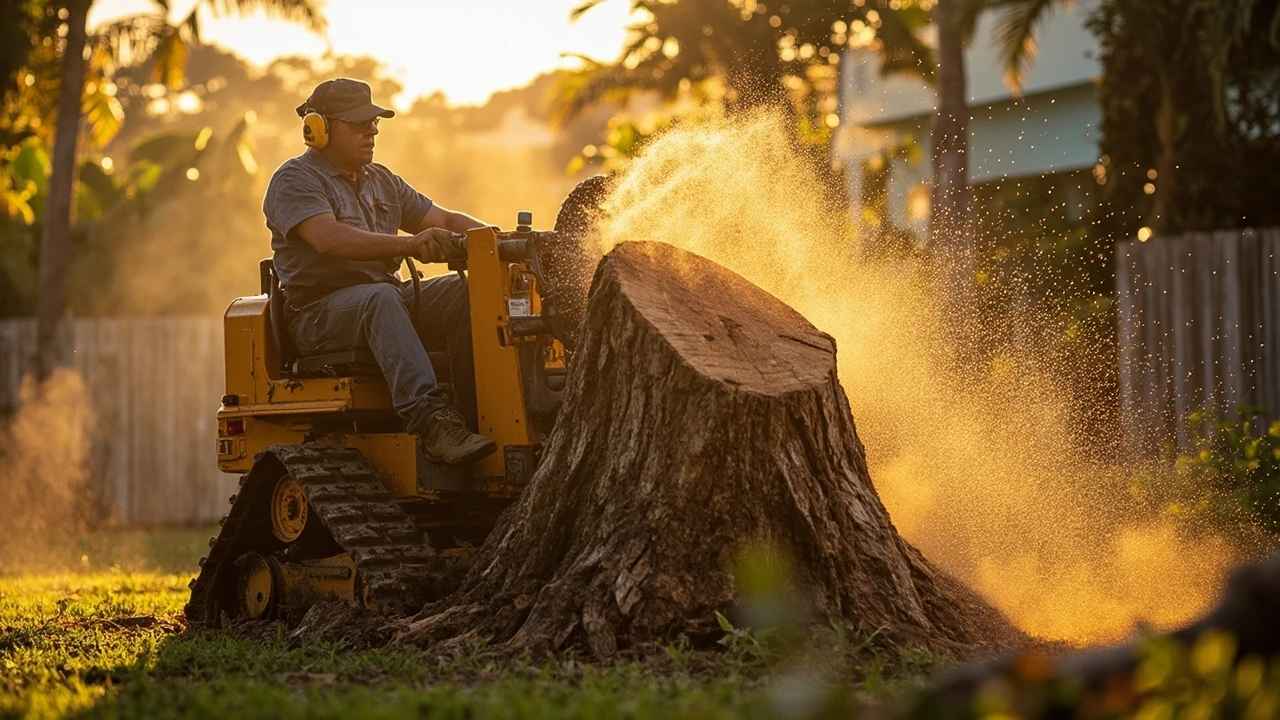
- Grinding. A tracked machine with a spinning carbide-tipped wheel chews the stump down several inches below the soil line. The grindings are raked out, and the hole is filled with topsoil or left as-is depending on the contract. Roots are not pulled, so the trunk’s lateral root system stays in the ground and slowly decays.
- Full extraction. The stump and main lateral roots are physically pulled from the ground with a mini-excavator or by hand. This is messier, leaves a much larger hole, and is usually only chosen when the homeowner plans to replant in the exact same spot or is building a structure on top of it.
For most residential lots in Honolulu, grinding is the standard answer. It is faster, cheaper, and leaves a yard that can be replanted or sodded in a week. The exception is when a landscape architect or a building contractor needs a clean slate where the stump used to be.
How Honolulu crews actually price a stump
Local stump grinding is priced per inch of stump diameter, with a small-job minimum to cover the cost of mobilizing the grinder. The diameter is measured across the cut at ground level, not at the wider base where the trunk flares into the root plate. A 30-inch cut on a stump that flares to 48 inches at the base is billed as a 30-inch job, which is one of the more common surprises on a quote walkthrough.
| Stump diameter at ground level | Typical Honolulu per-inch rate (2026) | Indicative job range |
|---|---|---|
| Up to 12 inches | $8 – $14 per inch | $100 – $175 minimum trip |
| 12 – 24 inches | $7 – $12 per inch | $150 – $300 |
| 24 – 36 inches | $6 – $10 per inch | $300 – $500 |
| 36 – 48 inches | $5 – $9 per inch | $450 – $800 |
| 48 inches and up | $4 – $8 per inch, often custom | $800 and up, site visit required |
These bands reflect the typical Honolulu market. The lower end of each band is a competitive quote from a crew that already has a grinder on the island and is running a multi-stop day. The higher end is a smaller operator, a single-stump emergency call, or a job with poor access. National cost guides confirm a similar structure: a per-inch rate with a mobilization floor, which is why a single 8-inch stump in a side yard rarely costs less than the trip charge itself.
Volume is the second lever. A crew that has already mobilized a tracked grinder to a property will usually grind a second or third stump at a steep discount, because the expensive part of the job is the trip, not the cut. A useful habit is to walk the entire lot before the crew arrives and count the stumps that have been quietly forgotten under vines or behind a hedge. Old avocado, mango, and shower-tree stumps from previous owners are very common on older Honolulu lots.
Access, slopes, and the hidden line items
Honolulu’s housing stock is a mix of flat coastal lots, hillside homes on Old Pali or Wilhelmina Rise, and dense older neighborhoods where the only path from the street to the backyard is a 3-foot side gate. Access changes the equipment that can be used, and equipment choice changes the price.
| Access condition | Typical equipment | Pricing impact |
|---|---|---|
| Open front yard, grinder can drive straight to the stump | Tracked grinder, no manual carry | Base rate, no surcharge |
| Side gate access, level ground, 36-inch opening or wider | Smaller tracked grinder or walk-behind unit | +$50 to $150 for the equipment change |
| Tight side yard with a turn, narrow gate, stairs | Hand-carried walk-behind grinder, extra labor | +$150 to $300, sometimes more |
| Hillside lot with significant slope | Specialty equipment or hand work for safety | Site visit required, custom quote |
| Stump flush against a foundation, fence, or utility line | Slower grinding, hand cleanup, possible root cutting | +$100 to $250 for the careful work |
Underneath the access question is a utility question. Older Honolulu neighborhoods often have irrigation, sewer laterals, or low-voltage lighting lines running exactly where the crew would prefer to grind. The conservative practice is to call for a utility locate before any deep grinding. Most local crews handle this as a matter of routine, but it is worth confirming in writing that the locate has been done and that the crew is responsible for damage to marked lines.
Grind depth, replanting, and the sod-ready finish
Grind depth is the decision that quietly shapes what happens in the yard over the next year. A shallow grind of 4 to 6 inches below the soil line is enough if the area will be lawn or ground cover and the homeowner accepts that some root decay and minor sinkage is possible. A deeper grind of 10 to 18 inches is the right answer if the spot will host a new tree, a hedge, or a garden bed, because it removes more of the structural root mass and reduces the chance of regrowth or sinkage later.
Most contractors price the grind and the cleanup as separate lines. A “sod-ready finish” usually means the grindings are removed, the hole is backfilled with screened topsoil, and the area is raked smooth enough to lay turf directly. The grind itself does not include hauling the wood chips away, because many homeowners prefer to keep a portion of the chips for mulch and only pay for the excess to be removed.
- Shallow grind, chips left on site, no fill: cheapest option, suitable for areas that will not be planted.
- Standard grind, chips removed, hole filled with topsoil: the most common mid-tier package.
- Deep grind with full root chasing, chips removed, premium screened topsoil, finish raked: the package a landscape contractor usually writes into a renovation spec.
Homeowners planning to replant a tree in the exact same spot should also be aware that the old root system will decay slowly and may affect the new root ball for a year or two. Replacing a significant amount of the soil in the planting pit, rather than just backfilling over the chips, is the standard remedy.
Permits, easements, and the rules of the road in Honolulu
Grinding a stump in a private yard almost never requires a building permit in Honolulu, but there are still rules that can affect the job. Crews that need to set up a grinder in the street or on a sidewalk to reach a stump close to the property line may need a lane closure permit from the city. Easements along utility corridors can also limit how deep a crew is willing to grind without a locate.
For larger removals where the tree itself is being taken down before the stump is ground, the rules get more involved. Trees on the city’s protected tree list, or trees in designated historic districts, can require a permit before any work begins. A homeowner dealing with a large legacy tree on an older lot should ask the contractor to confirm whether the species triggers a permit, because the fine for removing a protected tree without one is considerably larger than the cost of a stump-grinding job.
Disposal is the other piece. Green waste from a Honolulu stump-grinding job can usually go to a city transfer station, but volumes from a large job often justify a roll-off dumpster or a dedicated haul-away. Most local crews include a basic haul-away in the quote, but the threshold for what counts as “basic” varies, so it is worth asking specifically how many cubic yards of chips are included.
How to vet a Honolulu stump-removal crew
Stump grinding looks simple from the outside, but the work is heavy, the equipment is expensive, and the consequences of a careless cut can be an underground utility strike or a damaged fence. Two checks beat every online review score.
- Ask for a current insurance certificate sent directly from the insurer’s office, not a PDF the contractor pulled up on a phone. The certificate should list general liability and workers’ compensation, with the contractor as the named insured. A one-person operation that cannot produce a workers’ comp certificate may still be legitimate, but the homeowner is then accepting the risk of an injury on the property.
- Ask whether the jobs that need judgment are supervised by an ISA Certified Arborist. The International Society of Arboriculture certifies working arborists, and a certified arborist on the crew is the clearest signal that the company treats tree work as a profession rather than a side hustle. Stump grinding on its own is not always supervised by an arborist, but a company that employs one for its tree-removal work is a safer bet than one that does not.
Two more practical checks are worth doing before any work begins. First, ask for a written scope that names the stumps, lists the diameters measured at ground level, and states the grind depth and the cleanup. Second, confirm who calls for the utility locate and who is responsible if a marked line is hit. Local services that compile Honolulu crews note that the insurance and written-scope checks are the two that protect the homeowner, while online ratings are useful only as a tie-breaker between otherwise similar companies.
How to read a written quote without getting burned
A good Honolulu quote is short, specific, and free of jargon. A weak one hides mobilization, cleanup, and depth decisions inside a single round number. The questions below are the ones a homeowner should be able to answer after reading any quote.
- How many stumps are included, and what is the measured diameter of each at ground level?
- What is the grind depth below the soil line, and is deeper grinding available if I plan to replant?
- Are the grindings hauled away, and if so, what volume is included in the price?
- Is backfill with topsoil included, and what kind of topsoil will be used?
- Who calls for the utility locate, and who pays if a marked line is damaged?
- Is access from the street to the stump included, or is there a surcharge for a tight side yard or stairs?
- What is the payment schedule, and is any deposit refundable if the schedule slips?
Comparing two quotes that answer those questions is a much fairer exercise than comparing two round numbers. The cheapest quote is often the one that quietly leaves out the haul-away or assumes a 4-inch grind on a stump that needs 12 inches of removal before it can be replanted.
The Honolulu-specific risks that mainland guides miss
Honolulu’s climate, soil, and housing stock create a few failure modes that are not common in the guidebooks written for the mainland United States.
| Local factor | Why it matters for stump work | What to ask the crew |
|---|---|---|
| Volcanic and coral-based soils | Hitting lava rock or coral substrate a few inches down is common, especially in older coastal neighborhoods. The grinder has to be repositioned, and tooth wear is higher. | Is there a surcharge if the crew hits rock before reaching the agreed grind depth? |
| Tropical regrowth | Some species, including albizia and certain figs, will sucker from the remaining roots if the grind is too shallow. | What grind depth do you recommend for this species to minimize regrowth? |
| Trade-wind season and storm spikes | After a strong front, demand for grinding rises sharply, and crews may add a storm surcharge or push jobs by a week or more. | How soon can you do the work, and is the quote time-sensitive? |
| Termite and Formosan drywood termite risk | Old stumps can be a vector for termite colonies. Some homeowners prefer full extraction for that reason, especially close to the house. | Has the stump been inspected for termite activity, and is extraction a better option here? |
| Roots tangled with irrigation and sewer laterals | Older lots may have shallow laterals that are not on any map. A deep grind can nick a line. | Will you do a locate, and is hand digging around the lateral part of the plan? |
These are not edge cases. They are the reason a local crew familiar with island soils is a better fit than a mainland franchise that just opened a Honolulu desk.
Working out a realistic Honolulu budget
Putting all of the levers together, a realistic Honolulu budget for a typical residential job in 2026 looks like this. A single small stump with easy access and a 6-inch grind, with chips left on site, will land in the $150 to $300 range. A medium job with two or three stumps of mixed size, a 10-inch grind, chips removed, and topsoil backfill will usually land between $400 and $800. A larger job with deep grinding, premium screened topsoil, and full haul-away can easily cross $1,000, especially if access is difficult or the crew has to work around a fence line. Comparing apples to apples on those three tiers is a more useful exercise than chasing the lowest per-inch number, because the per-inch number alone does not capture the cleanup and access decisions that usually move the total.
Homeowners planning more than one outdoor project on the same visit should also ask the crew whether a small package of related work can be added at the same trip charge. A crew that is already on site for stump grinding can often take on a small tree removal, a hedge reduction, or a chipping job for a lower marginal cost, which is a useful way to flatten the per-trip mobilization fee across several projects at once.
What to do the week the crew is scheduled
Preparation is what separates a clean one-hour job from a four-hour mess. The morning the crew is due, the homeowner can do a few simple things that materially change how the work goes.
- Mark sprinkler heads, low-voltage lighting, and any visible irrigation lines near the stump with small flags or paint.
- Move patio furniture, planters, and pets’ water bowls at least 10 feet back from the work area.
- Unlock side gates and make sure the path from the street to the stump is clear of toys, hoses, and debris.
- Confirm with neighbors if the crew will need to use a shared driveway or stage equipment on a joint property line.
- Decide in advance what to do with the grindings: spread as mulch, bag for green-waste pickup, or haul away.
Once those five items are handled, the crew can usually start within minutes of arrival, which keeps the visit short and the bill at the lower end of the quote.
How stump work connects to broader yard and property care
Stump grinding rarely stands alone. A property owner taking down a failing tree usually ends up making decisions about the surrounding landscape, and a fresh grind is the start of a small project rather than the end of one. The list below is a sensible order of operations for a Honolulu lot where a tree has just been removed.
- First, deal with the stump so that regrading and replanting decisions are not blocked by a wood mass in the ground.
- Second, address the soil. The grind area and the area where the tree’s canopy used to be have very different moisture and nutrient profiles from the rest of the yard, and they benefit from fresh topsoil and compost before any new planting.
- Third, decide what to plant in the now-sunny spot. A common Honolulu mistake is to plant a species with the same mature size and root footprint as the tree that was just removed, which sets up the same problem in 20 years.
- Fourth, adjust the irrigation. A mature tree transpires a great deal of water, and the irrigation that supported it will overshoot a smaller replacement plant until the system is rebalanced.
Homeowners working through a longer list of property priorities in 2026 often find it useful to read a broader practical overview of tree care and outdoor maintenance before committing to a sequence, because the order of the work matters as much as the choice of plants. A short read through a current property-care guide can also help a homeowner frame the right questions for the crew on the day of the visit.
Frequently asked questions
How much does tree stump removal in Honolulu typically cost in 2026?
Most single-stump jobs in Honolulu land between $150 and $400 once access, diameter, and grind depth are accounted for. Multi-stump packages with cleanup and backfill usually run $400 to $800, and larger or harder-access jobs can cross $1,000. The per-inch rate is only useful as a baseline, because access, depth, and cleanup move the final number more than the diameter alone.
Is it cheaper to grind a stump or remove it entirely?
Grinding is cheaper in almost every Honolulu residential case, because it mobilizes less equipment and leaves a smaller hole. Full extraction is more expensive, more disruptive to the yard, and is usually only chosen when a homeowner is replanting a tree in the exact same spot, building a structure on top of the area, or dealing with a species that is likely to sucker from the remaining roots.
How deep should the crew grind below the soil line?
For a lawn or ground cover, a 4 to 6 inch grind is usually enough. For a garden bed or a hedge, 8 to 12 inches is more typical. For a new tree, many contractors recommend 12 to 18 inches so that the new root ball has clean soil to grow into. Deeper grinding is always more expensive because it takes more time and produces more chips.
Do I need a permit to grind a stump in Honolulu?
Grinding a stump in a private yard almost never requires a building permit. Lane closures for street-staged equipment, work on protected tree species, and removals in historic districts can each trigger separate approvals. A reputable local crew will know which rules apply to a specific address before work begins.
Should I worry about utility lines under the stump?
Yes, especially in older Honolulu neighborhoods where irrigation laterals, low-voltage lighting, and sewer lines were laid in unconventional paths. The standard practice is to call for a utility locate before any deep grinding, and the homeowner should confirm in writing that this has been done and that the crew accepts responsibility for marked lines.
What do crews do with the grindings?
Most homeowners keep a portion of the chips as mulch and let the crew haul the rest away. Some contractors include a small volume of haul-away in the base price and add a per-cubic-yard surcharge beyond that. It is worth specifying in the quote how many cubic yards of chips are removed and what happens to any leftover material.
How long does a typical Honolulu stump grinding job take?
A single small stump with good access is often a 30 to 60 minute visit, plus setup and cleanup. A medium job with two or three stumps usually takes two to three hours. Larger stumps, difficult access, and the discovery of rock or roots can stretch the visit to a half day. A good quote will name the expected duration so the homeowner can plan around the crew.
Can I plant a new tree in the same spot after grinding?
Yes, but it is worth doing the work properly. The grind area should be over-excavated to at least the depth of the new root ball, the old chips should be removed, and the pit should be refilled with fresh topsoil and compost. Planting a new tree in a depression of chips without replacing the soil often leads to slow establishment and root rot in the wet season.
How do I compare two Honolulu stump removal quotes?
Normalize them on diameter, grind depth, cleanup, and access. A cheaper quote that quotes a shallower grind or that excludes haul-away is not actually cheaper once the missing items are added. The fairest comparison is line by line, with each contractor pricing the same scope in writing.
When is the best time of year to schedule stump grinding in Honolulu?
There is no bad season in Honolulu, but demand spikes after strong trade-wind or Kona storm events push weakened trees over. Crews are easier to book and prices are usually more competitive in the calmer summer months. If the work is not urgent, scheduling two or three weeks ahead of the visit gives the homeowner the best mix of availability and price.
Leave a Reply